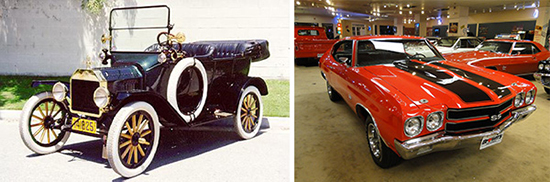
At left, a Model T Ford from the early 1910s. At right, a 1970 Chevelle SS
As most of you regular readers know, I collect far more things than any sane individual should. But being involved in half a dozen or so hobbies does give me the ability to spot general, or macro trends in the world of collecting. With a perspective approaching about half a century, an interesting trend that crosses numerous fields has been apparent for some time.
Simply stated, most people like to collect things they remember from their youth. When an item no longer has a personal connection to them, it loses appeal. Of course there are exceptions, and the very rarest and finest treasures in any hobby continue to command intense interest and value. But across numerous disciplines, many items that formerly were in great demand simply are no longer on the want lists of most collectors. Some examples will put this into focus:
In the old car hobby, for many years the Model T Ford was a cherished acquisition. Yes it was rather crude and noisy, but for thousands of collectors, it brought back fond memories of their youth. The last Model T rolled off the assembly line 90 years ago. So to have a vivid memory of one, one has to be in their late 80s or early 90s – a bit late to be collecting old cars. As a consequence, prices and demand for Model T’s has fallen significantly in recent years, and most have settled in museums. A nice example today can be bought for less money than in the 1970s or 1980s, not even accounting for inflation. What’s hot? Muscle cars from the 1960s and early 1970s, which people in their 50s and 60s vividly remember.
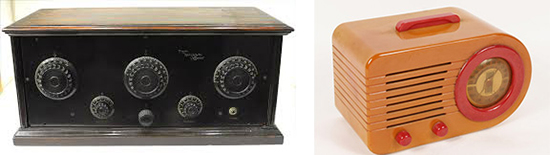
Left, a three dial radio from around 1923-24, while at right, a Catalin FADA "Bullet" radio
When I began calling auctions for the Vintage Radio and Phonograph Society in Dallas back in the early 1980s, three dial battery-operated radios from the mid-1920s used to sell for between $125 and $150 all day long. Today, when I call auctions for the Southern California Antique Radio Society, these same sets open for $30, and not a hand is to be seen. Why? Again, in order to remember a set like that, the person has to be approaching 90 or 95 years old. Today, small plastic sets of the 1950s with interesting styling bring far more money than the early battery sets.
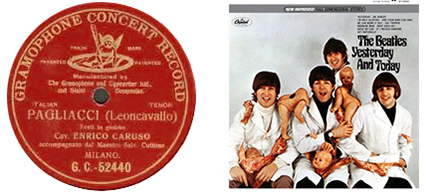
Left, an early Caruso selection while at right, the famous "Butcher Cover"
Early acoustically recorded opera records used to be the holy grail of most record collectors back in the 1940s and 1950s. They were rare and expensive, and when new, marked the owner as a cultured individual with impeccable taste in music. Today, they go begging as no one remembers listening to them, and opera itself is not the attraction it once was. What’s good today? Rare jazz and rock & roll stuff.
We all know that numismatic items have their cycles, and certain areas get "hot" for a while. This is due as much to promotion though as demographics. Over the long haul though, the same rules apply, and areas such as Colonials and early copper that were once dominant now play a relatively minor role in the overall hobby.
The bottom line? Collect what you love and want to collect. Some stuff you enjoy may not remain popular, and what you’d hoped might be a good investment, may turn out to be marginal at best. Nothing is forever, and areas once treasured will often be abandoned by succeeding generations of collectors.




 Copper & Nickel
 Silver Coins
 Gold Coins
 Commemoratives
 Others
 Bullion
 World
World
 Coin Market
 Auctions
 Coin Collecting
 PCGS News