
The 50 State Quarters program launched in 1999 provided each state the reverse of the quarter as a canvas to feature a design emblematic of that state’s unique history, tradition, and symbolism. Iowa, the 29th state quarter to be issued in the series, in 2004, has a design that features many facets and a rich history. The reverse design was inspired by the works of Iowan artist Grant Wood and reflects the state's history and pride for its future through education and a desire to leave a greener world for the next generation. So many people are tied into the backstory of Wood’s painting as replicated on the coin, itself designed by John Mercanti. It is a coin accessible to all and affordable to those on even the tightest numismatic budget.
How does a state come up with a design that commemorates itself? That was the task that all states had to deal with in choosing the design for their quarter. Iowa had no less of a difficult task with this assignment especially since Iowans don’t always agree on symbolism that represents them. Five proposals were sent to the United States Mint for review for the concept of the Iowa Quarter. One theme that the United States Mint made several versions of was the feature of Iowa as an agriculture state — “FEEDING THE WORLD” as the motto of the coin and featuring corn, grain, pig, and cow.
Another concept was to feature the Sullivan brothers, who were five brothers who were killed in action in 1942 serving together on the USS Juneau during World War II. The other three designs were all from paintings produced by Grant Wood, arguably one of the most famous of Iowans and easily one of the America’s most significant artists. The three Wood paintings featured on the other Iowa Quarter concepts were Young Corn, American Gothic, and Arbor Day. Ultimately, it was the design based on Wood’s Arbor Day that was chosen by Iowa Governor Thomas Vilsack for use on the quarter.
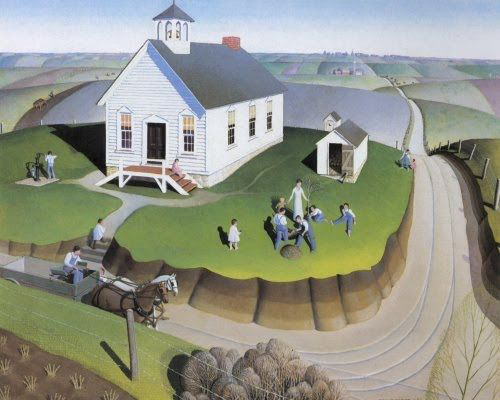
Arbor Day, which the design of the Iowa quarter is based on, has an interesting story all to itself. Wood originally painted Arbor Day in 1932 as a gift and tribute to McKinley Junior High School, located in the district where Wood had taught art. The painting was a tribute to teachers Catherin Motejl and Rose L. Waterstradt, who had passed away. Wood and school principal Frances Prescott drove around eastern Iowa looking at one-room schoolhouses for inspiration. The problem was Wood brought a handle of whiskey for the ride and became more drunk than inspired. Eventually, Wood designed the schoolhouse in the painting himself, getting the most inspiration from his boyhood Antioch School house in Jones County. Cedar Rapids School District paid Wood $200 for Arbor Day and hung it on the wall. Wood requested the painting back and the school district returned it to him, with the artist instead exchanging it with a sketch called Tree Planting. Tree Planting served as the inspiration for Wood’s Tree Planting Group, which Wood would make and sell his first lithographs from.
Wood put Arbor Day on display in the Whitney Museum, where it was exhibited in Gallery V for the Second Biennial Exhibition of Contemporary American Painting exhibit from November 27, 1934, until January 10, 1935. After its display in the Whitney, Arbor Day was sold to King Vidor, an American film director and producer. Vidor died in 1982, and his estate put the painting up for auction in 1985, where Sotheby’s sold it for $1,375,000 to become the first Wood painting to surpass the million-dollar mark. The buyer was William Koch, a billionaire businessman who still owns the painting.
Arbor Day was chosen for the design of the Iowa quarter and was redesigned and modified by John Mercanti to fit the small canvas, with modifications accommodating the name of the state, date of statehood (1846), date of the coin’s issue, and “E PLURIBUS UNUM.” The legend “FOUNDATION IN EDUCATION” was added above the schoolhouse and the artist’s name Grant Wood was added below the design.
The design wouldn’t go without limited controversy. Arbor Day is the same name of a holiday first introduced in the United States in Nebraska, and the Nebraska Quarter – the 37th issue for the series – wouldn’t be struck until 2006; the Nebraska Quarter features Chimney Rock, a departure from the Arbor Day theme. Interestingly, some have pointed to the motto “FOUNDATION IN EDUCATION” on the Iowa Quarter as a call to action to improving the educational standards for Iowan students.
The Iowa Quarter is a common coin. The Philadelphia Mint’s output was 213,800,000 and the Denver Mint produced a mintage of 251,800,000. Many coins were saved from the 50 State Quarters program, and thus finding uncirculated examples of both is very easy. The Philadelphia Mint coins are typically in poorer condition than those of the Denver Mint, with the highest-graded example for a Philadelphia Mint Iowa Quarter being just 21 examples in MS68, with one of these examples reaching a record price of $1,500 on eBay in 2019. In comparison, the Denver Mint Iowa Quarter offers 571 examples graded MS68 by PCGS, a single example graded MS68+, and 10 specimens grading MS69. The record price for a Denver Mint Iowa Quarter was achieved in 2007 when a PCGS MS69 sold for $1,840 in a Heritage Auctions sale.

For proof examples, the clad proof San Francisco has a mintage of 2,740,684. PR70DCAMs are quite abundant, with 909 currently graded at PCGS and the typical sales price at under $30 on eBay for such a specimen. The silver San Francisco Mint proof issue has a mintage of 1,769,786, with PCGS grading 1,266 examples as PR70DCAM, with many selling for around $35.


 Copper & Nickel
 Silver Coins
 Gold Coins
 Commemoratives
 Others
 Bullion
 World
 Coin Market
 Auctions
 Coin Collecting
 PCGS News