
Image courtesy of Library of Congress.
Photograph shows members of the 332nd Fighter Group pilots. From left to right: Robert W. Williams, Ottumwa, IA, Class 44-E; (leather cap) William H. Holloman, III, St. Louis, Mo., Class 44-?; (cloth cap) Ronald W. Reeves, Washington, D.C., Class 44-G; (leather cap) Christopher W. Newman, St. Louis, MO, Class 43-I; (flight cap) Walter M. Downs, New Orleans, LA, Class 43-B.
African-Americans have participated in every war fought by the United States dating back to the Revolutionary War. The unbending system of racial segregation in the Armed Forces has followed right alongside. During both training and war times, soldiers of color were placed in separate units than white personnel. This would continue through World War II. In fact, between 1924 and 1939, the Army War College commissioned a study that would ultimately conclude that persons of color were ’unfit’ for leadership roles in the military and were especially incapable of aviation. However, during World War II, a group of men would change that notion forever.
At the start of World War II, Jim Crow Laws had consumed society in the southern U.S. states. When African Americans were drafted or volunteered, they were generally assigned to support roles, such as cook, or sent to all-black divisions. Even being served meals, blacks and whites stood in separate lines in the mess hall. In 1941 of the war, President Franklin D. Roosevelt ordered the creation of an all-Black aviation training program. At the time, no U.S military pilots had ever been black.
Due to the on-going segregation, black military pilots were to be trained at a separate airfield built near Tuskegee, Alabama. They would receive an education at the local university and would become known as the ’Tuskegee Airmen.’ Along with the 761st Tank Battalion and the 452nd Anti-Aircraft Artillery Battalion, this group of men would inspire reform in the Armed Forces leading to the desegregation of all U.S. Armed Forces by President Harry S. Truman in July 1948. Nearly a thousand pilots trained in Tuskegee. Between 1941 to 1946, the airmen destroyed a total of 112 enemy aircraft in the air and received three Distinguished Unit Citations.
Congress voted to award a Congressional Gold Medal in April 2006 and presented the award to the surviving airmen, in March 2007, at a ceremony in the U.S. Capitol. This medal remains at the Smithsonian National Museum of African American History and Culture.
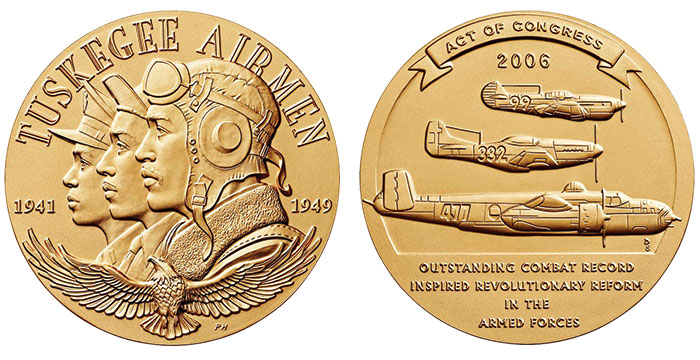
Tuskegee Airmen Bronze Medal (obverse and reverse)
The Bronze Medal copies, available to the public, come in two sizes: 1.5 Inch and 3 Inch; honoring the Tuskegee Airmen in recognition of their military service, between 1941-1949. The obverse depicts three Airmen: (from left to right) an officer, a mechanic, and a pilot. The reverse depicts three different types of aircraft the Tuskegee Airmen flew in WWII: P-40, P-51, and B-25.
Specs
Composition: 90% Copper & 10% Zinc
Design: Phebe Hemphill (Obverse) Don Everhart (Reverse)
Mint: Philadelphia (no mint mark)


 Copper & Nickel
 Silver Coins
 Gold Coins
 Commemoratives
 Others
 Bullion
 World
World
 Coin Market
 Auctions
 Coin Collecting
 PCGS News