
Morgan Dollar varieties are among the most widely collected and well-publicized areas of United States numismatics. With more than 3,000 of them identified and documented, Morgan Dollar varieties represent virtually every type of variety known: from die doubling to different mintmark styles, repunched dates (RPDs) to repunched mintmarks (RPMs), overdates to overmintmarks, and more.
Known as VAMs (an acronym for the original cataloguers Leroy “Van Allen” and A. George “Mallis"), they are replete with catchy names like “Wild Eye Spikes,” “Tripled Blossoms and Leaves,” and “Alligator Eye.” PCGS currently attributes 317 VAMs that have been identified by variety collectors as worthy of specific recognition and considered the most important, rarest, and/or most readily discernible.
Let’s discuss some of the well-known VAMs featuring prominent tailfeather variations.
In 1878, the first year of Morgan Dollar production, the Philadelphia Mint used three different reverse die designs (the A, B, and C Reverses) to strike over 10 million coins. The first of these reverses, the original design, features eight tailfeathers (as opposed to the latter two, which have seven tailfeathers). This 8 Tailfeathers (8-TF) design was then used to create at least 19 known 8-TF reverses (each with its own uniquely engraved wing-feathers configuration), which in turn were used to create the 41 known 8-TF Morgan dollar varieties.
Among the rarest of these are the VAM 14.19 (“Broken 8”) and VAM 14.17 (“Chip In Ear”). However, the most desired VAM among specialists and non-specialists alike may be VAM 9 because it was the “1st Die Pair” used to strike Morgan dollars.

Click image to enlarge.
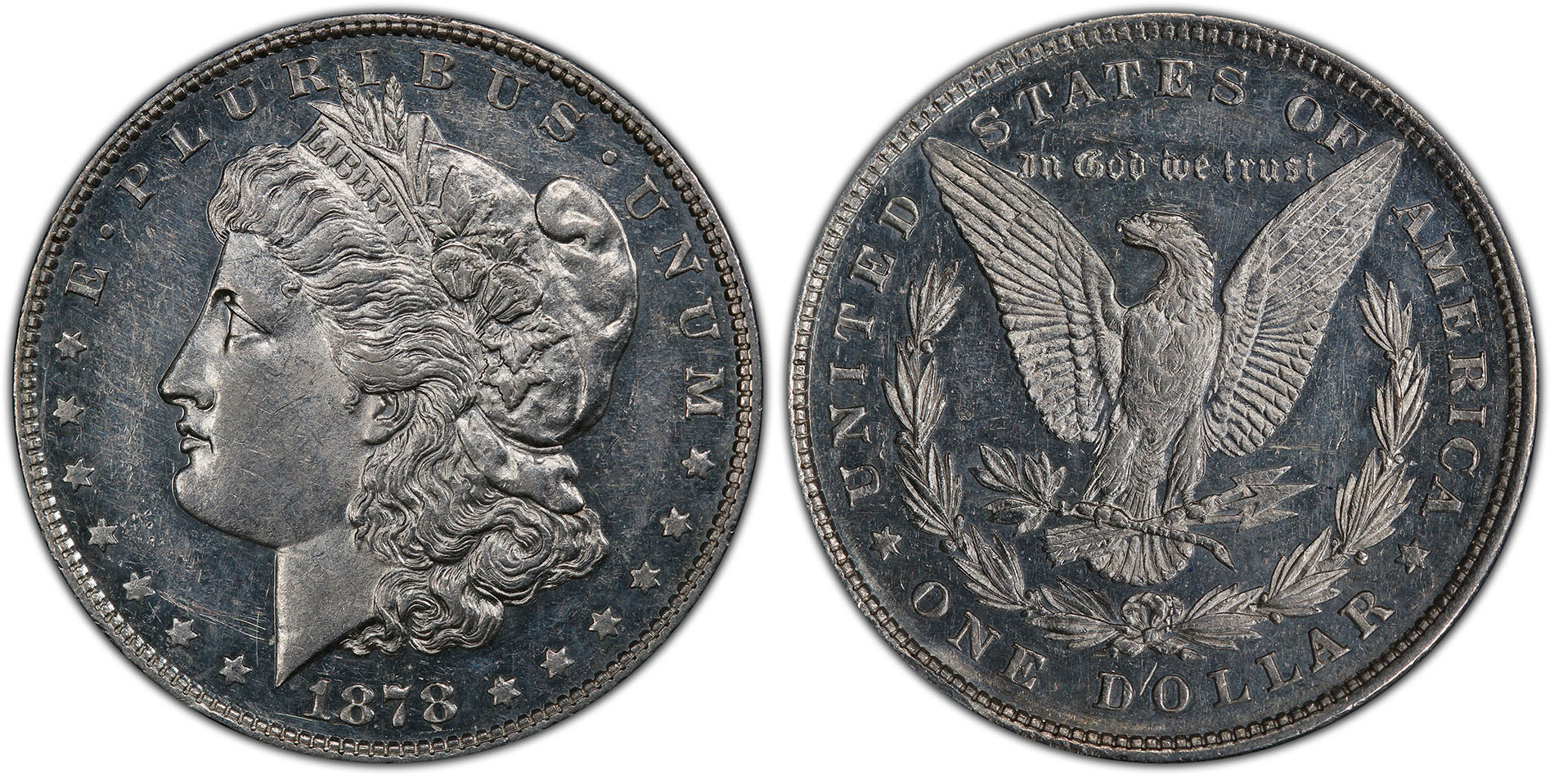
Click image to enlarge.

This doubling, known as Class IV Offset Hub Doubling, occurs when a die being rehubbed is off center in the hubbing press from a previous hubbing. In the case of the “Shifted Eagle” reverse, the hubbings were misaligned in a north-south direction, resulting in all of the doubling going in the same direction and with the same distance between impressions/images.


 Copper & Nickel
 Silver Coins
 Gold Coins
 Commemoratives
 Others
 Bullion
 World
World
 Coin Market
 Auctions
 Coin Collecting
 PCGS News