Example 1: In a recent article about ANA President Anthony Swiatek, Timothy Rolands, reporter for Numismatic News, told how Swiatek began collecting coins in 1952 when his uncle gave him a Proof set that year. His father then gave him a 1921 Pilgrim commemorative half dollar. Swiatek was 11 years old at the time.
He became serious about collecting around 1966-1968. His first purchase was a "gem red Uncirculated" 1849 copper cent, which turned out to be "artificially " colored.
Swiatek's experience is not particularly unusual. Often, beginners in the hobby scan various offerings in magazines, at flea markets, and elsewhere, and assume that there is a code of honor among coin sellers, and that if an 1849 copper cent is marked "gem red Uncirculated," then other collectors would generally agree that this is the proper grade.
Example 2: On a television shopping channel a very convincing sales team tells viewers that, in effect, the sponsors have made the buy of the century. By amazing good fortune they were able to purchase a large number of old "rare" and "valuable" coins. After doing this, they examined some "coin books" and, lo and behold, the coins were, indeed, very valuable. However, because they were purchased at such a low cost, now you, the lucky viewer, can for only $400 buy coins that are "worth" $2,000 if bought from a coin dealer!
We are quite skeptical. A leading numismatic consumer advocate did some studying of coin offers on television, and concluded that the typical Morgan silver dollar was offered for a price of two and one-half to four times as much as the average established reputable coin dealer would charge at full retail!
Example 3: From an Internet seller, an alert numismatist obtained for only $350 a beautiful 1652 Pine Tree shilling, a coin grading VF to EF and normally worth at least $2,000 to $3,000. And, indeed, it was beautiful. Trouble is that it was also a fake.
Cure: Years ago, Lee F. Hewitt, publisher of the highly successful Numismatic Scrapbook Magazine, said, "There is no Santa Claus in numismatics. You get what you pay for."
If a "rare $1,000 coin" is available for $200, it is probably a $200 coin (if that), almost certainly not a $1,000 coin.
The cure is simple: Before buying a coin, learn something about it. One of the "blessings" we all have is an abundance of information. In fact, we probably have too much information.
If (real example) someone on television offers you a "rare, Mint condition" 1878 Morgan dollar for "only $199, " and the coin is barely Mint State, it might be useful for you to know that established rare coin dealer X, who has been in business for 10 years and who has numismatists as his primary customers, would sell you one for, say, $40.
Here is how to be a wise coin buyer:
- Point 1: If you are not a serious numismatist yourself, a simple protection is to buy a coin certified by one of the leading grading services (the three largest are PCGS, NGC, and ANACS). While grading is a matter of opinion, and there may be differences among graders, at least if PCGS (for example) calls a coin MS-65, it is not likely that it is greatly different from that; it may be called MS-64 or MS-66 by someone else, but it is hardly likely to be MS-60.
- Point 2: For pricing information, consult "Trends" in Coin World, or "The Coin Market" in Numismatic News, or the Coin Dealer Newsletter (a short list; there are other good guides as well). If a coin is listed for $40, then you can assume that there are plenty of such coins around, and that a nice specimen will cost about $40.
- Point 3: Look at the coin and determine that it is pretty. If it is spotted, stained, or ugly-no matter that it may be in a certified holder-pass it by and wait for a nicer one.
- Point 4: Build a small (at least) library of coin books. Determine which series and coins are appealing and interesting to you, and then buy those pieces. Often, if you read about the history and romance of a coin, its ownership desirability will double or triple and you'll have a lot more enjoyment with it.
- Point 5: Except for Virgil M. Brand (who died in 1926), no numismatist has ever had the inclination or financing to buy one of every coin under the numismatic sun. Thus, pick a niche or specialty.
- Point 6: Except for great rarities, a coin that you are not able to buy today will probably be available tomorrow or next month. Some patience is required. However, as United Airlines used to say (and perhaps still does), "getting there is half the fun." Gathering an interesting collection coin-by-coin is what numismatics is all about.
- Point 7: Enjoy your experience. If you are not a "happy numismatist," consider another hobby. Any avocation worth pursuing should add to your quality and enjoyment of life. Life is too short to do otherwise.
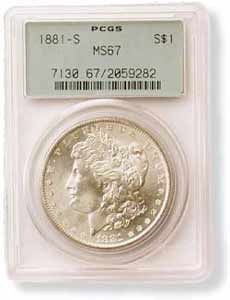
Having a coin certified is a good
protection for collectors.


 Copper & Nickel
 Silver Coins
 Gold Coins
 Commemoratives
 Others
 Bullion
 World
World
 Coin Market
 Auctions
 Coin Collecting
 PCGS News