The Norweb Collection - An American Legacy
Michael Hodder and Q. David Bowers
CHAPTER TWO
ALBERT F. HOLDEN
Introduction
Albert Holden, "Bert" to those closely associated with him, was a hard man to get to know as a friend, and very few of his associates did. He was, however, a man to be respected, for in each of the three fields he ventured into, the mining business, collecting mineralogical specimens, and collecting coins, he showed indefatigable energy and a quick understanding of their subtleties. He was also a man to be feared, by his business associates, his employees, and even his own family. He was very much the man of his times. The boundless enthusiasm with which he started each of his projects and the unconquerable optimism that told him he) would succeed at them were traits he shared with Theodore Roosevelt, his contemporary and the best known exemplar of this curious mixture of character traits.
Bert emulated his father in many ways, taking over Liberty's mining business, his newspaper, and perhaps even his numismatic hobby. With such a pre-eminent example before him it would have been hard for Bert to do anything else. But, in each endeavor, he surpassed his father's accomplishments, and when he was finished he headed the second largest mining, refining, and smelting trust in the world, whose net earnings for the 12 short years Bert controlled it were $30 million. This substantial figure did not include the earnings from the Plain Dealer, which he also owned. The year before his death Bert traveled to Juneau, Alaska, where he supervised the opening of two new gold mines, one of which, the Perseverance Mine, would become one of Alaska's richest. Had he lived longer he could not have avoided history's notice.
Liberty Holden studied mineralogy in his spare time, to give himself enough of an understanding to run his mining business. His son Bert took a formal route and graduated from Harvard in 1888 with a degree in mining engineering, soon turning his study to practical use in the field. He personally inspected many new sites for proposed mines, took samples of the ores he found there, and could tell intuitively if a site would yield enough profit after expenses to make it worth developing. In time he became one of the most competent mining engineers in the country.
He translated his academic training into a hobby as well as a business. As soon as he joined his father's staff in Utah, around 1892, he began collecting mineralogical specimens from his own, as well as neighboring, mines. In time, his collection grew to become one of the finest in the United States, and included specimens from around the world. The Holden Collection and its substantial $500,000 endowment later became the nucleus of Harvard's present holdings.
Bert probably first learned about coins from his father but was not involved in the hobby until after he returned to Cleveland from Salt Lake City around 1904. His earliest recorded purchases were from Henry Chapman's sale of the Stickney Collection, in June 1907, his last from Thomas Elder in 1912. During those five years he acquired fully half of the United States colonial and federal issues now included in the Norweb Collection, a remarkable achievement in so short a time. Like his contemporary, Virgil M. Brand, he purchased entire series of coins in single transactions. His first love was colonial coins, doubtless in homage to his family's close connection with our country's colonial past, and his first and last purchases were colonials. In numismatics, as in business, while he followed in his father's footsteps, his stride was longer and he traveled further.
The Man of Business
Bert Holden was educated at Phillips Exeter Academy and Harvard University. His college papers have been preserved and show him to have been only a middling student, although he was elected into Phi Beta Kappa upon graduation. He excelled at sports, however, and was captain of the Harvard football team for his last two years there. He was noted as a great broken field runner, and the two touchdowns he scored in the classic Harvard Yale game of 1887 won the day. He played football with the driving will to win he later exhibited in his business dealings. In a speech before the American Collegiate Athletic Association, delivered in 1914, Dean Briggs of Harvard remarked that the early days of football were "years of barbarity and rancor and low cunning" He went on to say that some men emerged from the mass showing "... that wonderful capacity for standing fire. Such was the late Bert Holden, whom I can see at this moment dashing down the field with the brilliancy of a cavalry officer leading a desperate charge. In him sincerity was an overmastering force."
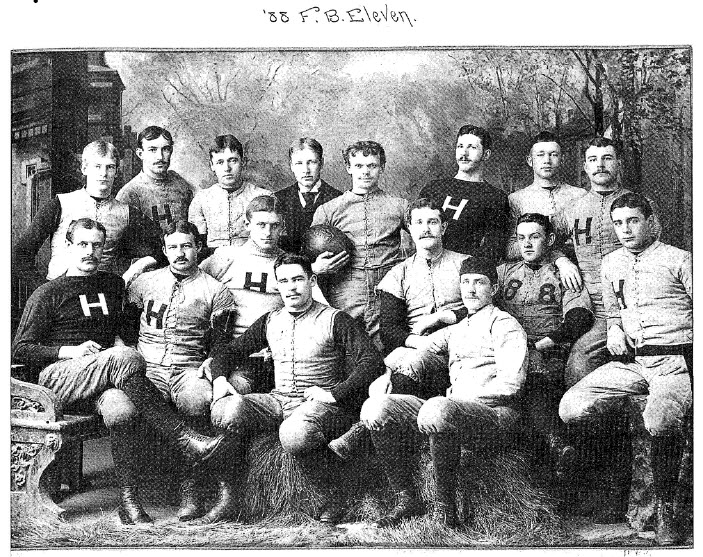
Group photograph of the Harvard football team of 1888. Albert Holden, captain of the team, is standing in the center holding a football. Albert was one of Harvard's greatest broken field runners at the time. The touchdowns he scored in the Harvard-Yale game of 1887 won the victory for his school. Although he is pictured here as captain of the 1888 team, he did not play in the Harvard-Yale game of that year, due to an injury.