The Norweb Collection - An American Legacy
Michael Hodder and Q. David Bowers
On March 14, 1896 Bert wrote to Wolff:
I have just returned from a three days collecting trip to the famous Tintic district in Juab Co. I had a good time though not a very successful one from a collecting point of view.
Mineralogy is my recreation-perhaps a little more than recreation as I of times fear I let it interfere with business. They do say out here that Mr. Bixby [another collector in Utah] and myself would go further to get a good mineral specimen than we would to see a good mine.
Albert's trip was not so unsuccessful as he first thought. He writes to Wolff two days later:
My trip to Tintic that I wrote you about the other day turned out more satisfactory than I thought at the time. On examining my plunder I found I had one fine specimen 3 crystals on it of linarite. As far as any of us out here know these are the first reported from Tintic. Now that we know they are there we will find more.
I have three collections, only one of which I am pressing. I have rocks-with sections-that is pure business and I only collect as business calls for it. I have an economic collection I make only by myself. I have some rare ores, one or two of which I shall include in your box. The collection I am most interested in is straight minerals crystallized, if possible. I hope to perfect that some day and give it to Harvard. However, my enthusiasm may wane, but I think not.
Later on, in July 1908, Bert wrote Wolff concerning donating his collection to Harvard. Clearly, he had not lost his enthusiasm, nor his intention of donating the collection to his old school:
That reminds me that I never answered your letter concerning my suggestion of giving my collection to Harvard now. I suppose I ought to turn it over but somehow I have a feeling that on the whole, both Harvard and I are better off for my not doing so. If I should give it to you I should probably lose all interest in further collection. My not giving it to you costs from one to two thousand a year that I spend in furthering my hobby.
From his letters it is plain Bert collected his specimens with a careful eye to condition, as well as rarity. As early as 1896 he had become sophisticated enough to keep population and condition census records (i.e., number of specimens that survive and the 10best in terms of condition) on rare specimens. In a letter dated June3 of that year, Bert wrote Wolff that a specimen he had just acquired was only the sixth one known. On October 7 of the sameyear he wrote Wolff, saying that the example of orpiment he had just sent to Harvard was the second finest known, his own being the finest, and that no dealer had anything to match those two. Later, on January 14, 1897, Bert wrote that the specimen of martite he wanted to buy was the finest known, but the owner, Mr. Bixby, wanted too much for it. Bert enlisted the help of Clarence Bementin negotiating a reduction in price, which was $35. Bert's close relationship with Bement continued for many years.
In 1912 Bert was offered the entire Hancock Collection for purchase. He wrote Dr. Charles Palache of Harvard on January 12:
Thank you for your letter which reached me yesterday.
On the strength of it, I took the liberty of writing Mr. Bement concerning Hancock's collection, offering to take it at his appraised value. It is not often I would do this, but knowing Mr. Bement's reputation for reasonable liberality and absolute fairness, I am very willing to take the chances.
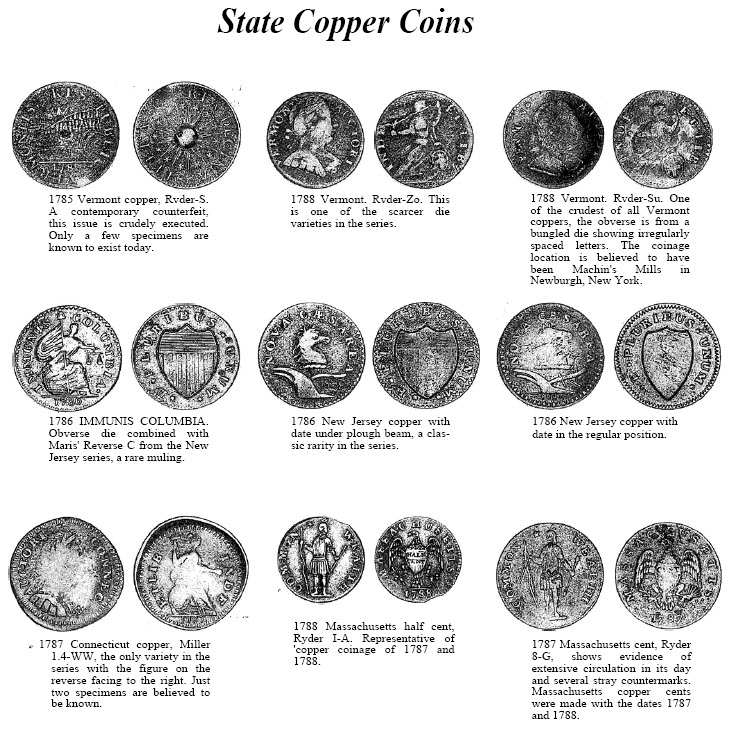
DURING THE LATE 1780s several states authorized or produced their own copper coinage. Vermont, an independent entity at the time (it did not join the Union until 1791), authorized an issue of copper coins. The early ones were produced by Reuben Harmon, jr., in Rupert, Vermont. Later pieces were made at Machin's Mills, a private enterprise on the shore of Orange Pond near Newburgh, New York. Vermont coppersbear dates from 1785 through 1788. Forty different die varieties are known.
New Jersey coppers, bearing dates from 1786 to 1788, were struck by several individuals. The general motif is similar on all regular pieces and bears on the obverse a horse head and plough and on the reverse a shield. A rare variant has the date 1786 under the plough beam instead of near the rim.
Connecticut copper coins were manufactured privately under the authority of the state and bear dates from 1785 through 1788. Most bear a male portrait on the obverse and a seated figure on the reverse. Shown on this page is an exceedingly rare variation, with the seated figure on-the reverse facing to the right rather than the usual left. Over 300 different die varieties of Connecticut coppers are known today.
Massachusetts decided to operate its own mint, and in a state-owned facility half cents and cents dated 1787 and 1788 were produced. An analysis of the operations was conducted, and it was discovered that each piece cost over twice face value to produce, so the venture was soon discontinued.
Copper coins were made by various other individuals and entities as well, most notably at Machin's Mills, a private enterprise conducted bv Thomas Machin, who earlier served in the Revolutionary War. He set up a mint near Newburgh, New York, which manufactured counterfeit British halfpennies as well as unauthorized imitations of various state coinages, including Connecticut and New Jersey. Vermont pieces were also made there, but under special arrangement with Reuben Harmon, Ir., who held the franchise.
Today, copper coins of the 1785-1788 era are avidly collected by numismatists. The Norweb Collection contains a wide variety of issues rang-ing from scarce to exceedingly rare.