The Norweb Collection - An American Legacy
Michael Hodder and Q. David Bowers
Further north, Bert's surveying company reported on several promising gold mines operating in Juneau, Alaska, owned by the Alaska Gold Mines Company. In June 1912 Bert traveled to Juneau with his friend Daniel Jackling aboard Jackling's million-dollar steam yacht Cyprus. Jackling was connected with the famous Mercur Mine in Utah and had the reputation of favoring fast boats and faster women. When the mining community looked for someone to represent them at Utah's statehood admission ceremonies in 1896 Bert was chosen to attend rather than Jackling, who was felt to be too fond of the bottle and likely to be an embarrassment.
Bert Holden did not lose any time in Juneau. During the Alaskan summer months he, Jackling, and his daughter Emery May tramped through the mining sites owned by the Alaska Gold Mines Company, surveying the terrain and photographing mines in which they were interested. Bert was an amateur photographer, owned a collection of new and old cameras, and liked taking pictures. One mine in particular, the Perseverance, seemed to offer the best potential, and images of it were prominently mounted in Bert's photo album.
Whether Bert, or his successors, bought the Perseverance is unclear from the few documents we have seen. A neighboring mine, the Ebner, is listed in the 1920 edition of the Mines Hand-book as being among the properties owned by the holding company founded years earlier by Bert.
When Bert came back from Alaska toward the end of 1912 he was suffering from cancer. By December of that year he was able to go to his office only every other day, and then only to dictate some letters to his secretary. He wrote his old mentor, Professor Wolff of Harvard's Department of Mineralogy, that he was forced to take things very slowly now. When the new year opened he was confined to his bed, and five months later he was dead. During his decline he conducted very little business and his affairs, along with his companies, became disorganized. The lack of his leadership, and the confusion that resulted from it, account for the gaps in the historical record from this time.
Taking all the evidence that is available, the following summarizes the Holden mining empire. For the entire period Liberty and his son Bert were active in the mining and refining business, 1876 through 1912, their companies shipped metals whose total worth was nearly $236 million. The total net earnings onthese shipments may have been as high as $58 million ($20 million of this figure is documented). Their enterprises today would earn them a place in the ranks of the most successful businessmen. In their own times they were accounted among the more important industrialists of the nation. It is surprising that neither Liberty nor his son Albert are well known among historians of American business.
Holden vs. Hardy (1898)
Like his father before him, Albert Holden seemed to attract lawsuits. Like his father, Bert was a sharp and hard businessman who had little time for legal niceties when he had set his mind on getting something he wanted. Some legal troubles that plagued the family seemed never to go away. In 1905 ownership of the Old Telegraph Mine was once again in dispute, perhaps brought by the heirs of one of the original owners. The case seems to have been settled in Albert's favor; it may never have come to trial. Two years later, Bert's ownership of the Kempton Lode in Nevada was tested before the United States Supreme Court in Wall vs. u.s. Mining Company. Bert won this contest, also. For Bert, and for the history of labor, his most important legal test had come earlier.
The March 25, 1896 issue of the Deseret News stated that Albert Holden was the secretary of a state board holding hearings on proposed legislation then before Utah state representatives.The legislation limited the working day for all laborers in mines, smelters, refineries, and reducing plants to a maximum of eight hours. The rationale for the new limit was that the mining and allied industries were particularly hazardous to the health of workers employed in them. The foundation for the proposed law rested on the powers granted states by the federal Constitution to make laws governing the safety of their inhabitants, called the "police power"
Early American Issues
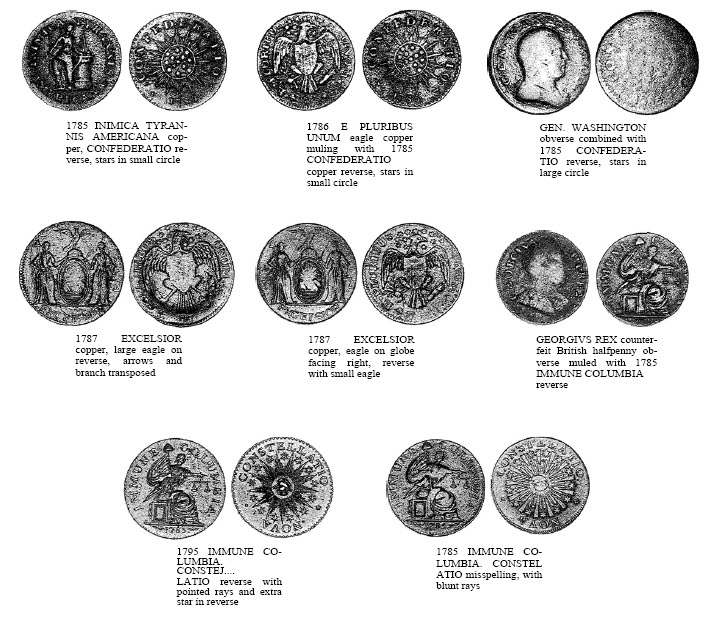
THE ISSUES shown on this page are among the most enigmatic in the American series. The INIMICA TYRANNIS AMERICANA obverse combination with the CONNFEDERATIO reverse, with stars in small circle, and the related muling showing an eagle obverse may have been made from dies prepared by George Wyon in Birmingham, England. The GEN. WASHINGTON obverse die was muled with several reverse dies, including CONFEDERATIO with stars in large circle, as shown here, a well-worn specimen. The two 1787 EXCELSIOR coppers bear legends relating to New York State, although it is not known under what authority they may have been issued. Next follows a crudely cut GEORGIVS III REX obverse die for a counterfeit British halfpenny, combined with the 1785 IMMUNE COLUMBIA. Pieces with two different styles of NOVA CONSTELLATIO reverse, one with the misspelling CONSTELATIO, were struck by unknown parties, possibly at Machin's Mills.
OVERLEAF: View of the Perseverance Mine reducing works in Alaska. Although un-dated, this photograph was found in Albert Holden's album of pictures taken during his trip to Alaska in the summer of 1912.