The Norweb Collection - An American Legacy
Michael Hodder and Q. David Bowers
Mrs. Norweb's purchase in October 1935 introduced her to Wayte Raymond, and a business relationship developed that would later playa significant part in the Norweb's collecting activities through the 1950s. She probably needed no introduction to Scott Stamp & Coin Company: her father Albert had been an important client of the firm before his death. She had used their Standard Catalogue as an inventory guide before 1913.
The Norwebs patronized Scott's neighbor, J.C. Morgenthau, as well. On October 11, 1935 the Norwebs purchased from J.C. Morgenthau an 1892-CC double eagle, graded by them as VF, for $60; an 1891-CC eagle, not graded in the inventory ledger, for $20; and an 1880-CC eagle, graded VF by the Norwebs, for $35. These three Carson City issues had been lots in Morgenthau's auction sale of the R. de Silva Santos, Jr, sale. While they were low mintage issues, the significant thing to notice about this transaction is that the Norwebs were now going about acquiring coins in a systematic manner. From this time forward, until the end of 1937, many of their purchases were of multiple coins from discrete series. Their goal was to fill gaps in whole series as speedily as possible, rather than one coin at a time.
To illustrate, we have selected two series, Charlotte and Dahlonega Mint half eagles purchased before the end of 1937. These are, relatively, small series, as they include coins struck only from 1838 until 1861. The data that follow are taken directly from the Norweb inventory ledgers, and it must be remembered that the ledgers do not include the same information for each and every coin purchase. This is especially true of coins bought by Mrs. Norweb's father Albert Holden; after 1937, when the ledgers were started, much information from Albert's days had been lost:
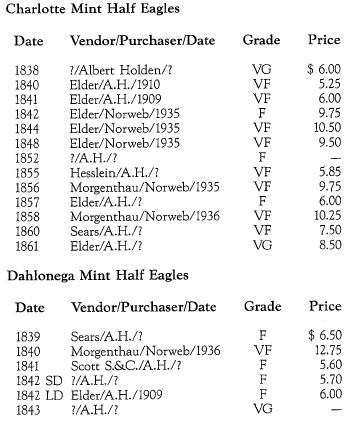
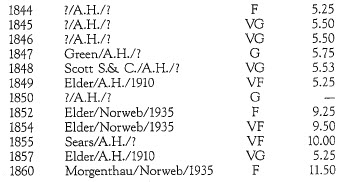
The reader will notice immediately that neither series as we have listed them above is complete. Only those dates present in the collection before 1937 were included, to illustrate Ambassador and Mrs. Norweb's activity in these two series when they first began collecting in a serious way. Even so it should be obvious that their, goal was to complete each of these two series quickly, building on what Mrs. Norweb's father had left them. Albert Holden had done most of the work in filling the dates already, and perhaps that was why they chose these two in particular to work on during 1935-1937. Still missing after 1937 were the three rarities in these series, the 1842-C Small Date and the 1861-C and 1861-D issues. These would be purchased much later on.
Their inventory books record many other purchases made during the time the Norwebs were stationed in Mexico City, Bolivia, and the Dominican Republic, from 1935 through 1937. Besides Bolender, Elder, and J.C Morgenthau & Co., the Norwebs purchased some coins from Charles H. Fisher, who had a coin business in their home town of Cleveland and conducted auction sales in the 1930s. Acquisitions from Fisher were limited to quarters, halves, and dollars of the 1920s and early 1930s. Their most important source for United States coins at this period was the flamboyant B. Max Mehl of Fort Worth, Texas.
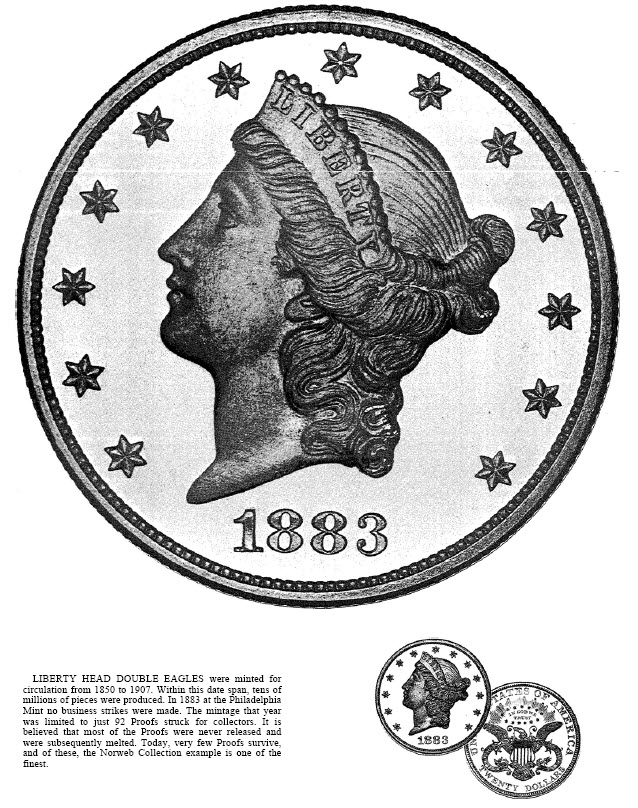
1883 Double Eagle