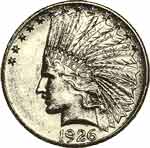
In 1997, an influx of counterfeit gold coins was led by an old friend from 15 to 20 years ago -- a 1926 $10 Indian. This same counterfeit received a blitz of publicity around 1980 that sent it into hiding, but it came back, probably due to the spike in gold prices. It's an excellent counterfeit, but easy to spot if you know what to look for.
Is this counterfeit being remanufactured or simply recycled? It's impossible to tell right now, but one thing is certain: due to the number submitted, it is fooling a lot of people. Unlike the fake 1908-D No Motto, 1916-S (and the laughable 1913-D), this 1926 doesn't have that obvious "glow in the dark" look that is the usual easy giveaway for fake $10 Indians.
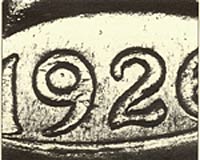
The lead characteristic for detecting this counterfeit is a patch of recessed lines near the right side of the lower loop of the "9." If you find this characteristic, be assured that the coin is not genuine.
A second tell-tale of a counterfeit $10 Indian that is seen on this fake is the "stock edge." A stock edge is seen when the same collar is used to produce more than one date of counterfeit coins. The flaw, or mistake made by the counterfeiter, is a group of short, thick lines between the stars on the edge, followed by gaps, followed by more short, thick lines, etc.
The diagnostics of this counterfeit can be easily seen with a 3X or 5X magnifier.
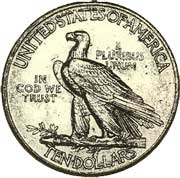
Reverse of the same counterfeit shows no conclusive tell-tale diagnostics.
Reverse of the same counterfeit shows no conclusive tell-tale diagnostics.


 Copper & Nickel
 Silver Coins
 Gold Coins
 Commemoratives
 Others
 Bullion
 World
World
 Coin Market
 Auctions
 Coin Collecting
 PCGS News