commemorative coin look like?
How about this fantasy
combination of pin and keychain?
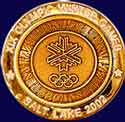
Here we go again. Another politician in U.S. Congress has sponsored a commemorative coin bill to mark the upcoming Salt Lake City Winter Olympiad in 2002.
It's the same old tired idea through the same old tired way. When will Congress ever get the hint they should privatize the U.S. Mint and let the Mint decide what to issue or not to issue like every other Mint in the world?
Realistically, we all know this "ain't going to happen" since the only reason some congressman ever sponsors a coinage bill is so the coins (if you call non-circulated legal tender commemoratives `coins') can finance somebody's pet project.
As a result, in recent history we have had coins marking such events as the bicentennial anniversary of Congress in 1989, the USO (which was never bothered to be spelled out on the coin) in 1991, the 200th anniversary of the White House in 1992, the 38th anniversary of the Korean War in 1991 (You'd think somebody would have waited until the 40th anniversary!), the bicentennial of the Capitol Building in 1994 and more.
Realistically, how many Americans care about the anniversaries of some of our governmental departments or buildings that house them?
Congress appears to have found every "important" anniversary it could celebrate except Teddy Roosevelt falling off his horse. Maybe we'll see a bill to mark that anniversary next week.
We've had such great designs as a depiction of Eunice Kennedy Shriver on the 1995 Special Olympics World Games silver dollar (This is a depiction of a living person.) and of a U.S. soldier looking like he's having a great time on the 1993 World War II $5 gold coin. People complained about the designs of the classic commemoratives of 1892 to 1954. These older commemoratives look great when compared to the art work on the more recent series.
With the exception of the coins marking sporting events, all of the subjects appearing on recent U.S. commemoratives have been past historical anniversaries.
In ancient times, the original intent of a commemorative coin was to mark a current event while getting propaganda value from it. As a result a crescent moon was added to the Athenian silver tetradrachm of the fifth century B.C. to mark the victory at the Battle of Marathon. Nero depicted himself playing a lyre on an ancient Roman coin to tell the world he was such a great musician in the then-current Olympics (The judges had to agree if they didn't want to lose their heads). Philip II of Macedon celebrated his personal victory in the Olympic chariot race with a coin--after the event, not to finance it. Vespasian and Titus issued Judaea Capta coins to celebrate their victory over a major Jewish revolt against Rome.
Where was the U.S. commemorative coin to mark our victory over Iraq in the Gulf War during the 1990s? The only country to issue coins to mark the great victory was the Marshall Islands!
At least in 1971, on the reverse of the Eisenhower dollar coin, we managed to acknowledge we had landed on the moon. But this was a circulation issue, not a commemorative.
So here we go again with H.R. 3679 sponsored by Rep. Merrill Cook (Rep.-Utah) with 120 of his closest colleagues, all of whom are just licking their chops to turn this into yet another pork barrel issue meant to make money for their pet projects by using tax payer money and the U.S. Mint for coins which incidentally may not even finance the Olympic Games. Read the version of the bill that becomes law to see what's in it. Stranger things have happened.
H.R. 3679 calls for 80,000 gold $5 half eagle and 400,000 silver dollar coins.
Some of the most recent U.S. NCLTs have actually sold out. Did you know some NCLT commemorative coins didn't sell out during the early 1980s? This wasn't a problem.
Special legislation was later passed to ensure whatever group was legislated to benefit from profits from sales got the money they expected regardless of the sales results.
Not a bad deal. Maybe we should lobby for a bill to strike a coin celebrating the anniversary of the first sale of the Brooklyn Bridge.
Richard Giedroyc is a numismatic writer, researcher, auction cataloger and coin dealer. He has been in the hobby and business most of his life, now having more than three decades’ experience in this fascinating hobby field. During this time Giedroyc has been the owner of Paris Bergman Galleries, owner of Classical Coin Newsletter, international editor of Coin World and owner of Giedroyc-Anderson Interesting World Coins. He is currently a numismatic consultant. He has written more than 2,000 byline numismatic stories and contributed to several coin catalogs.


 Copper & Nickel
 Silver Coins
 Gold Coins
 Commemoratives
 Others
 Bullion
 World
World
 Coin Market
 Auctions
 Coin Collecting
 PCGS News