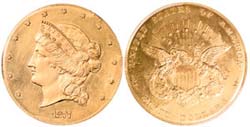
Want to hear a good story? Yeah, I thought you did. A little less than a century ago a collector named William Woodin made a deal to buy two coins. The price was outrageous and unprecedented (reportedly $10,000 per coin), but he agreed to pay it. Then, after Mr. Woodin took delivery of the coins the seller changed his mind. "I must have them back," the seller cried, "for they are unique national treasures."
Mr. Woodin wasn't happy about it, so the seller offered to trade him other coins. Two trunks filled with coins, in fact. United States Pattern coins, in fact. So, the only two $50 Half Union pieces ever struck in gold were returned to the National Collection, and Mr. Woodin suddenly owned the largest collection of U. S. Patterns ever held by a private citizen. At a later date Mr. Woodin went on to become Secretary of the Treasury of the United States, but that's politics, and definitely something you don't need to hear more about these days.
Because the U. S. government reneged on its agreement to sell the two 1877 Half Unions they are not available today for private ownership. It is speculated that they might be the most valuable coins in the world, but it's something we'll never know. The good news is that there were some off-metal Pattern coins struck from the same dies, and one of them is coming up for sale in the Bowers & Merena Rarities Sale on January 3, 2001. Lot #633 of the sale offers a PCGS Proof 63 specimen that is one of eight known. The huge Pattern is gilt copper, as are five of the eight known pieces from this die pair. It is often said that this coin has a rich history, but that's almost an understatement. The 1877 Half Union is a numismatic classic, to be sure, but it nearly became the most famous coin in the world. To view lots and participate in on-line bidding in the Bowers & Merena Rarities Sale, click here.
"Franklin half dollars and Walking Liberty half dollars have joined the expanding modern issues market," says Michael Byers of Byers Numismatic Corporation in Lake Forest, California. "The Proof sets of 1950 and later have also come into great demand. There's an abundance of new collectors in the market and they're seeking affordable coins and series that can be completed.
"Another excellent area of the market is Mint errors," Byers continued. "Now that the major errors are being certified they are universally accepted as an important part of numismatics. Collectors for errors are just like collectors in other areas of the market in that they're looking for completeness."
How do you "complete' a set of Mint errors? For that matter, what makes up such a set? "After the collector buys a Kennedy half dollar struck on a quarter planchet he wants one struck on a dime, a nickel and a cent planchet as well," Byers explained. Among the more interesting errors he's recently handled are the first certified Sacagawea dollar on a Susan B. Anthony planchet and (appropriately enough) a Susan B Anthony dollar on a Sacagawea planchet.
"It's a buyer's market in some areas because money is a little tight," says John L. Schuch of John L. Schuch Rare Coins in Sacramento, California. "Collectors and dealers are more picky than ever about what they're buying. If the coin isn't white or attractively toned it can be a hard sell. Everyone is very price conscious right now as well."
Are things really that bad? "Not bad. Don't get me wrong," Schuch continued, "there's a lot of action in collector coins in collector grades, and pre-1940 Washington quarters are hot. It's just that a number of coins that are already cheap have to be discounted further in order to move them."
Can you give us an example, John? "Walking Liberty half dollars in MS65 and MS66 are really undervalued. Yes, there are a lot of them, but they're beautiful and a fantastic coin for the price."
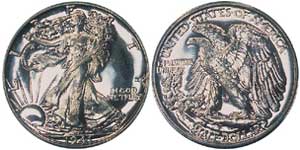
One of America's most beautiful coins, the Walking Liberty Half Dollar, is popular with collectors


 Copper & Nickel
 Silver Coins
 Gold Coins
 Commemoratives
 Others
 Bullion
 World
World
 Coin Market
 Auctions
 Coin Collecting
 PCGS News