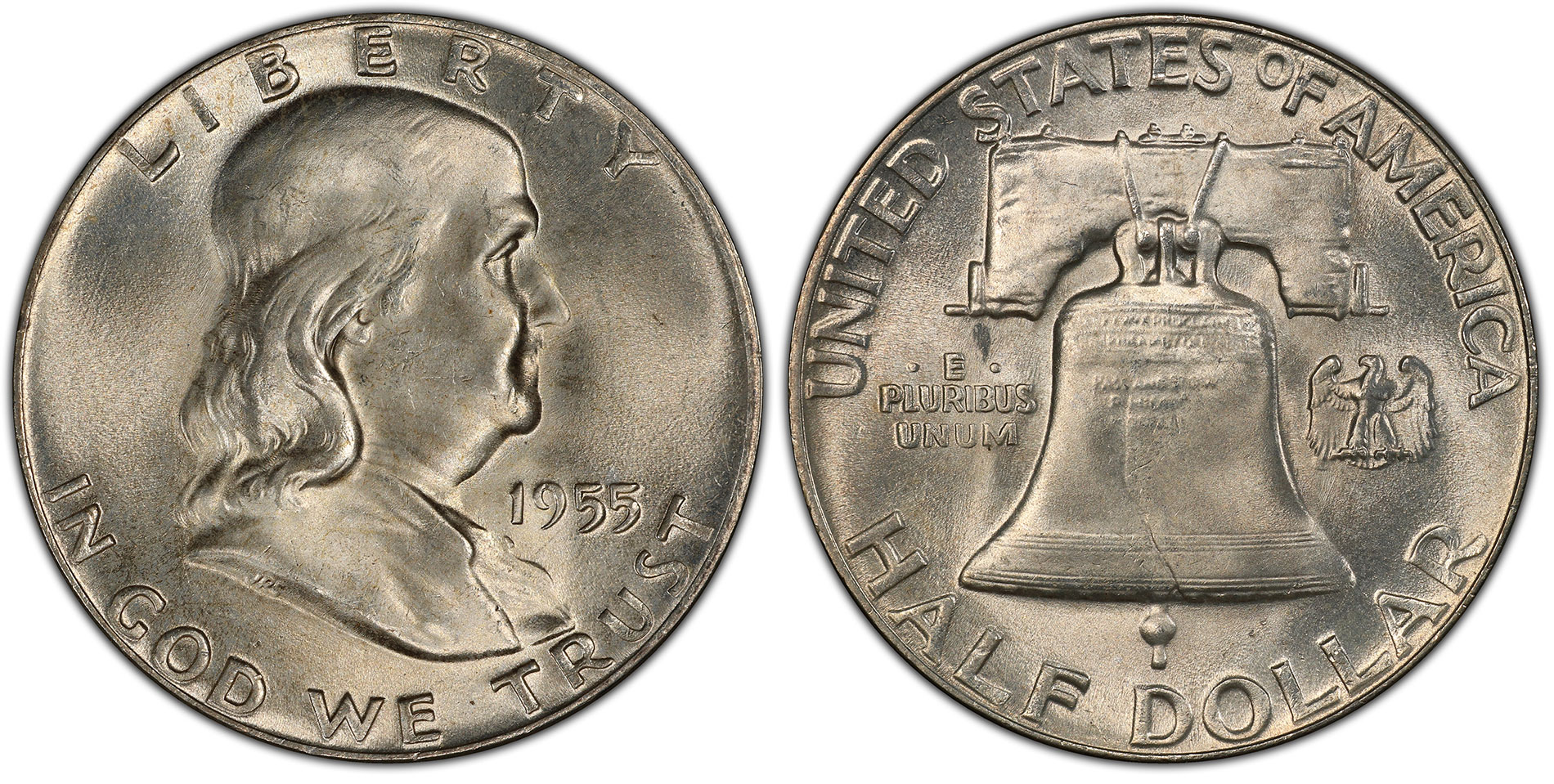
Franklin Half Dollar, 1955 50C "Bugs Bunny" FS-401, PCGS MS66. Click image to enlarge.
Does your Franklin Half Dollar appear to show Benjamin Franklin with buck teeth? If so, it may just be a Bugs Bunny Franklin Half Dollar! Named for the iconic Warner Brothers cartoon hare with buck teeth and a penchant for munching on carrots while cracking the line, “what’s up, Doc?,” the Bugs Bunny Franklin Half dollar is a beloved die variety arising from a clashing of the obverse and reverse dies. The appearance of Franklin’s buck teeth was caused by the eagle’s wings on the reverse die impressing the obverse die in the region of Franklin’s mouth. The result? An aberrant spike that, with one quick glance, suggests ol’ Ben Franklin needs some interventive dental work – stat!
Bugs Bunny Half Dollars: Classic, Yet Not Long in the Tooth
Any dentists itching to break out the braces may want to take a step back. Bugs Bunny Franklin Half Dollars are not only collectible, but they’re also valuable. While not necessarily rare, the Bugs Bunny Half Dollars are quite popular with hobbyists. They were discovered soon after their appearance on the 1955 Franklin Half Dollar and quickly rose in prominence. But why did this particular die clash variety become so entrenched in American numismatic culture? Bear in mind, for a moment, the period during which the coin arose…

This closeup of a 1955 Bugs Bunny Franklin Half Dollar clearly shows evidence of the die clash, which appears in the form of buck teeth. Image courtesy of PCGS True View. Click image to enlarge.
It was the height of the coin collecting boom in the United States, and modern coins were at the fore of the market. The 1955 Doubled Die Lincoln Cent was a recent discovery and stirred the numismatic world as one of the first major – and to this day most popular – of all doubled die varieties. Meanwhile, post-war America was in the heart of a baby boom, and dancing across the small screens in an increasing number of new homes throughout suburbia were a host of cartoon characters aimed at entertaining tens of millions of school-age youth.
Among them? Bugs Bunny, a wisecracking hare who debuted on the big screen more than a decade earlier in 1940 before the eyes of the Greatest Generation. By the 1950s, Bugs Bunny was firmly implanted as a cultural icon – Warner Brothers’ younger, prank-driven rival to Walt Disney’s more unassuming Mickey Mouse, who launched to fame on the silver screen in 1928. Surely, this sociocultural milieu helps explain why this rather subtle, relatively common die clash variety grew to such great importance in numismatics, especially when it did.
The Bugs Bunny variety is known on at least a handful of dates in the Franklin Half Dollar series, which ran from 1948 through 1963. The 1955 and 1956 Franklin Half Dollars are the two issues most commonly attributed with the Bugs Bunny die clash. But of those two, the 1955 Franklin Half Dollar is by far of greater popularity. Even in an era when Saturday Morning cartoons have gone the way of the music videos on MTV, the Bugs Bunny Half Dollar remains a popular collectible and perhaps one of the most important varieties in the Franklin Half Dollar series.
Collecting Buck Tooth Franklin Half Dollars
The Bugs Bunny Franklin Half Dollar isn’t necessarily a difficult coin to locate in the marketplace. Several thousand are known. Well more than 2,500 have been graded by PCGS, the vast majority of these being the 1955 and a much smaller but still significant share represented by the 1956. As this die clash is rather difficult to spot when one isn’t searching for it, 1955 and 1956 Franklin Half Dollars are often overlooked by coin dealers and bullion brokers and thus can be cherrypicked raw. When attributed and graded, the Bugs Bunny Half Dollar is a popular seller, with high-grade pieces faring particularly well in the marketplace.
As with all Franklin Half Dollars, there is a subset of collectors who vie for examples with Full Bell Lines (FBL). These pieces show complete horizontal lines across the Liberty Bell on the reverse and are indicative of a well-struck coin – rather scarce among circulation strikes as opposed to the more common, mushier strikes that proliferate in the Franklin series. With or without the FBL designation, Franklin Half Dollars are popular as a whole, and at least one representative of the Bugs Bunny variety is often included in series runs.
Some Franklin enthusiasts will include both the 1955 and 1956 Bugs Bunny Franklin Half Dollars in their sets, and still others will seek examples of the famous die clash on other dates in the series. Typical specimens of the 1955 and 1956 Bugs Bunny Half Dollars are in the MS63 to MS65 range, where prices for the earlier piece generally hover between $50 to $100, while the latter may fetch $65 to $130 in that same grade threshold.
Examples with Full Bell Lines are much less common though are still available on the market for a price. A 1955 MS65FBL trades for around $200, while the scarcer 1956 lists for more than double that in the same grade at $450, according to PCGS CoinFacts. Among the 1955 Bugs Bunny Half Dollars, PCGS has graded only one at the top grade of MS67, while just a couple have been graded by PCGS as MS66+FBL, the top grade for that designation; either type takes $3,000 or more in those grades. For the 1956, PCGS has graded just two at the grade of MS66+ and but 3 in MS67FBL, and these, too, trade in the $3,000 to $5,000 range in the rare instances they appear in the marketplace.
PCGS Variety Attribution
A popular variety, the Bugs Bunny Franklin Half Dollar appears throughout a number of years ranging from 1948 to 1963. These are caused when the dies clash and a small, buck-tooth spike appears on Franklin's upper lip. For more on variety attribution please visit: PCGS.com/varietyfaq
Sources
- Breen, Walter. Complete Encyclopedia of U.S. and Colonial Coins. Doubleday, 1988.
- “Franklin Has Buck Teeth on ‘Bugs Bunny’ Half.” Numismatic News. April 9, 2019.
- Tomaska, Rick. A Guide Book of Franklin & Kennedy Half Dollars. Whitman Publishing, 2011.


 Copper & Nickel
 Silver Coins
 Gold Coins
 Commemoratives
 Others
 Bullion
 World
World
 Coin Market
 Auctions
 Coin Collecting
 PCGS News