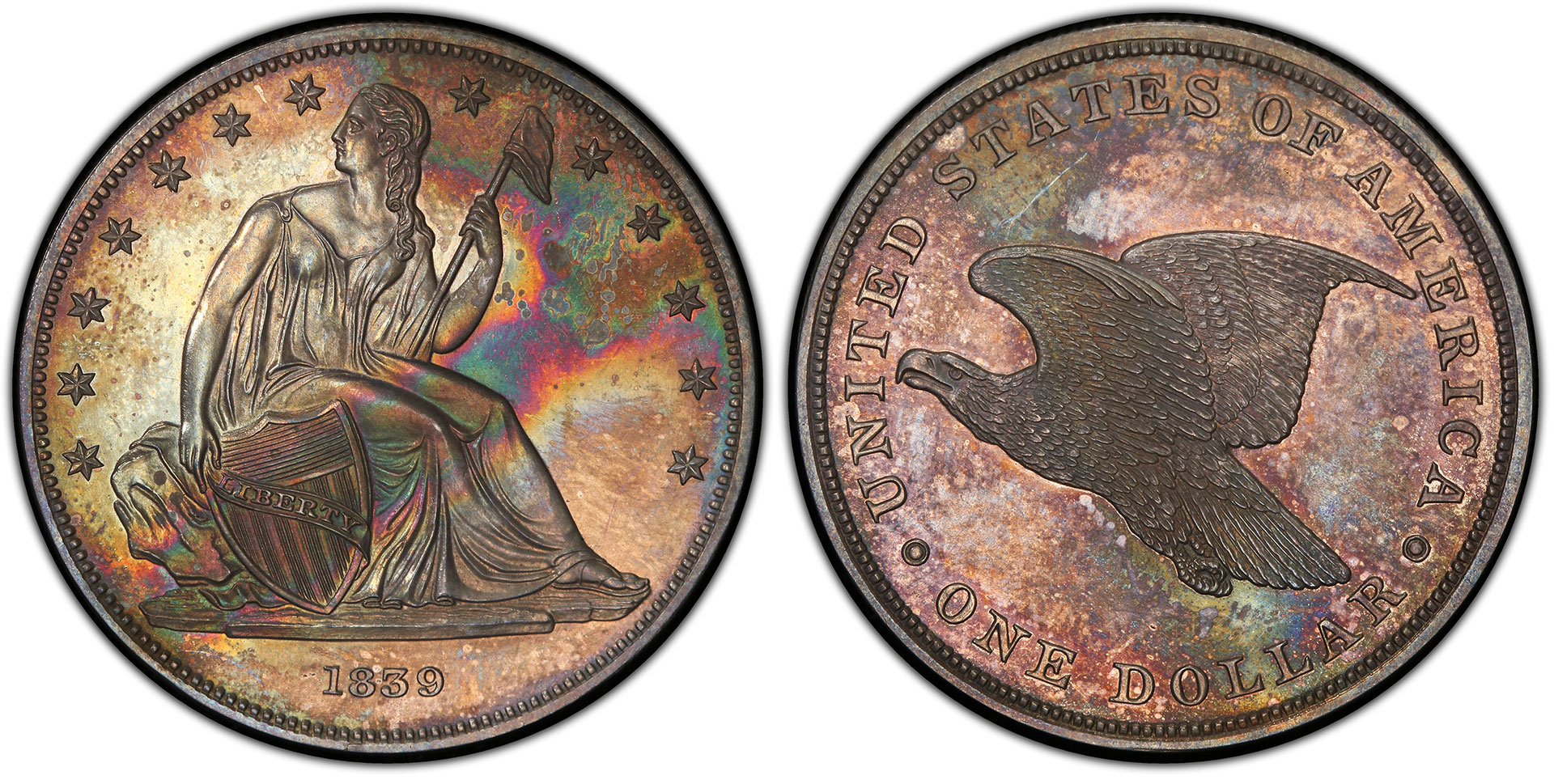
To conclude this three-part series on Christian Gobrecht, I will concentrate on the coin we most often associate with the man, the Gobrecht Dollar. The success of the Gobrecht Dollar, while somewhat tentative at first for the dollar itself, was immediately evident in the new Liberty Seated design that Gobrecht had introduced. Between Gobrecht’s new half and large cent designs, his new Liberty Head Gold designs, and of course all the Liberty Seated silver issues virtually all U.S. coinage for decades would be from a Gobrecht design!
I can still remember seeing my first Gobrecht dollar. It was at a small show in the Midwest sometime in the late ‘70s. This pre-dated third-party grading and the coin was lightly cleaned and pretty beat up. Although probably a pocket piece at one time, I was fascinated by this maybe VF-ish example regardless. Wow, his name’s on it! I had seen the coin in my Red Book, but actually holding the coin made it real.
Regardless of the number of years you spend in the coin business, the number of Gobrecht dollars one might handle are few. Gobrecht Dollars are all scarce. The regular issues are scarce and not often available. The pattern and restrike issues, while relatively numerous by number, have only three issues with more than four examples graded by PCGS. Most have none known. They are rare.
Mint Director Robert Patterson fervently believed that a nation, the U.S., would be judged by the artistic and design quality of its largest silver coin. In the Gobrecht Dollar, Patterson hoped to launch a renaissance of U.S. coin design with the goal of making the U.S. the designers and producers of the highest-quality coinage in the world!
Patterson’s approach of combining known artists’ talents with the engraving genius of Gobrecht worked brilliantly. On August 1, 1835, Patterson wrote a letter to Philadelphia artist Thomas Sully to create an obverse design for a Liberty Seated Dollar in keeping with the Neoclassical movement prevalent at the time. Noted sculptor Titian Peale was commissioned to create a reverse design of a soaring bald eagle.
In September production of working dies began once Gobrecht had interpreted both Sully’s and Peales’ work and created designs for the obverse and reverse dies. On October 17, sketches from Gobrecht were presented to President Andrew Jackson and his cabinet. These sketches were received very well. The new dollar design itself received immediate acclaim as a masterful work. Eighteen trial pattern coins were struck from this first design in November. These 18 die trial pieces were of the initial design with Gobrecht’s name under the base of Liberty, “C. Gobrecht F.” The “C” stood for his first name Christian, while the “F” was short for the Latin term “fecit” or “made it.”
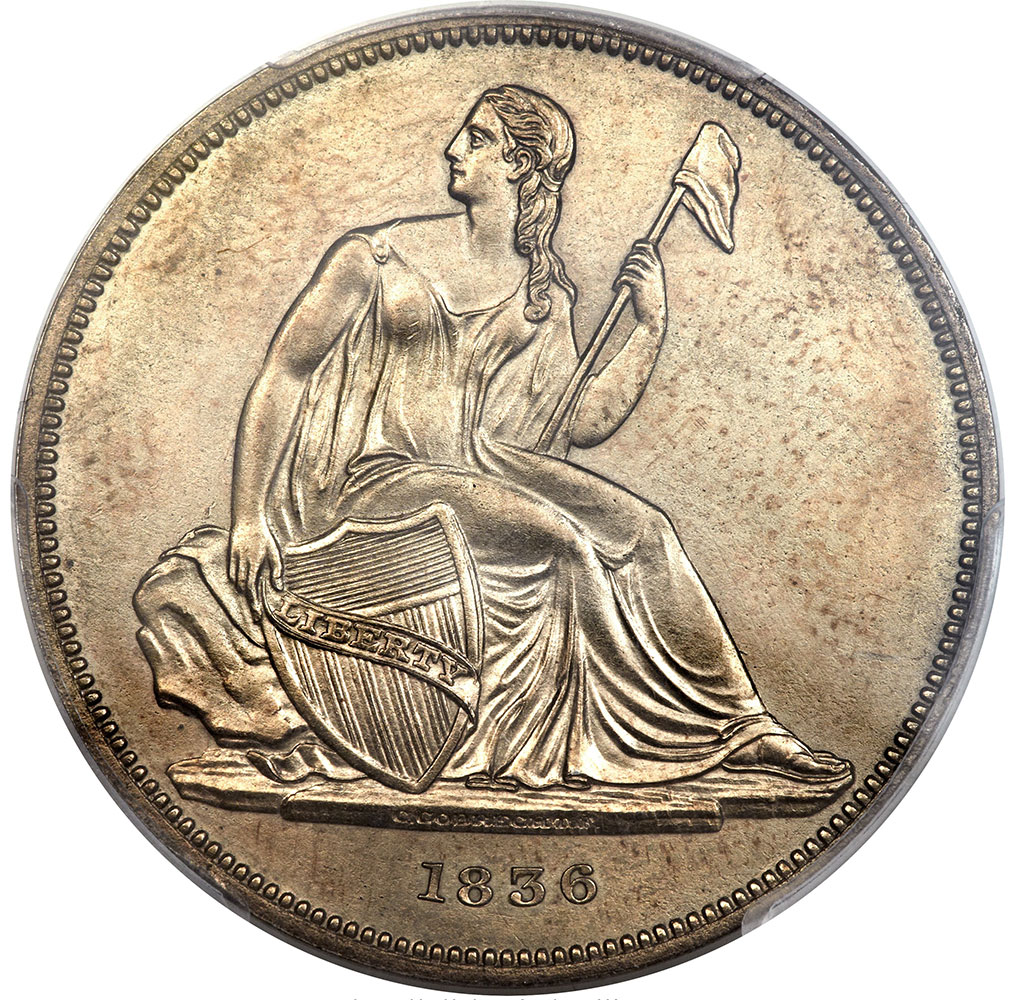
Both Jackson and his cabinet reacted very favorably to the new dollar sketches provided by Gobrecht. Patterson, too, was immensely pleased with Gobrecht’s work, but despite ordering Gobrecht to place his name on the initial design, Gobrecht’s name was moved to the base of Miss Liberty. Because of some criticism over the prominent placement of his moniker “C. Gobrecht F.” below Miss Liberty, the design was altered and Gobrecht’s name was moved to the base of Miss Liberty before 1,000 coins were struck for circulation in December 1836. This original circulation issue weighed 416 grains, the standard enacted for dollars in 1792. Most of these 1,000 coins were struck with a coin alignment and entered circulation. This first Gobrecht Dollar is often considered the most desirable because of its rarity as a circulation issue.
There is nothing simple about the classification of Gobrecht Dollars. After the 1,000 coins were struck in December 1836, nothing about the issue would ever be straightforward again. Jeff Garrett in his excellent article on the subject breaks down the Gobrecht Dollar issues into three basic categories. These are: circulation and original issues, patterns, and restrikes. Add to the confusion the fact that Gobrecht Dollars are known to be struck in both coin and medal alignment. Oh, and yes there’s even a confusing die alignment of the eagle — some are flying horizontally, others are ascending upward!
In January 1837 the standard weight of silver dollars was reduced to 412.5 grains from 416 grains. A total of 600 pieces were struck in March 1837. These were melted, but although most believe J-61 — the reeded edge example that is unique — is not part of these 600 melted coins, there is speculation it might be the only survivor with none to compare it to. By the way, the weight of this coin is 412.5 grains, which is the same as those minted (and then melted) from March 1837.
In 1839 there were 300 Gobrecht Dollars, Judd 104, struck for circulation. These all have a medal alignment with a level eagle. These, too, are a very rare and desirable issue. This 1839 issue was the last of the circulation and original issues. Those include the 1,000 examples of the 1836 and 300 specimens from 1839 for a total of just 1,300 produced.
To date PCGS has graded 403 total 1836 original Gobrecht Dollars. Of these 403, 333 have a coin alignment while 70 have a medal alignment. For the 1839 Original issue only 23 total have been graded in all grades. Scarce indeed!
The Gobrecht pattern issues are limited both in issue and production. The Gobrecht issues of 1838 are considered patterns (J-84) and all known examples are proofs and generally seen in high grade. PCGS has graded 42. There are two J-84 original examples graded by PCGS including the Smithsonian coin. The name has been removed from the base on this issue, stars have been added to the obverse with an eagle flying level, and it has a reeded edge.
All other Gobrecht issues are considered restrikes. Like I stated in Part 2 of this series, proof coinage had begun to gain in popularity as early as the 1820s and ‘30s. With the technical advances at the U.S. Mint and the quality and artisanship exhibited by Gobrecht, proof issues became well sought. When large cents were discontinued in 1857 and replaced with the Flying Eagle Small Cent, all of a sudden folks were interested!
Coin collecting, as it was, hadn’t really amounted to much prior to the late 1850s. The American Numismatic Society was formed in 1858. Rare coin auctions, too, began to occur with more frequency.
In the U.S. Philadelphia was the center of the numismatic universe, which brings to mind the term “go to the source.” I’m sure there was demand from collectors for coins they needed, but who can argue with some additional revenue for dusting off some old dies and striking rarities to meet that demand. Of course, this was out the backdoor of the mint and in addition to the regular business strikes and proof Issues produced already.
Until recently, identification of restrikes has been argued. Gobrecht restrikes were made in the 1850s to 1870s. No records were kept of course, and the only accurate accounting we have of these issues today is a census of those that exist. These known examples can be identified as restrikes because of a tiny reverse die break. Although this crack is tiny, it is the most accurate diagnostic for restrikes.
Current pricing for the 1836 original issue ranges from $6,250 for a low-grade example to $375,000 for the finest known MS66+. The good news is that a half dozen PCGS coins have sold at auction in the last year. Unless you’re aiming for a finest known specimen, this issue is obtainable.
The 1839 original issue is a different story. Although three examples have sold in the last year, PCGS coins available are limited to XF45 to MS65. Currently, if you can find one, a circulated example will cost well into five figures while an MS65 example sold for $168,000 in August of last year.
Pricing the pattern and restrike Gobrecht Dollars is similar to throwing darts. Only six of the various restrike issues have any graded quantity available. These six issues (listed below) count for 244 of the 278 total Gobrecht Restrikes graded. The few remaining Gobrecht restrike issues were mostly struck on copper planchets and the overall rarity is diluted further depending on the color:
- 1836 J-58 Restrike
- J-60 Restrike
- 1838 J-84 Restrike
- J-85 Restrike
- 1839 J-104 Restrike
- J-105 Restrike
These restrike issues are obtainable albeit infrequently. There are some circulated-grade coins available for the budget minded, but most of these issues run in the mid-five figures to $150,000 and above for MS65 examples.
For those with Gobrecht aspirations, the difficulty is both cost and availability. Several years ago, a close friend and colleague visited a major Chicago-area dealer’s offices. I was focused on value and grade and the more immediate return of a quick resale or possible upgrade. Most often this is a dealer’s overall focus. My friend was buying for his personal collection.
We spent a couple hours going through an extensive selection of coins. I pulled about 45 or 50 coins for prices and bought roughly 35 or 40 of those I priced. My friend priced a couple of coins, but walked away with just one — a Gobrecht Dollar!
At lunch right after our appointment, we didn’t discuss a single one of my purchases, but we did drool over his Gobrecht. Years later, I don’t recall a single other purchase from that day, but I do remember the Gobrecht!
Works Cited
Bowers, Q. David. The American Numismatic Association Centennial History, Volumes 1 & 2. Published by the American Numismatic Association by Bowers and Merena Galleries, Inc. 1991
Breen, Walter. Walter Breen’s Complete Encyclopedia of U.S. and Colonial Proof Coins 1722-1977. F.C.I. Press, 1977
Breen, Walter. Walter Breen’s Complete Encyclopedia of U.S. and Colonial Coins. F.C.I. Press, 1988
Garrett, Jeff and Ron Guth. Encyclopedia of U.S. Gold Coins 1795-1933: Circulating, Proof, Commemorative, and Pattern Issues. Whitman, 2006
Julian, R.W. “The Mint and Coinage in 1837.” Numismatic News November 23, 2019.
Lupia, John N. III. The Encyclopedic Dictionary of Numismatic Biographies. NumismaticMall.com. 1990.
U.S. Coin Encyclopedia. Coin Designers and Engravers. “Christian Gobrecht Biography.” USAcoinbook.com


 Copper & Nickel
 Silver Coins
 Gold Coins
 Commemoratives
 Others
 Bullion
 World
World
 Coin Market
 Auctions
 Coin Collecting
 PCGS News