The Indian Head Quarter Eagle and Half Eagle were struck from 1908 through 1929 as continuations of two gold denominations that trace back to the 1790s. The Indian Head gold coins of $2.50 and $5 face values, designed by noted Boston artist Bela Lyon Pratt, are beautiful on the merits of their overall theme and artistic detail. The designs, identical on the quarter eagle and half eagle, feature a Native American chief on the obverse and a bald eagle on the reverse. While the coins, designed by Bela Lyon Pratt, have long been embraced by coin collectors, they weren’t so warmly received at first…
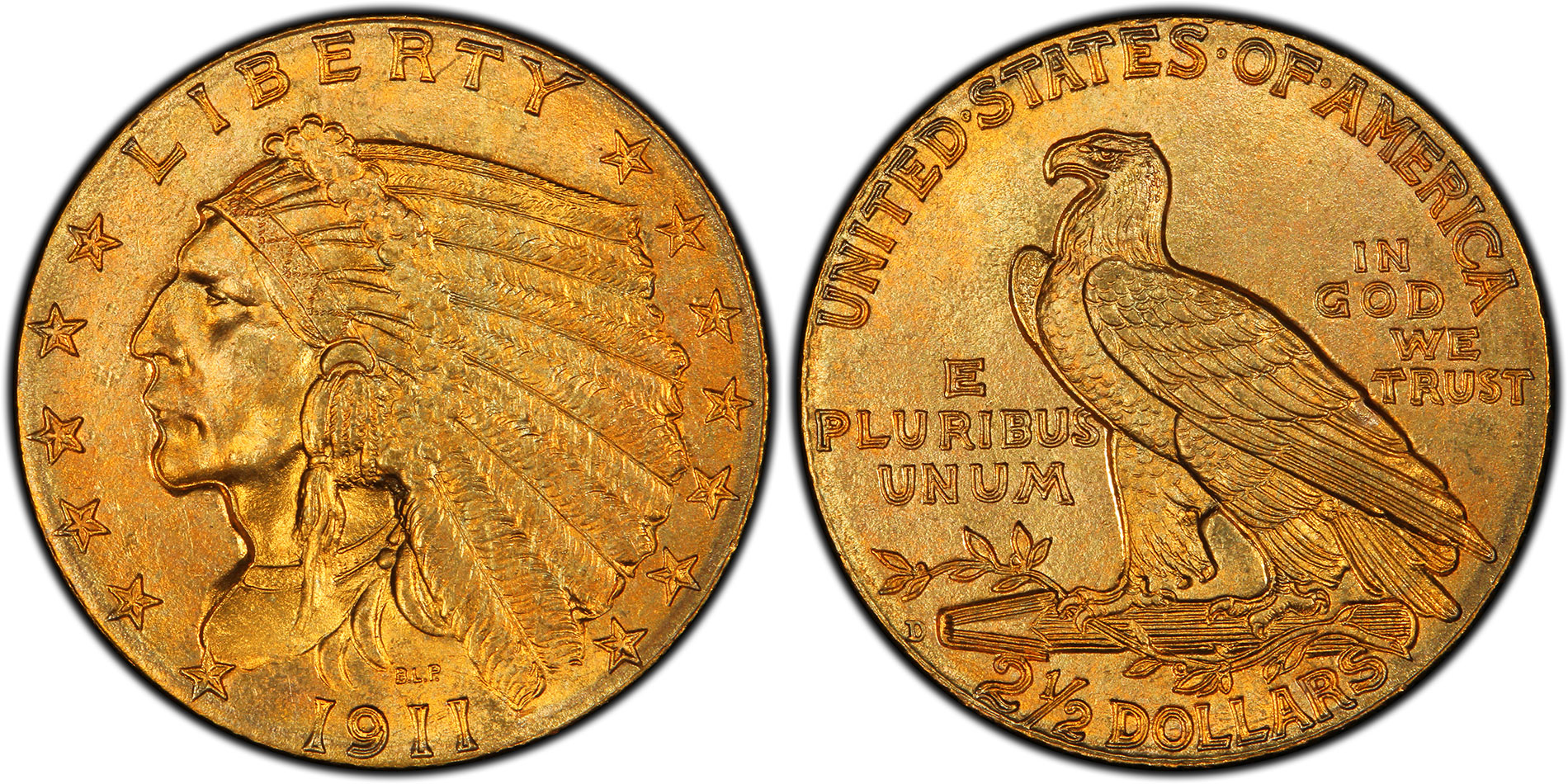
Indian $2.5, 1911-D $2.50 Strong D, PCGS MS66+. Click image to enlarge.
The coins debuted during the early years of the Renaissance of American Coinage, a period of time marked by the introduction of exquisite designs across all denominations of United States coins. The Renaissance can be traced back to 1905, when President Theodore Roosevelt expressed great dissatisfaction with the artistic state of the United States coins that were then in production.
He subsequently tasked renowned sculptor Augustus Saint-Gaudens to redesign America’s coinage from one-cent coin to double eagle. Unfortunately, Saint-Gaudens died shortly after he began working on this wide-ranging, multifaceted commission. Before his cancer-related death in 1907 at the age of 59, he was able to successfully redesign only the $20 Double Eagle and $10 Eagle; he also produced sketches for a revamped one-cent coin. While the Saint-Gaudens “penny” never materialized, his Indian $10 and Saint-Gaudens $20 coins did, becoming instant numismatic hits; to this day, his double eagle reigns as a coin widely considered the most beautiful ever produced by the United States Mint.
Questions soon swirled around who could offer the artistic capability to redesign other United States coins with the aesthetic gusto and expert skill of Saint-Gaudens. Pratt’s name was first pitched to President Roosevelt by mutual friend Dr. William Sturgis Bigelow, who also suggested that the designs for the $2.50 and $5 gold coins might be sunken, or incuse, to mitigate wear on the high points of the design. Precedence for incuse coins can be found throughout time and place, spanning back to the coinage of ancient Italy and Egypt. And as for the United States? The Indian Head Quarter Eagle and Half Eagle became the first incuse coinage produced in the nation for circulation. When these novel coins entered circulation in November 1908, they turned heads – sometime for the wrong reasons.
One of the earliest and most vocal critics of the new coins came from a Philadelphia coin dealer named Samuel Chapman. He was concerned that the engraved (versus bas-relief) designs could be easily counterfeited. He also felt the Native American chief appeared “emaciated.” And he was worried the incuse design would harbor dirt, germs, and other bacteria. The incuse design would “permit enough germs to accumulate to prove a health hazard,” stated Chapman. He went on to indict the incused Pratt coinage as “a great receptacle for dirt and conveyor of disease, and the coin[s] will be the most unhygienic ever issued.”
As history went on to prove, Chapman’s concerns about the coins transmitting disease were unfounded. But his sentiments live on with the narrative behind these coins, which circulated particularly well in the West and were popular as holiday gifts in the 1910s and 1920s. The coins remain numismatic favorites today, in part because they are among the most affordable of the classic pre-1933 United States gold coins.
Most business-strike examples of the Indian Head Quarter Eagle and Half Eagle are widely available. Meanwhile, matte proof examples are extremely rare. Also rare are a few of the key dates found within these two gold series. For the Indian Head Quarter Eagle, the 1911-D serves as the series key, while the Indian Head Half Eagle counts the 1909-O and 1929 as its rarest business-strike issues.
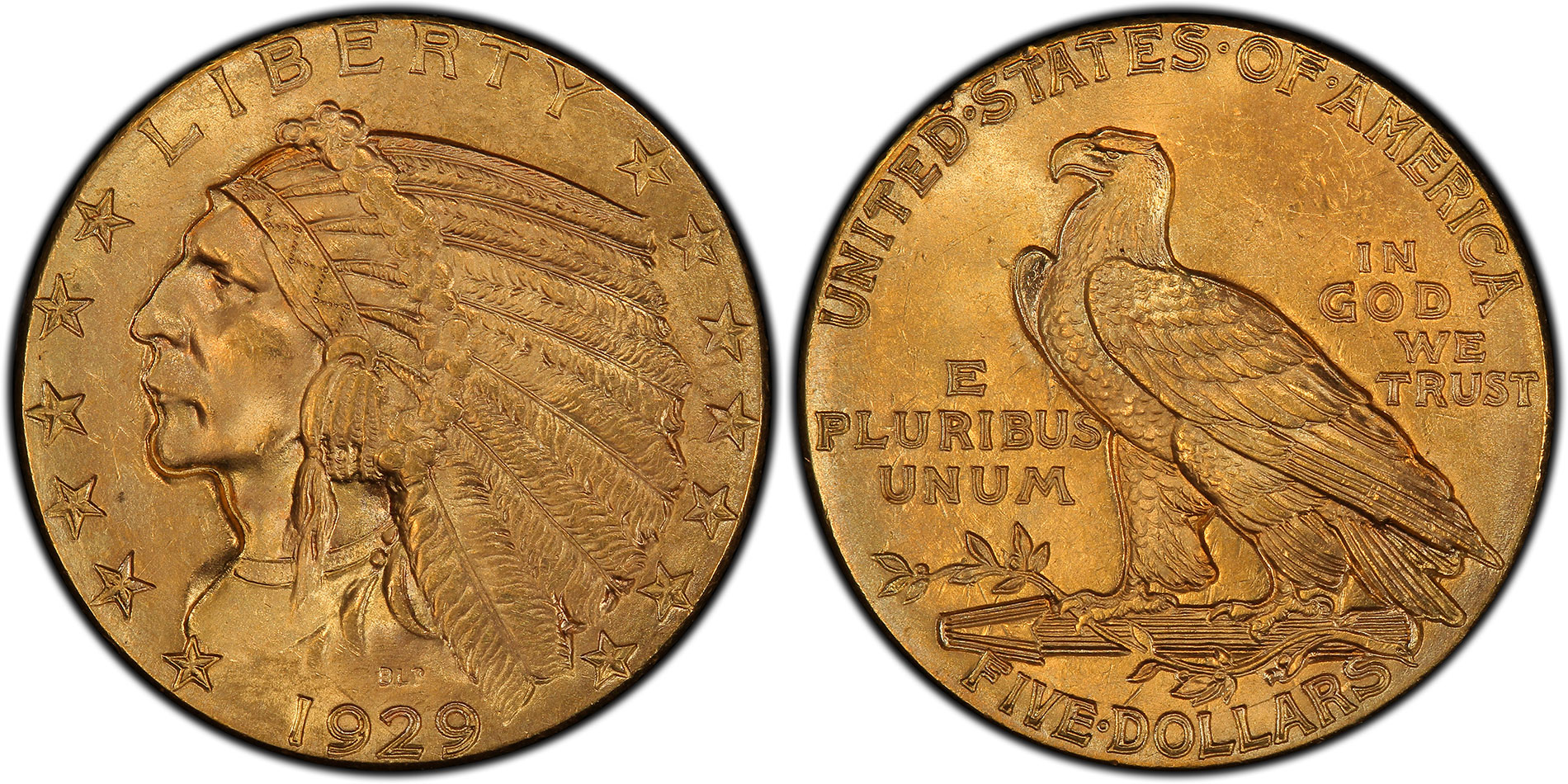
Indian $5, 1929 $5, PCGS MS65. Click image to enlarge.
Save for the values of the key dates and matte proofs, prices are remarkably uniform across within the Indian Head Quarter Eagles and Half Eagles series. Typical PCGS-graded MS63 examples of almost any business-strike Indian Head Quarter Eagles can be had for around $635 each, while similarly graded Indian Head Half Eagles usually retail for approximately $1,100; prices for either tend to fluctuate with the prevailing winds in the bullion market. Meanwhile, the rare 1911-D Indian Head Quarter Eagle takes over $12,500 in PCGS MS63, and in that same grade the 1909-O and 1929 realize $95,000 and $37,500, respectively. PCGS-graded PR65 matte proof Indian Head Quarter Eagles command $30,000 while their Half Eagle counterparts snag $50,000.
Many collectors long to obtain even just one circulated example, which can be bought for a relatively small amount over their bullion value. Still, other numismatists will spend decades assembling a complete series run, encompassing 15 business strikes for the Indian Head Quarter Eagle and 24 for the Indian Head Half Eagle. The most ambitious and financially well-heeled collectors often opt for the best examples of these and build PCGS Registry Sets based around the coins. Yet, no matter how narrow or broad one’s objectives for incorporating these gorgeous incused coins into their collection, one never need to worry about falling ill handling these coins. More than a century after their release, they have yet to be medically associated with causing even one case of the cold or flu!


 Copper & Nickel
 Silver Coins
 Gold Coins
 Commemoratives
 Others
 Bullion
 World
World
 Coin Market
 Auctions
 Coin Collecting
 PCGS News