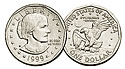
The totals are in for 1999 U.S. Mint production, including the all-important statistics regarding the 1999 Susan B. Anthony dollar coins.
According to Mint statistics, there were 29,592,000 circulation strikes produced at Philadelphia and an additional 11,776,000 at Denver for a total of 41,368,000 SBA coins.
These figures are important to collectors, since the coins represent one of the shortest sets of dates available in the entire United States series. With only four dates and a few Mint mark varieties to choose from, the series is similar in composition (not in rarity or collector values) to the short lived 20-cent coins of 1875 to 1878 and the $4 Stella gold coins of 1879 to 1880.
The final circulation strike mintages indicate the 1999-P coins are roughly as common as the 1980-P (mintage 27,610,00) and the 1980-S (mintage 20,422,000) dollars.
The mintage for the 1999-D SBA dollar is significantly lower, placing the availability of the coin above the 1981-P, 1981-D and 1981-S issues (each with a mintage of 2,908,145), but below the availability of all 1979 and 1980 business strike varieties.
In other words, the three 1981 Mint mark varieties are still the most difficult to obtain in Brilliant Uncirculated and circulated grades, based on mintage figures. This does not consider Proofs.
The SBA dollar, known among other unflattering names as "The Jimmy Carter Penny" was doomed from the start. The coin was too similar to the quarter dollar in color, composition and diameter. The quarter has a weight of 0.2 ounces Avoir. compared to 0.3 ounces for the dollar. The quarter has a diameter of 0.96 inches while the SBA dollar has a diameter of 1.04 inches.
Jimmy Carter, who was president when the disastrous coin was introduced, was unable to control domestic inflation. It was from this economic problem the nickname for the coin originated.
Public Law 95-447 dated Oct. 10, 1978 authorized the ill-fated SBA dollar, while ordering discontinuation of production of the larger diameter Eisenhower dollar as of Dec. 31, 1978.
Frank Gasparro, chief engraver of the U.S. Mint at the time, was responsible for the stern-looking portrait of Susan B. Anthony appearing on the obverse. It was the first time a portrait of an American woman rather than a symbolic woman had appeared on a circulating U.S. coin. Let’s hope the artist’s rendition of Sacagawea on the new 2000 dollar coin meets with more success. No image of Sacagawea is known to exist.
The eagle landing on the moon image on the reverse of the SBA dollar is the same as that on the previous Eisenhower dollar coins of 1971 to 1978, although reduced in size.
Most people don’t know that this is not actually the symbol of Apollo 11 as generally accepted, but the symbol of Tranquillity Base. Tranquillity Base is where on July 20, 1969, Neil Armstrong set foot as the first human ever to have walked on the moon. Gasparro was also responsible for this reverse design.
The SBA dollar was billed by the Treasury and Bureau of the Mint as "The dollar of the future" when it was introduced in 1979. It is interesting to review material published at that time by the Treasury.
According to one brochure, "The new one dollar coins save time and reduce errors at the cash register." Boy, did they take the wrong bus!
Another interesting comment was, "Bills often stick together and cannot be distinguished by size."
Then there is the statement, "Easy to find in pocket or change purse since it is sized between the quarter and half dollar and weighs 1/3 as much as four quarters."
But the clincher has to be, "Easy for children to use--Easy to hear when dropped."
Richard Giedroyc is a numismatic writer, researcher, auction cataloger and coin dealer. He has been in the hobby and business most of his life, now having more than three decades’ experience in this fascinating hobby field. During this time Giedroyc has been the owner of Paris Bergman Galleries, owner of Classical Coin Newsletter, international editor of Coin World and owner of Giedroyc-Anderson Interesting World Coins. He is currently a numismatic consultant. He has written more than 2,000 byline numismatic stories and contributed to several coin catalogs.


 Copper & Nickel
 Silver Coins
 Gold Coins
 Commemoratives
 Others
 Bullion
 World
 Coin Market
 Auctions
 Coin Collecting
 PCGS News