The Norweb Collection - An American Legacy
Michael Hodder and Q. David Bowers
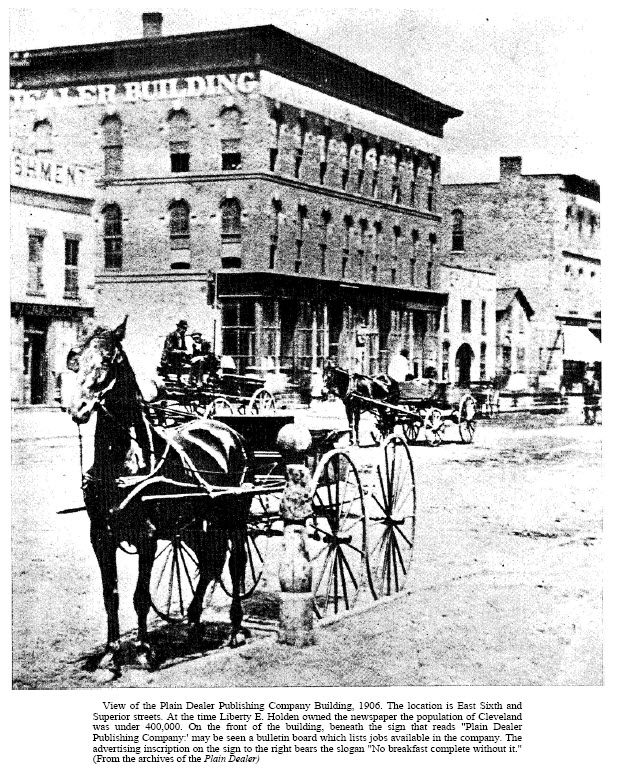
Early in that year Liberty hired one of the two men who would shape the paper most profoundly, and who would ultimately wrest control of its editorial policy away from his employer. Charles E. Kennedy, late of the Herald, a skilled reporter but without much business experience, was hired as the paper's general manager. Kennedy was never much Liberty's man, although in the early years he paid respect to the man who owned the paper and paid his salary. He tried to manage the business of the Plain Dealer as a professional would, and in the beginning did not concern himself much with its editorial content. In September 1893 Bone was suspended as editor-in-chief and relegated to the book review department, where he languished. Kennedy was appointed editor, but Libertyassumed joint editorial control with him.
Liberty may have proclaimed his paper's policy in its inaugural editorial as: "We shall at all times be watchful of the right of man, holding that man is superior to party and that all government should be for the good of the governed:' but his own feelings about the rights of man did not include acceptance of unionism, which, to him, smacked of anarchism. With true business vision, Liberty decided to streamline his prints hop by introducing the latest in technology, the Mergenthaler typesetting machine (patented 1884 and 1885), which cut down on manpower needs and increased productivity by mechanizing a previously hand-done operation. Workers in the prints hop promptly declared a strike, fearing for their jobs. Liberty reacted by firing all the striking workers immediately and serving notice that no union member of any kind would ever work for his newspapers again. The Plain Dealer remained an open shop through 1925.
From 1893 until 1898 Liberty Holden wrote many of the editorials appearing in the paper, and those he did not write he approved before they were published. These were the years of Liberty's maximum influence over the running of the Plain Dealer. Charles Kennedy fought with Liberty over many issues rightly the concern of the business manager, because Liberty had not yet learned that a newspaper was not the same thing as a silver mine. On October 2, 1893 Kennedy lowered the weekly subscription price of the paper from 20 to 10 cents, in an effort to increase circulation. Liberty stormed into Kennedy's office to denounce the change, and the two wrangled for some time. When, at last, Liberty had cooled down, he said, "I will admit that the Plain Dealer is not worth 20 cents a week, but I am not quite willing to see it go into bankruptcy. Why not reduce it to 15 cents?" Kennedy replied that a partial reduction would only start a price war. He argued that a big reduction would undercut the rival Leader, while a smaller one would allow the Leader to drop its own price in reply and still remain profitable to its owners. Once started on a downhill slide, each paper would have to respond to its rival's price reductions, and who could tell where it all would end? Liberty reluctantly agreed with the drop in price. An unlikely ally for Kennedy's cause was Liberty's son Dean, manager of the Hollenden Hotel, who supported Kennedy's independence in business decisions.
Kennedy and his friend Dean did not win all their arguments with the old man, however. In the spring of 1897, followingBryan's defeat the previous year, and with it Liberty's hopes of reviving something like the Sherman Silver Purchase Act (whichhad been repealed in 1893), Liberty decided that the nation was on the brink of financial collapse. Accordingly, he decided tostreamline his Cleveland business affairs and started by reducing the Hollenden Hotel's operating budget by 25%. Dean objected, but in vain. Liberty then confronted Kennedy with the same reduction, and when Kennedy objected, saying the cutback would imperil the paper's future, Liberty replied (in a rare, recorded quote), "But all sensible men are reducing expenses now. I tell you, Charlie Kennedy, we are in the midst of a panic and no man can foresee the end. They wanted a gold standard and now they are getting it." War with Spain the following year diverted attention away from economic problems and the great panic Liberty feared did not occur.
Kennedy had a few tricks for handling Liberty's interference with the paper, one of the subtlest being an appeal to Liberty's love of "all things New England" Kennedy had hired William R. Rose to write for the Sunday edition of the paper. Rose was a respected short story writer and a middling poet, who had gotten his start in journalism on Cleveland's Sunday Morning Voice, edited by Harry L. Vail. Rose's stories in the Sunday edition of the Plain Dealer were lighthearted, not to be taken seriously, just Sunday diversions for the readers. Liberty apparently missed the point, however, when he first saw Rose's work in print. He asked Kennedy, "You surely do not call these stories literature, do you?" to which Kennedy replied that they were liked in Cleveland and that the Boston papers were reprinting them. This was enough for Liberty, who thereafter left Rose alone. As Kennedy says in his Fifty Years of Cleveland, 1875-1925, Liberty was a sucker for anything with the New England label.
Liberty's nagging interference in the day to day running of the paper eventually got to Kennedy, and in 1898 he left to join the St. Louis Post Dispatch. Left on his own, Liberty soon realized that running a paper without professional help was not like running a mine, and he admitted that the Plain Dealer was better off under Kennedy than it could be under Holden. His son, Dean Holden, secretly traveled to St. Louis to meet Kennedy, bearing Liberty's terms for a new relationship, one that was also new to the newspaper publishing business. Liberty agreed to give full business and editorial control, under contract, to Charles Kennedy and Elbert H. Baker; they in turn agreed to pay a set, yearly sum to Liberty and the corporation that owned the paper's stock. This contractual relationship governed the running of the paper through 1907, when Kennedy retired. Professional management and a large measure of editorial independence for the paper was assured by the contract, and Liberty's investment in it was protected by the annual payment. The relationship was workable only as long as all parties to it respected each other's interests, and probably could not have worked as well as it did had different personalities been involved.