The Norweb Collection - An American Legacy
Michael Hodder and Q. David Bowers
The Holdens in the Revolutionary War
The next Holden to enter our story, Liberty's great-grandfather John, was a fourth generation Holden, whose great-grandfather was Richard Holden of Groton. Born in 1738, John was one of seven children. He grew up with stories of the early frontier days and the hardships faced by his forebears. By the middle of the 18thcentury, when John came of age, Richard and Justinian Holden's life stories had already become embroidered with some of the fanciful stories later recorded as facts by Abiel Holden.
To John, and more so to later generations of Holdens, Richard and Justinian became exemplars, models of perseverance whose emigration to the New World proclaimed their love of freedom and renunciation of the tyranny of the Old World. Growing up in the 1740s and 1750s, a time of outspoken debate over the English crown's authority to regulate colonial American commerce and politics, John took to heart the stories he heard from his father and older relatives. When the time came for the colonies to declare their independence from Great Britain, John had the examples of his forebears to influence how he should act.
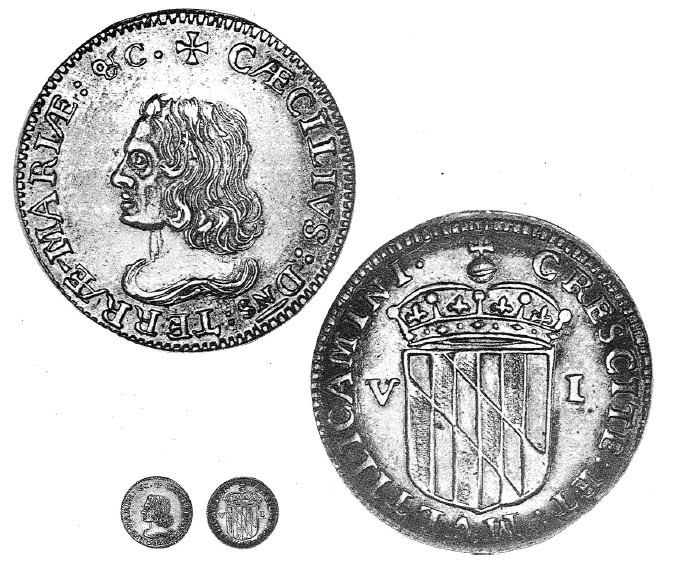
SILVER COINS were struck in England for the colony of Maryland circa 1658, under the auspices of Cecil Calvert. Denominations made included the four pence (or groat), sixpence, and shilling. Each one was denominated on the reverse by an inscription in Roman numerals. Shown on this page is an extremely rare variation of the sixpence, with the reverse inscription spelled MULTlLICAMINI instead of the correct MULTlPLICAMINI, intended to be part of the legend CRESCITE ET MULTlPLICAMINI, which translates to "increase and multiply." The obverse of each issue bears the portrait of Cecil Calvert, the Lord Proprietor of the colony.
In addition to the three silver denominations, copper pennies inscribed DENARIUM were made at a later date. Although all Maryland coinage is believed to have been struck in England, there may have been a mint in Maryland as well. This possibility has intrigued numismatists for generations, but no documentary evidence of a native mint has ever surfaced.
John was born and raised in Stoneham, Massachusetts, where he plied the trade of a tailor. He married at the age of 22, in 1760. His wife Mary lived to be more than 100 years old. She bore him two sons, John and Daniel, who followed their father's trade. Mary was Liberty's great-grandmother, and he knew her when he was a youngster, listening to the stories she told of her husband's service in the cause of American freedom. Little is known of John's life before history overtook it and cast him into its light.
John Holden must have been an American patriot before he came to history's notice, for when Paul Revere raised the alarm on April 19, 1775, telling the patriots of Lexington and surrounding towns that British grenadiers under Lieutenant Colonel Francis Smith were on their way to trample the infant cause, John Holden responded as a member of the company of minutemen commanded by Captain Samuel Sprague. As one of over 4,000 others in the fields and behind the hedges that day, he saw his first action against British regulars and gave a good account of himself. He remained in Captain Sprague's company of militia for the rest of April and into May, and rejoiced along with his commander on hearing the news of the fall of Fort Ticonderoga on May 10. He may have been in the lines before Boston while still a volunteer militiaman.
John officially enlisted in the Continental Army as a six month man on May 20, 1775, the same day Rhode Island, Connecticut, and New Hampshire voted to send troops to the siege of Boston. His regiment was the Twenty Sixth, commanded by Colonel Loammi Baldwin, encamped at Chelsea as part of the northern ring around Boston. Still in the lines when his term of enlistment expired on December 30, 1775, John extended his tour for another year, moving from Captain Sprague's company, which had earlier enlisted as a body, to one commanded by Captain Richard Dodge of the Twenty Sixth.
John marched with his regiment all the following year, revelling in the triumph before Boston and fleeing before the defeat on Long Island. Forced from Manhattan and later White Plains, John Holden retreated with the army through New Jersey to Pennsylvania. His service records are not complete, but it is almost certain that he saw action with General Washington at the surprise attack on Trenton, December 26, 1776, for John was one of those who heard Washington's call and agreed to "tarry six weeks" beyond their term of enlistment, due to expire on December 31.
His subsequent military career is recorded only as ranks and regiment numbers. John was commissioned a first lieutenant in Captain Josiah Green's company of the Second Middlesex Regiment in April 1779. He later served as first lieutenant in Captain William Green's company of the Fourth Middlesex Regiment. Between July and November 1780 he was part of the American army bottled up in Rhode Island by an English fleet that had caught the French Admiral le Comte de Rochambeau in Newport harbor and blockaded them there. On December 3, 1781, six years after he first enlisted as a private, First Lieutenant John Holden and his company were dismissed from the Continental Army in a ceremony at West Point. He drew no pension during his lifetime, and his widow Mary did not apply to the government for one until December 1837, fifty-six years after her husband's retirement from service. The Holdens were not ones to ask for assistance from anyone, even when it was due them.
Liberty Holden, who was to become the first numismatist in our chronicle, owed his unusual Christian name to his great grandfather John's love of the patriots' cause. John's fifth son was born on March 14, 1775. To honor his newborn and make public his politics, John decided to name the boy Liberty. His wife was opposed to the idea, not because of any misgivings about its suitability as a given name, but more realistically because she felt such an act of public defiance might cause the family trouble. Her husband acquiesced, reluctantly, and named the boy Peter. After his return from the army in 1781, however, John habitually called his son "Liberty Peter:' For his part, Peter named one of his son's Liberty, and the name entered the list of approved Holden names. Peter was our Liberty Holden's grandfather.
The pioneering spirit that first brought the Holdens to America in 1634 lived on in their descendants a century and a half later. Liberty Holden's grandfather left the family settlement in Massachusetts and with his wife Hannah journeyed on horseback into the Maine wilderness to the newly founded hamlet of Sweden. They lived under canvas for six weeks while Peter and his son built their first house. Peter was one of the signers to the petition for the legal separation of Sweden from Massachusetts presented to the General Court in 1819. Peter's son Liberty, our Liberty's father, was born in Sweden, Maine in 1808. By trade a farmer, timber merchant, and later a cooper, he never enjoyed the financial success that seems to have characterized most Holden undertakings. With his wife Sally, however, who was a descendant through her mother from John and Priscilla Alden, he was a firm believer in the encouragement of his children's education, and in this he showed true Holden character. After much traveling about the state in search of fresh timber stands for his business, he finally settled on a farm in Raymond, Maine, a small town on the north side of Sebago Lake equidistant from Portland and Lewiston. There, on June 20, 1833, Sally gave birth to the couple's first son, whom they named Liberty Emery Holden.