The Norweb Collection - An American Legacy
Michael Hodder and Q. David Bowers
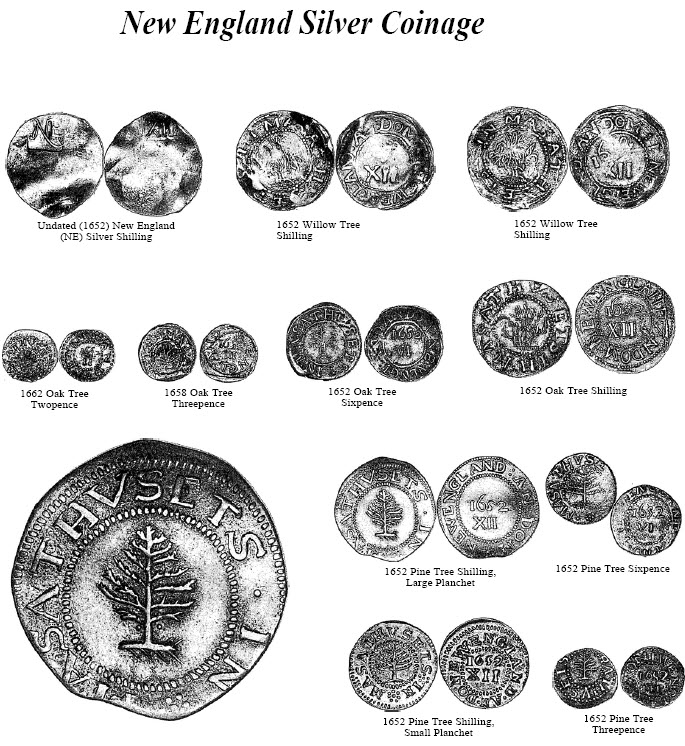
THE FIRST COINS struck in what is now the United States were the silver NE pieces of 1652. Produced in Massachusetts, the coins were made in response to a severe shortage of circulating currency. Following the simple NE coinage, which was made in the denominations of threepence, sixpence, and shilling, the so-called Willow Tree coinage appeared. Bearing the date 1652 (the date that was continued on all subsequent Massachusetts silver coins, with the exception of the 1662-dated Oak Tree twopence), the piece depicted on the obverse a tree made of swirling lines. All known Willow Tree examples are multiply struck, with incomplete or overlapping letters, the two pieces shown at the upper right of thispage being typical. Willow Tree coins were made in the denominations of threepence, sixpence, and shilling.
Then followed the Oak Tree coinage, actually made from 1660 to 1667, but, with the exception of the 1662-date twopence, all were dated 1652.
Denominations consisted of twopence, threepence, sixpence, and the shilling. The final coinage in this series was of the Pine Tree style, made in threepence, sixpence, and shilling denominations. These were produced circa 1667-1682. Shillings were made in two major styles, the large planchet format, produced from 1667 to 1674, and the small planchet format made from 1675 to 1682.
The Pine Tree pieces in particular have a permanent place in American folklore. It was said that a bride's dowry was sometimes given in her weight in Pine Tree coinage; Nathaniel Hawthorne penned a tale in this regard. A Pine Tree shilling, if bent twice, was said to be ideal for warding off witches, which were said to be prevalent in Sale. (Massachusetts) and surrounding communities during the time these pieces circulated.
The real religious motive for emigration to a harsh and unknown new world should not be discounted, however, as it impelled others to make the long and dangerous voyage to Massachusetts from the Suffolk port of Ipswich. Whether they came to seek their material fortunes or to foster their spiritual ones, or for both motives, by sailing on the Francis Richard and Justinian Holden caught one of history's spring tides, one which would carry them and their descendants toward success in the New World.
The Francis sailed in April 1634, arriving at Boston the following July. Her arrival was noted by Governor John Winthrop in his History of New England. She had sailed in convoy with some 15 other vessels from various British ports, all save one arriving safely with little loss of goods. One ship was an exception: the Elizabeth Dorcas struck a rock during her passage. Due to this accident, and her poor preparation for a long crossing, 60 souls were lost before reaching Boston. Justinian and Richard Holden, passengers on the Francis, are noted as first settling in Watertown after their arrival in the colony of Massachusetts Bay, and there they remained, living on Belmont Street, east of Grove Street, until about 1650, when they separated, each to stake his own fortune. Justinian, the less venturesome of the brothers, stayed near Watertown at first, eventually buying a large farm along Fresh Pond in Cambridge.
Richard was more daring than his brother Justinian, more willing to leave the relative safety of Watertown and brave the dangers of the further Massachusetts frontier, and together with his wife, Martha Fosdick of Charlestown, was among the original settlers of the town of Groton in the summer of 1661. Apparently named after the Suffolk manor held by the Winthrops, the new settlement prospered. Richard's fortunes prospered also, and on his death in 1696 he owned 149 acres of land in different parts of the township, including a 15-acre "house lot" on which stood his second house, large enough to be used as the town's militia garrison in 1711 and later to serve as an inn.
As a landowner Richard trained with the local militia commanded by Captain James Parker of Groton, but at age 55, with his captain's approval, he petitioned for release from service. The petition's wording, with its archaic spelling, has been preserved:
To the Hon'red
The County Cort in Cambridge
Octob 3 1665.
"The Humble request of Richard Holden of Groton Whereas the Providence of the alwise God hath ordered that sickness and weaknesse in body hath followed mee & increased upon mee this twenty yeare, & now a lingering consumption is more than formerly prevailing upon mee, disenabling mee from service, especially to beare armes, & being never like to be capable of doo any good in a military way, my weaknesse and distemper being come to such a height, & God knows how it is likely to bee with mee, but it is little likely that the body shld rise agen which hath been soe long failing; I wld yrfore entreat that yor worshipps would consider mee, and release mee fro training: Loth I have been, to trouble your worshipps this 7 years, though I had case enough, but now I am forced to ly at your feet & wait your pleasure, but not to trouble your worshipps any further; confiding in your benignitye
I commend my selfe
to your worshipps & Rest
Groton Sept ult, Richard Holden
1665
I doe conceive what is above expressed by Richard Holden is reall.
witness my hand
James Parker