The Norweb Collection - An American Legacy
Michael Hodder and Q. David Bowers
Kennedy had a few tricks for handling Liberty's interference with the paper, one of the subtlest being an appeal to Liberty's love of "all things New England:' Kennedy had hired William R. Rose to write for the Sunday edition of the paper. Rose was a respected short story writer and a middling poet, who had gotten his start in journalism on Cleveland's Sunday Morning Voice, edited by Harry L. Vail. Rose's stories in the Sunday edition of the Plain Dealer were lighthearted, not to be taken seriously, just Sunday diversions for the readers. Liberty apparently missed the point, however, when he first saw Rose's work in print. He asked Kennedy, "You surely do not call these stories literature, do you?" to which Kennedy replied that they were liked in Cleveland and that the Boston papers were reprinting them. This was enough for Liberty, who thereafter left Rose alone. As Kennedy says in his Fifty Years of Cleveland, 1875-1925, Liberty was a sucker for anything with the New England label.
Liberty's nagging interference in the day to day running of the paper eventually got to Kennedy, and in 1898 he left to join the St. Louis Post Dispatch. Left on his own, Liberty soon realized that running a paper without professional help was not like running a mine, and he admitted that the Plain Dealer was better off under Kennedy than it could be under Holden. His son, Dean Holden, secretly traveled to St. Louis to meet Kennedy, bearing Liberty's terms for a new relationship, one that was also new to the newspaper publishing business. Liberty agreed to give full business and editorial control, under contract, to Charles Kennedy and Elbert H. Baker; they in turn agreed to pay a set, yearly sum to Liberty and the corporation that owned the paper's stock. This contractual relationship governed the running of the paper through 1907, when Kennedy retired. Professional management and a large measure of editorial independence for the paper was assured by the contract, and Liberty's investment in it was protected by the annual payment. The relationship was workable only as long as all parties to it respected each other's interests, and probably could not have worked as well as it did had different personalities been involved.
Liberty could not entirely relinquish the reins, however, and the new relationship was tested almost at once. In the 1899 mayoral election the Democrats chose as their candidate John Farley, a tough politician who had already served one term as Cleveland's mayor, 1883-1884. The Plain Dealer, although a Democratic newspaper, took no editorial position during the campaigning, in retaliation for Farley's denial of access to the paper's reporters during his first term. Incensed at the lack of support from the city's largest Democratic paper, Farley, who had supported Liberty's candidacy as delegate to the Democratic Convention in 1896, visited Holden in his offices in the Hollenden Hotel and demanded the owner's intervention. Liberty sent a message to the paper's night editor, demanding support in the next morning's editorial. Kennedy and Baker then visited Holden in his room, at midnight, and after hearing Holden rail at them for failing their paper's party, not to mention the owner's, they settled down to a more cordial discussion. After listening to Liberty tell them stories of his days in Utah, they left with Liberty's admission that his order of support had been out of line and that they were free to do as they pleased. The next edition of the paper still took no stand in the election, and Farley recognized that his pressuring tactic had failed. Hat in hand, he came to Kennedy's office the next day, and after extracting a promise of favorable treatment for his reporters in future, Kennedy wrote the first editorial supporting the Democratic candidate. Farley won election to a second term.
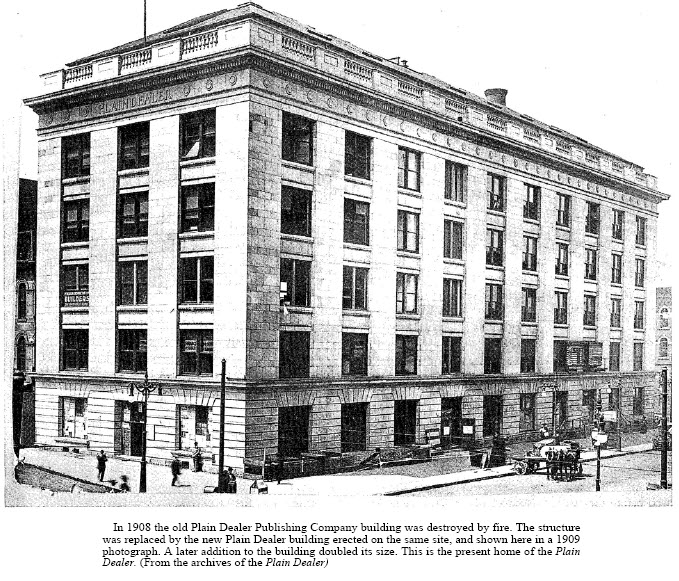
After 1902 Liberty had little to do with his newspaper. He had divested himself of most of his business ventures by that time, relinquishing control of his Utah mines to his son Albert and the Hollenden Hotel to his younger son Liberty Dean. Had Dean not died in 1906, the Plain Dealer would have been his. Instead, Albert purchased ownership of the paper's stock for $500,000. Albert Holden and Charles Kennedy did not get along well and in 1907 Kennedy left the paper and retired. One of his last editorials supported the three-cent street railroad fare in Cleveland proposed by Mayor Tom Johnson, whom Albert likened to William Jennings Bryan, calling them both "representatives of a dangerous element," Five years later, in 1912, Congressman Bulkely, a relative of Albert Holden by marriage, proposed reviving the old three-cent coin denomination, to make paying the streetcar fare easier. The Numismatist of February 1912 noted the congressman's proposal without supporting it, going on to say that earlier the Cleveland Ladies Club had called for the resurrection of the half cent.
Liberty Holden and Numismatics
To what degree Liberty was involved with collecting coins is not exactly known. As a New Englander, proud of his family's heritage, we can be sure he had some of the qualities that predispose towards collecting-an interest in his country's history and a deep personal involvement in it. We know he owned a collection of paintings and other art work, so we can also be sure he had been bitten by the collecting bug.
References to his involvement with coins, as a hobby, are few, but because of that they are that much more tantalizing. As the owner of one of Utah's most productive silver mines, he had more than a passing interest in the market price of silver. From this we can go further and assume that he had some interest in the government's plans for the silver coinage. Liberty's fortune was made when the Bland-Allison Act was passed in 1878, and while there are no records of his involvement to point to, it was in his interest to see that the legislation was successfully steered through Congress. Similarly, the passage of the Sherman Silver Purchase Act, in 1890, rescued many failing silver mines, and again we can assume Liberty had some interest in seeing that the Act was passed. Liberty knew Senator Sherman personally, and it will be remembered that the Senator invited him to Washington in 1881, to work with him on an anti-polygamy bill. It is unlikely that Liberty was unaware of the silver purchase legislation; it is more likely, although it cannot be stated as a fact, that he had a hand in promoting its passage.