The Norweb Collection - An American Legacy
Michael Hodder and Q. David Bowers
Bert's most intense collecting period was from September 1908 through October 1910. During these two years he bought from most of the "old dealers" he referred to in his ANA application.
His favorites were Thomas Elder, Henry Chapman, Ben Green, William Hesslein, David Proskey, and Scott Stamp & Coin. Most of his purchases from Proskey were colonial coins.
Pedigrees on many important coins in his collection show him to have been a bidder in some of the famous auction sales of his day. These included the Major Richard Lambert, Peter Mougey, Andrew Zabriskie, H. Jewett, Matthew Stickney, and James Wilson sales. The reconstructed inventory of Bert's collection, found in an accompanying exhibit, shows most of his purchases from these auctions, and we shall not go into further detail here.
One interesting fact that emerges from examining the inventory concerns Bert's collecting methodology. At times, and with certain denominations, Bert acquired entire date runs in one transaction. In this, he resembles his contemporary Virgil Brand. For example, Be recquired Proof cents dated 1857, 1860, and intermittently from 1866 through 1889, 13 specimens in all, from Elder's sale of the James Wilson Collection.
From the same auction, Bert purchased Proof silver three-cent pieces dated 1860, 1863, 1866 to 1868, 1870, and 1871, seven specimens; according to inventory records he paid nine cents each for them. Among nickel three-cent pieces, he acquired Proof examples of 1866 to 1868, 1870, 1871, 1877 to 1880, 1885, 1886, and 1887 to 1889 from the Wilson Sale. His cost for dates after 1879 was three cents each; earlier dates cost nine cents each. The overdate, 1887/6, he bought from Ben Green in November 1909, for $1.25.
Similar collecting methods can be seen in the quarter and half dollar denominations.
Bert was very demanding when buying colonials, half cents, and large cents, three areas he particularly appreciated. Highlights of each of these can be found in the inventory reconstruction to follow, but some general observations should be made here.
The inventory clearly shows that Bert collected by die varieties. This is especially apparent in the colonial coins, half cents, and large cents sections of his collection.
Bert's collection of state coppers, coins issued from 1785 to 1788 by Massachusetts, New Jersey, Connecticut, and Vermont, was small. This can be explained by the suddenness with which death took him, and not by any disinterest. Mrs. Norweb recorded in her first inventory book that a collection of 155 different Connecticut coppers, many from Dr. Hall's collection, was found in Bert's house after his death. She noted that the collection had been sent to him on approval, and that he had become too ill to work on it after they arrived in Cleveland. The trustees of his estate found them after his death and bought them sight unseen.
Bert Holden also collected by mintmark, which was rather advanced for his time. Augustus Heaton's Treatise on theCoinage of the United States Branch Mints had been published in 1893, but collecting copper, silver, and gold coins by mintmarks was still in its infancy. Bert, however, made a deliberate attempt at securing branch mint coins, as the inventory listing shows.
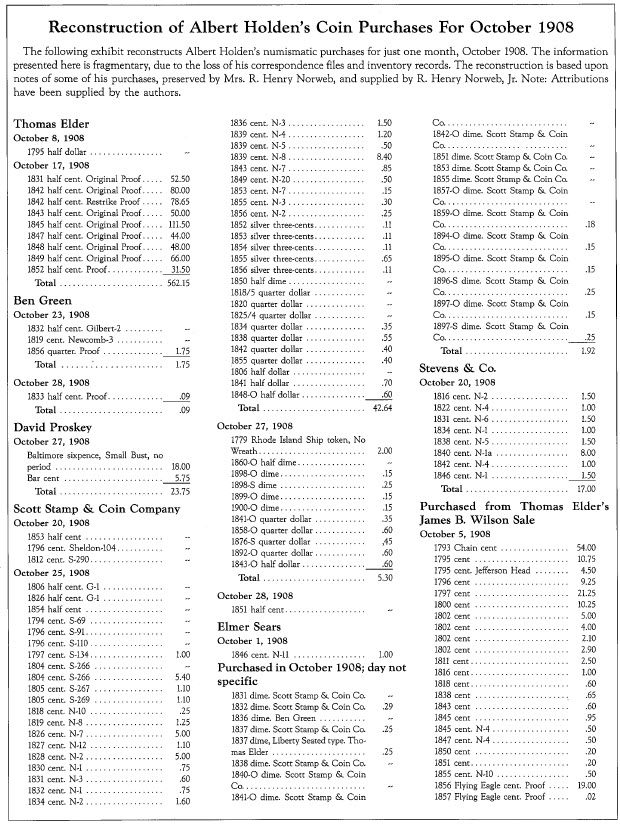
The pace of his collecting activity can be illustrated by breaking out of the reconstructed inventory purchases made over differing time periods. We have chosen the month of October 1908, to illustrate the enthusiasm he felt for coin collecting.
An accompanying exhibit lists Bert's purchases made in that month, broken down by vendor. The listing is impressive, even if it must be incomplete due to the gaps in the overall record for this period. The total spent, $2,136.64, in 1908 represented more than most mens' annual salary or the cost of a typical modest residence. Individual prices paid make interesting reading today.
We cannot tell from the records that survive if certain purchases were made from auction sales or via private treaty sale. Presumably, coins Bert bought from Scott Stamp & Coin may have been private transactions. Whether the coins were sent to him on approval, or filled gaps in a want list he gave to Scott, or were specifically ordered is also unknown now. The listings are, however, impressive.
From Thomas Elder's sale of the James Wilson Collection (October 1908) alone, Bert acquired a set of the 1873 trade dollar patterns;1836, 1838, and 1839 Gobrecht silver dollars; a 1793 Chain cent; the 1838-O half dollar; and a 1794 silver dollar. As the records show $1,480.69 spent with Elder, Bert Holden must have been one of the biggest buyers in the Wilson Sale.
Thomas Eider's invoice of October 17, 1908 (probably his 20th Sale), would make any collector of half cents sit up and take notice. The nine original and restrike Proof half cents he sold Bert are rare, and represented prizes for Bert's collection. Elder must have been pleased as well, since his prices were not bargains. All his October 1908 purchases together would make an important collection today.
A close reading of the annotations in Bert's handwriting found in the auction catalogues that survive from his library shows that grading was a concern then, as now. In the catalogue of Lyman Low's sale of September 1908, Bert used the standard adjectival grades in his comments (probably relayed to him from an agent who inspected the lots for him): Fine, Very Fine, Uncirculated, etc. By September 1910, two years later, Bert was using numerical grades. The "scientific" precision implicit in numerical grades probably appealed to the engineer in Bert.