
PCGS PR67+RB
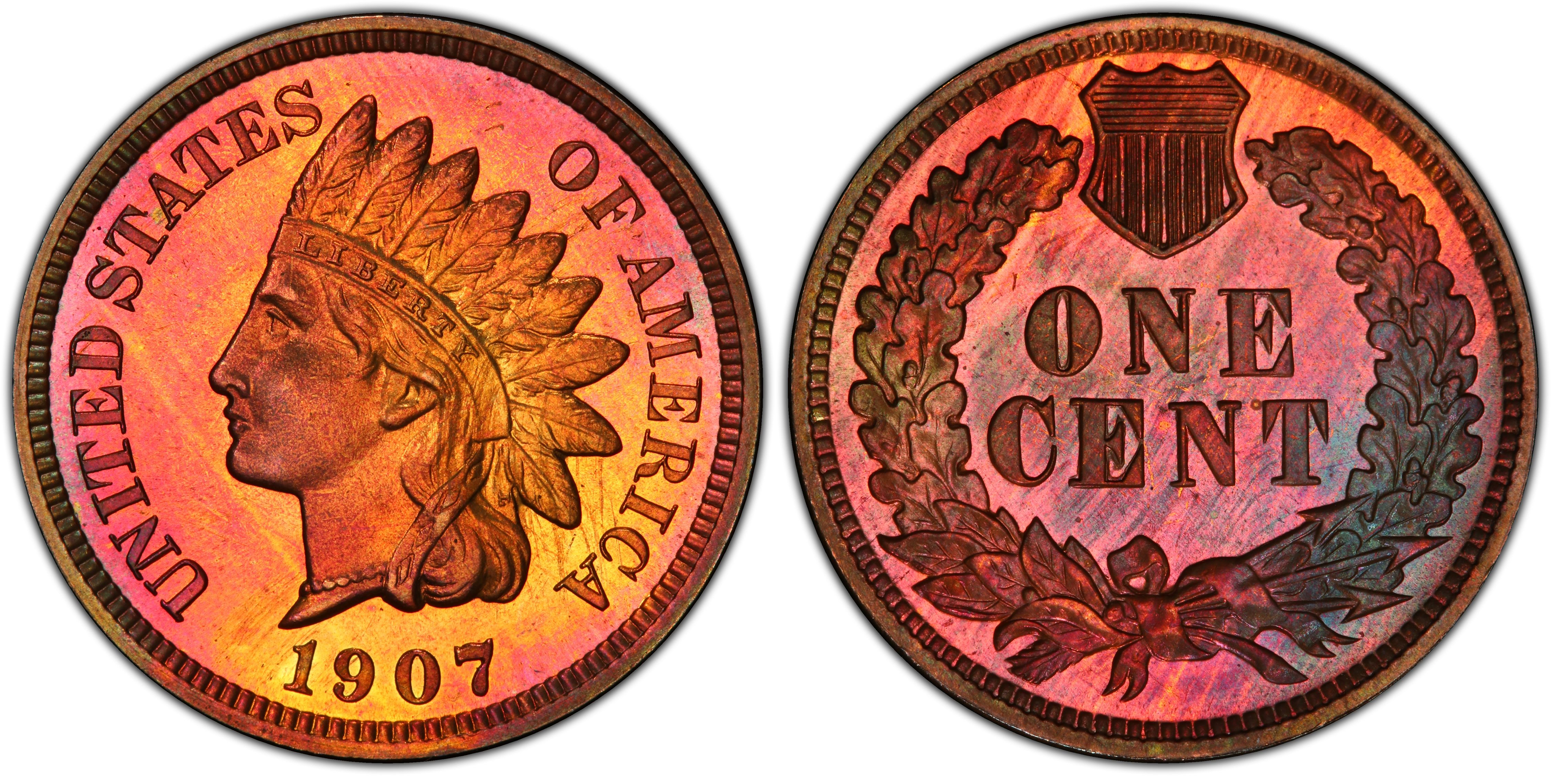
PCGS PR67+RB
- PCGS #:
- 2409
- Designer:
- James Barton Longacre
- Edge:
- Plain
- Diameter:
- 19.00 millimeters
- Weight:
- 3.11 grams
- Mintage:
- 1,475
- Mint:
- Philadelphia
- Metal:
- 95% Copper, 5% Tin and Zinc
- Auction Record:
- $10,800 • PR67+RB • 11-22-2020 • Heritage Auctions
Condition Census What Is This?
|
#1 PCGS PR67+RB
"Important Selections from the Bob R. Simpson Collection, Part II," Heritage Auctions, November 22, 2020, Lot 3008 - $10,800. |
 #1 PCGS PR67+RB
Magenta, green, and gold toning on the obverse. Honey gold color dominates the reverse. Small depression on Liberty's cheek. |
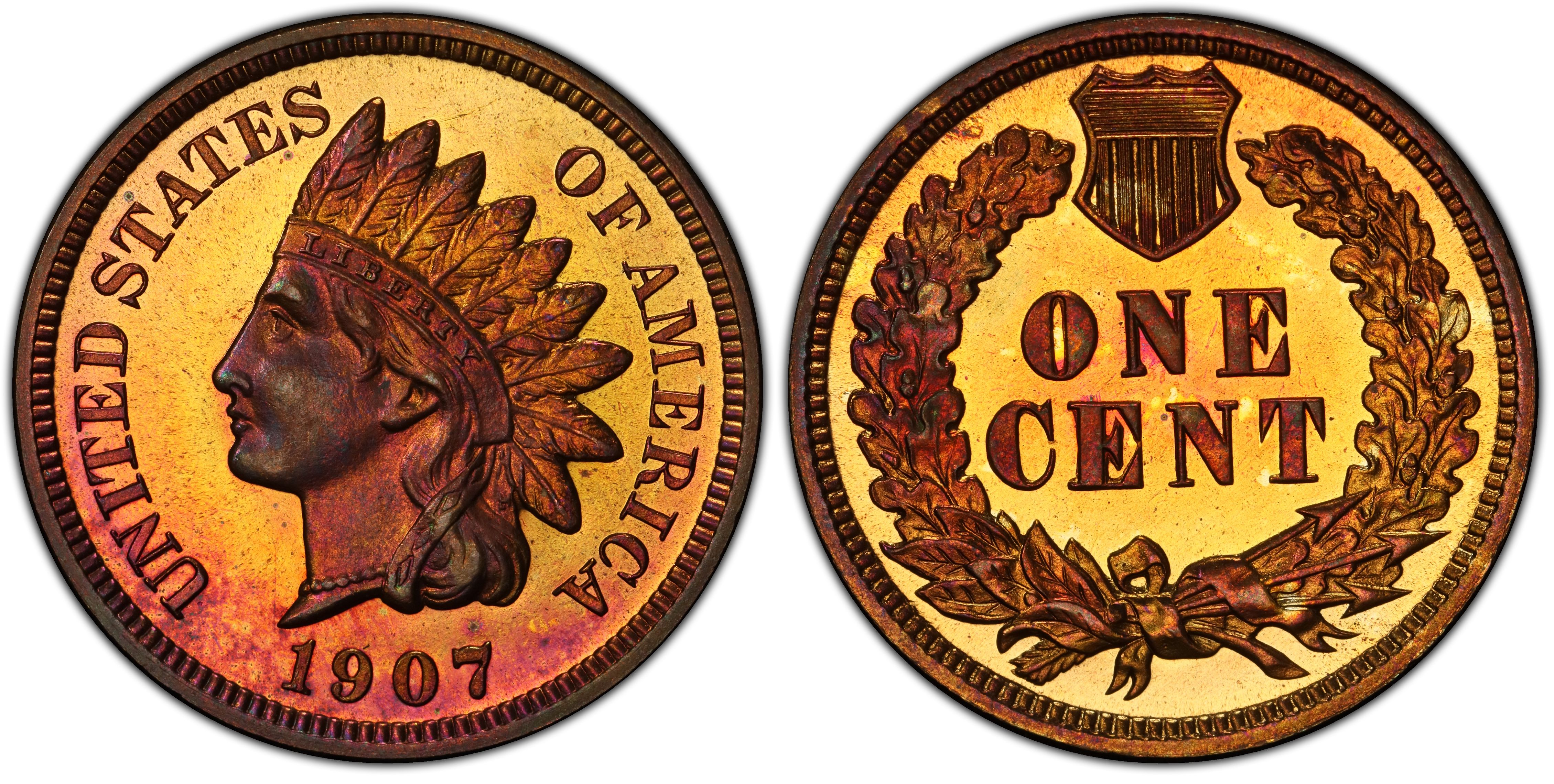 #3 PCGS PR67RB
As PCGS PR67RB #50036154. Heritage Auctions, July 26, 2003, Lot 5541 - $3,680. As PCGS PR67RB #06665958. "Important Selections from the Bob R. Simpson Collection, Part XI," Heritage Auctions, January 14, 2024, Lot 3152 - $7,320. Honey-gold centers with red-blue toning along the lower periphery and across Liberty’s portrait. Patch of pale toning on the shield. |
|
#3 PCGS PR67RB
Legend Rare Coin Auctions, December 14, 2017, Lot 129 - $3,407.50. Variegated toning blending orange, green, and magenta patination. |
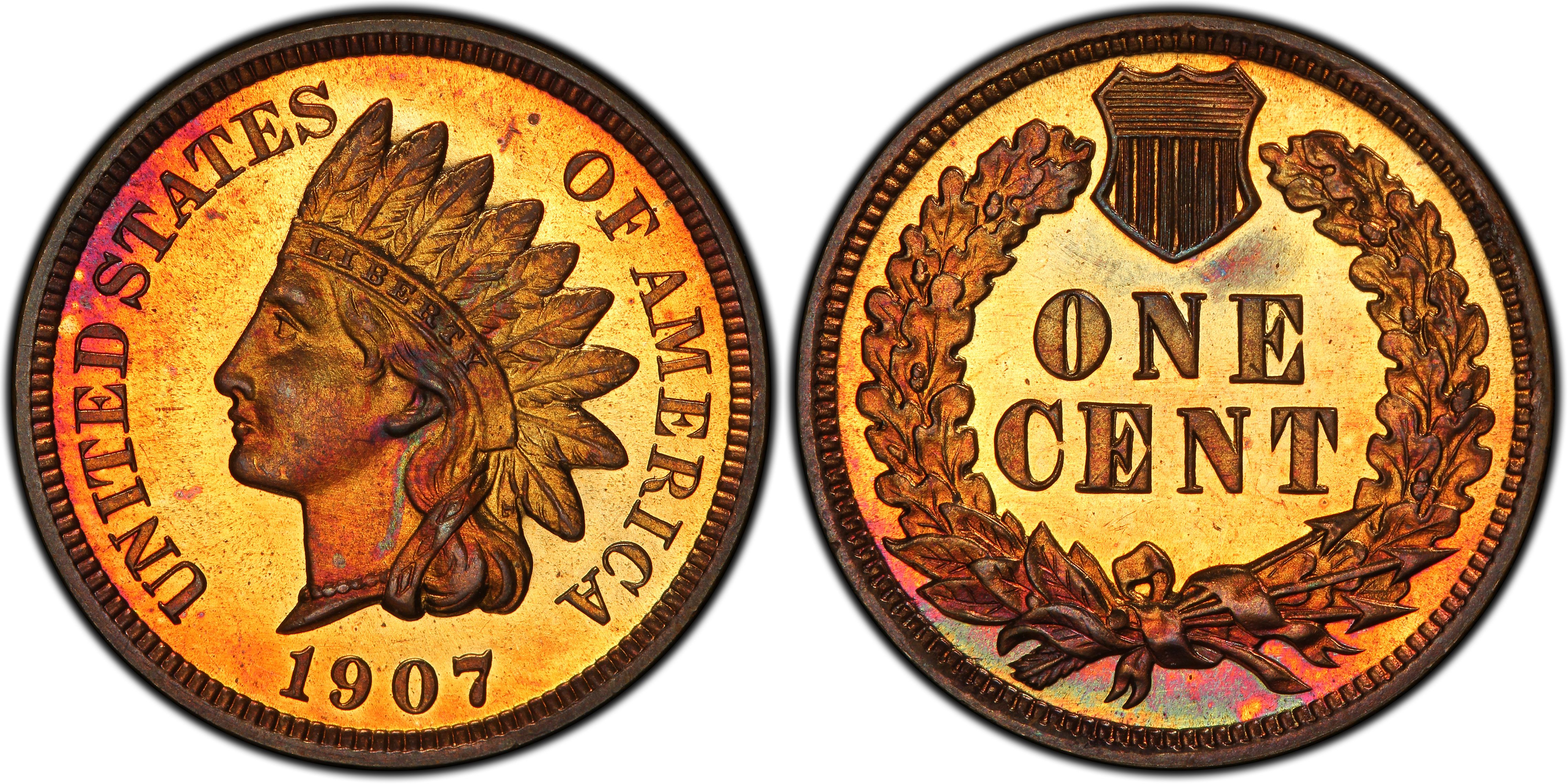 #3 PCGS PR67RB
"The BigMoose Collection" (PCGS Set Registry). Honey-gold centers. Magenta toning at the rim above "TED STATES." On the reverse, magenta, blue, and green toning along the lower periphery |
 #3 PCGS PR67RB
|
 #3 PCGS PR67RB
|
| #3 PCGS PR67RB |
The 1907 Indian Cent Proof
Proof coinage saw a slight dip in 1907, perhaps due to the summer recession that culminated in the collapse of the Knickerbocker Trust Company on October 22. For many denominations, the 1907 Proof issues followed the same visual aesthetic as those that preceded them. However, change was afoot as the Mint struggled to adapt Augustus Saint-Gaudens’ Eagle and Double Eagle gold designs for circulation.
While 1907 marked the end of the Liberty Head Quarter Eagle, the Half Eagle would see one final short production run in early 1908. Later that year, the Egyptian relief $2.50 and $5 gold coins designed by Bela Lyon-Pratt entered production. With the introduction of these new designs came a permanent shift in the fabric of American Proof coinage; instead of the brilliant finishes of the past, the new issues were primarily struck with a matte, satin, or sandblast appearance. Collectors at the time weren't keen on the change, but over time, numismatists grew to appreciate the unique character of these pieces. In this regard, the Proof releases of 1906–1908 represent the true end of an era in American coinage.
Collecting the 1907 Indian Cent Proof
The bronze composition of the 1907 Indian Cent Proof (#2410) is highly reactive; depending on how a coin was stored, its surfaces may remain vibrant, mellow, or develop a colorful patination. Typically, these coins lose their original "Mint Red" luster over time, toning to olive or brown. Due to the nature of the Proof finish, it is not unusual to see examples take on a vivid array of colors, including chocolate, blue, green, and magenta.
The 1907 Indian Cent Proof mintage of 1,475 represents the total number of Minor Proof and Silver Proof Sets offered that year. These sets also included the 1907 Liberty Nickel Proof (#3905). In the mid-1960s, hundreds of these sets were likely broken up as speculators sought to corner the market for the Proof nickel. Currently, the PCGS Census accounts for approximately 30% of the original mintage. While "Red" (RD) examples are scarce—and spot-free, evenly red examples are outright rare—collectors have no shortage of options when it comes to attractively toned examples in the "Red-Brown" (RB) and "Brown" (BN) categories.
* * *