1955 1C Doubled Die Obverse, RB (Regular Strike)
Series: Lincoln Cents 1909-1958

PCGS MS65RB
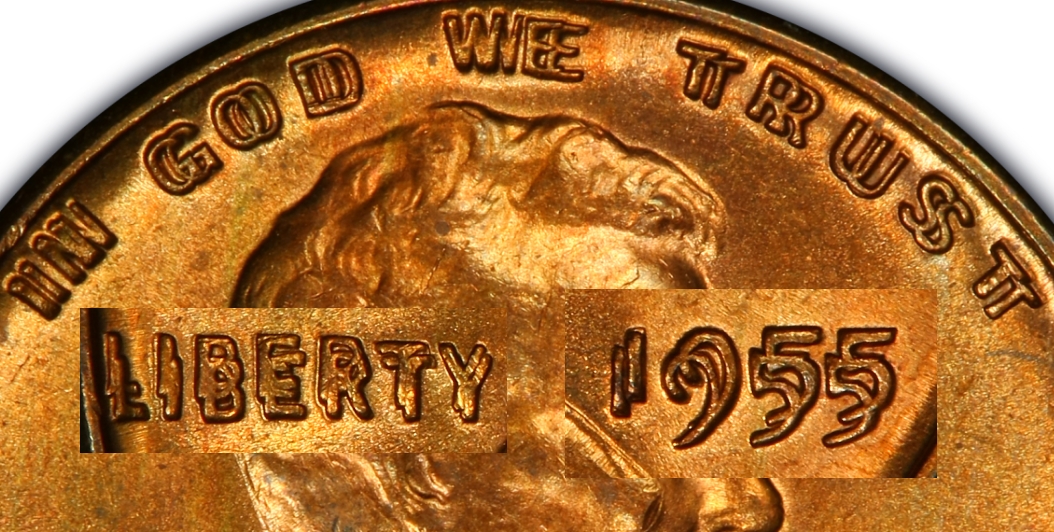
OBVIOUS DOUBLING
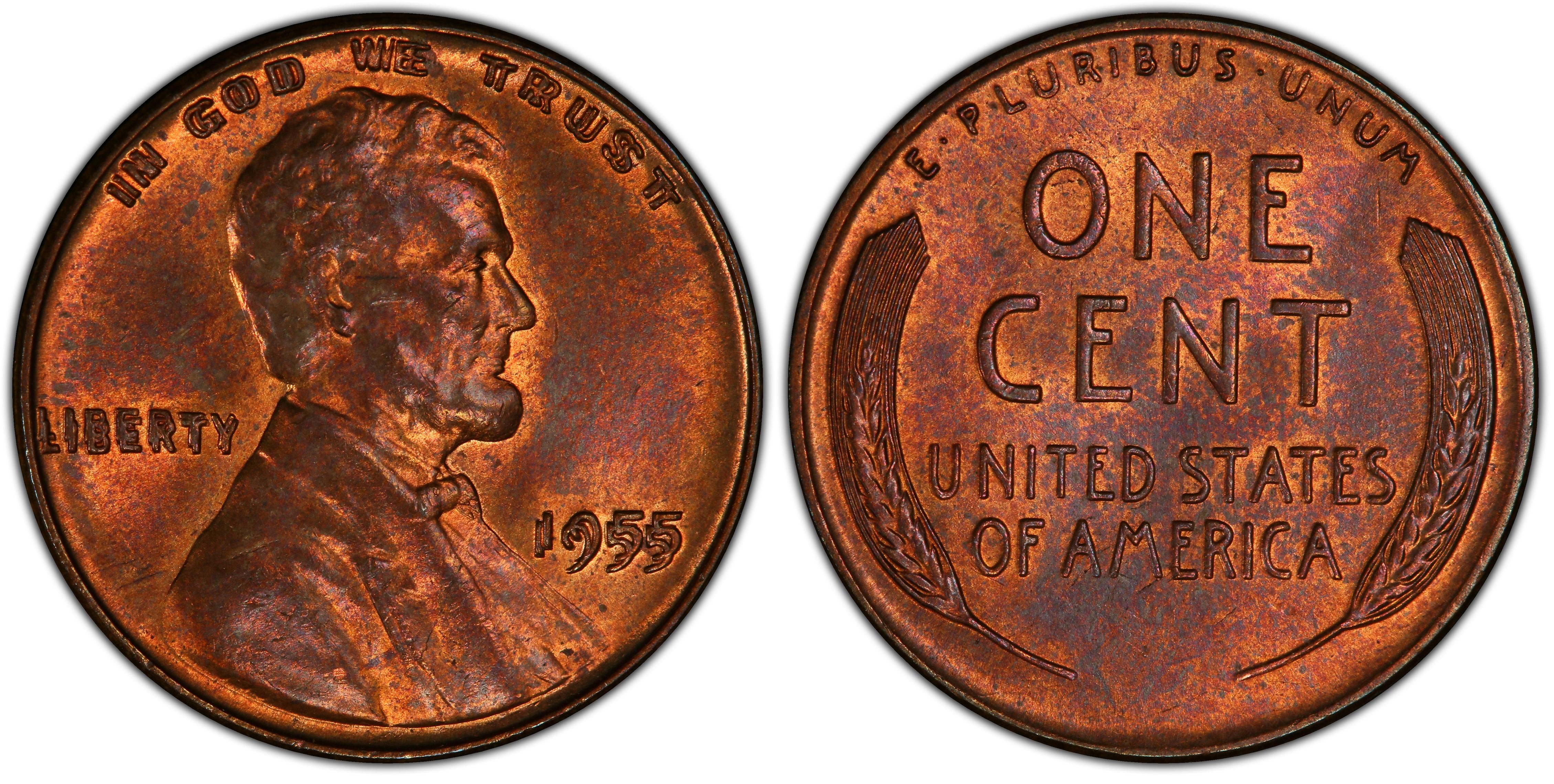
PCGS MS65RB
- PCGS #:
- 2826
- Designer:
- Victor David Brenner
- Edge:
- Plain
- Diameter:
- 19.00 millimeters
- Weight:
- 3.11 grams
- Mintage:
- 33,058,000
- Mint:
- Philadelphia
- Metal:
- 95% Copper, 5% Tin and Zinc
- Auction Record:
- $32,400 • MS65RB • 03-25-2020 • Stack's Bowers
Major Varieties
- 1955 1C, BN
- 1955 1C, RB
- 1955 1C, RD
- 1955 1C Doubled Die Obverse, BN
- 1955 1C Doubled Die Obverse, RB
- 1955 1C Doubled Die Obverse, RD
Rarity and Survival Estimates Learn More
| Survival Estimate | |
|---|---|
| All Grades | 2,250 |
| 60 or Better | 2,250 |
| 65 or Better | 75 |
| Numismatic Rarity | |
|---|---|
| All Grades | R-4.5 |
| 60 or Better | R-4.5 |
| 65 or Better | R-8.2 |
| Relative Rarity By Type All Specs in this Type | |
|---|---|
| All Grades | 43 / 143 TIE |
| 60 or Better | 43 / 143 TIE |
| 65 or Better | 9 / 143 TIE |
| Relative Rarity By Series All Specs in this Series | |
|---|---|
| All Grades | 44 / 146 TIE |
| 60 or Better | 44 / 146 TIE |
| 65 or Better | 9 / 146 TIE |
Condition Census What Is This?
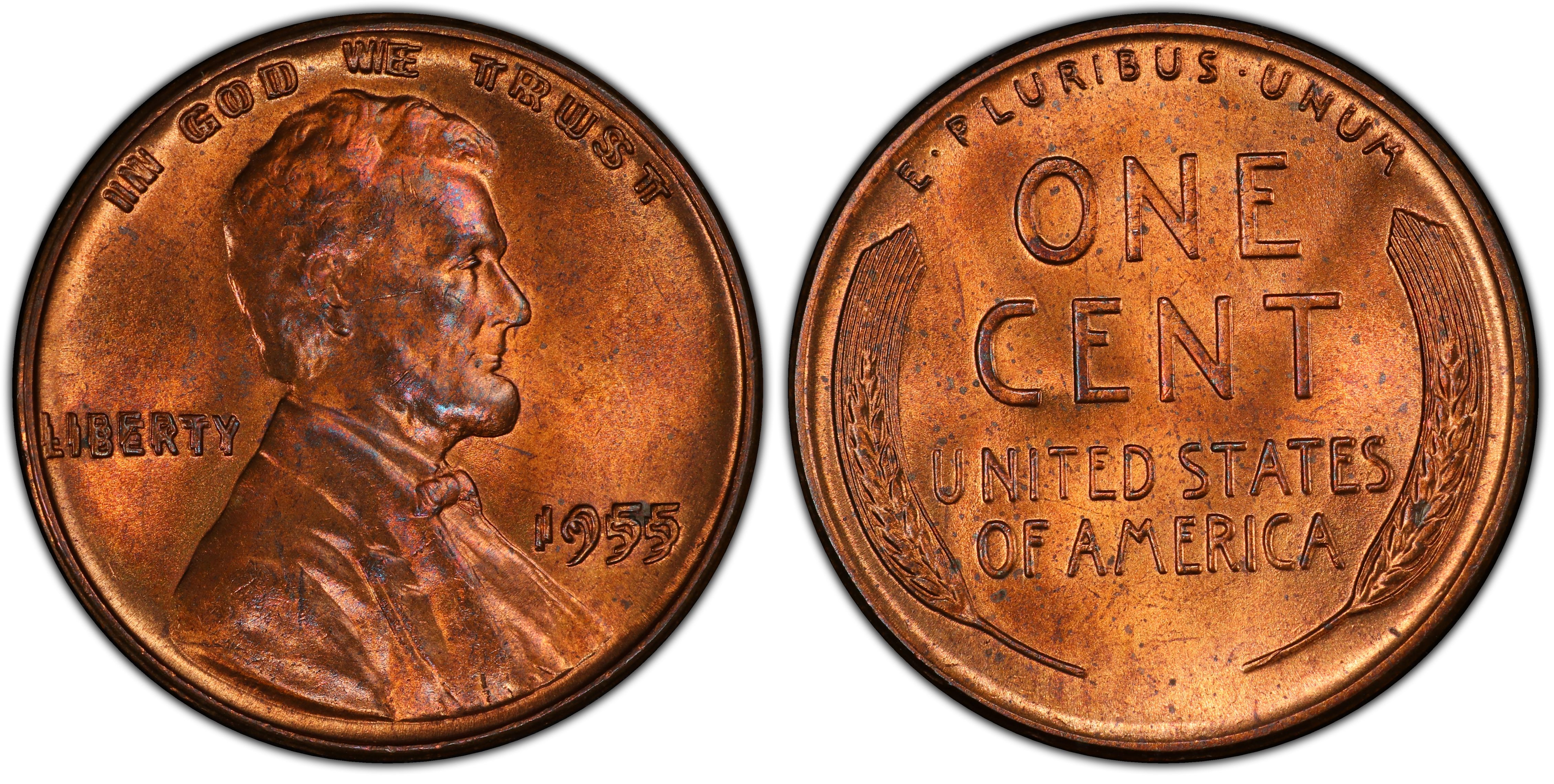 #1 PCGS MS65RB
GreatCollections, August 6, 2023, Lot 1404672 - $14,878.13. |
 #1 PCGS MS65RB
GreatCollections, August 23, 2020, Lot 874104 - $10,012.50; GreatCollections, April 2, 2023, Lot 1334019 - $12,999.38. |
|
#1 PCGS MS65RB
Stack's Bowers, November 18, 2020, Lot 9084 - $16,800. |
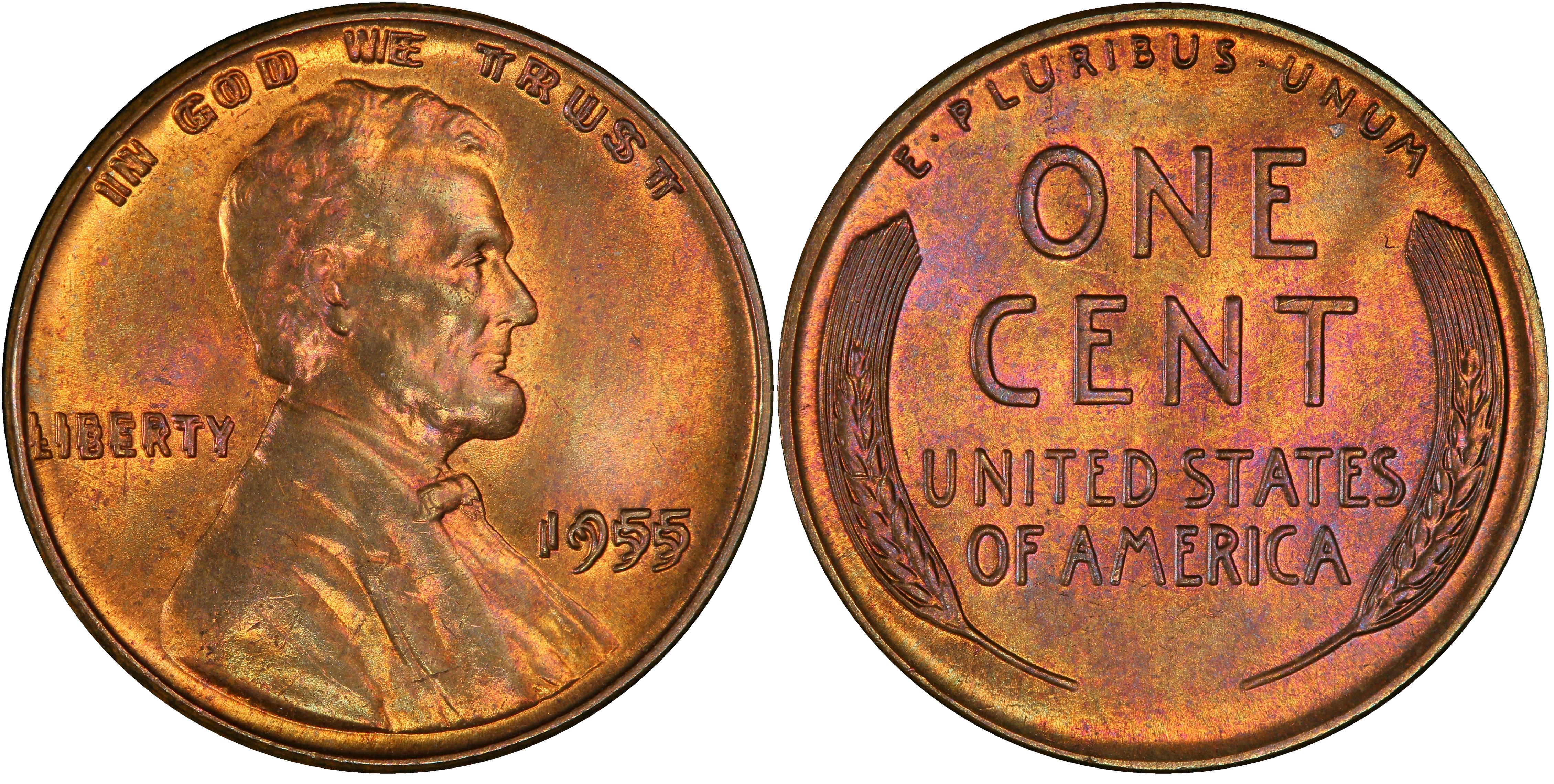 #1 PCGS MS65RB
"The Madison Collection," Heritage Auctions, January 2008, Lot 2716; D. Brent Pogue (personal collection); "The D. Brent Pogue Collection, Part VII," Stack's Bowers, March 25, 2020, Lot 7018 - $32,400. |
|
#1 PCGS MS65RB
Heritage Auctions, February 2, 2012, Lot 3924 - $10,350. |
|
#1 PCGS MS65RB
Heritage Auctions, April 1, 2009, Lot 2114 - $16,100. |
| #1 PCGS MS65RB |
 #1 PCGS MS65RB
|
 #1 PCGS MS65RB
|
|
#1 PCGS MS65RB
|
| #1 PCGS MS65RB |
Beware of counterfeits! A new "Bay Area" counterfeit mimics the die polishing lines found on a genuine 1955 Doubled Die, but the surfaces and the edge display mico-porosity which is NOT characteristic of a genuine example.
Sources and/or recommended reading: "1955 Doubled Die Cent - New Bay Area Fake Type Surfaces" by Michael Fahey, COIN WORLD, June 7, 2010, p. 44
The Famous 1955 Doubled Die
Red Book Variety. PCGS #2827, FS-101. The 1955 Doubled Die Obverse is a famous Mint error popularized by coin dealer James Ruddy. Ruddy famously advertised in Johnson City, New York that he was willing to pay 25¢ per example; however, he was quickly swamped with coins and ceased buying.
Numismatist Q. David Bowers (a future Ruddy business partner) was also a major market maker for this error. He established a shell company, the Endwell-Union Company, Incorporated, to serve as a vehicle for purchasing and maintaining a two-way market for the coins. Bowers and Ruddy later became aggressive buyers, with offers starting at $7.95. Of the approximately 40,000 specimens struck, around 24,000 were accidentally released into circulation. The remaining 16,000 still in the press operator’s bin were discovered and destroyed before release. The coins that entered circulation were primarily disbursed in and around Boston and Pittsfield, Massachusetts, as well as Endicott, Johnson City, and Binghamton, New York.
The Cigarette Cent
One curious facet of the 1955 Doubled Die's circulation is that many specimens were distributed through cigarette vending machines. At the time, a pack of cigarettes cost 23¢, but the machines lacked a mechanism to dispense small change. To resolve this, distributors tucked two one-cent coins inside the cellophane wrapping of each pack before loading them into the machines.
Other examples entered circulation in less colorful ways. Surprisingly, despite being a highly visible Mint error, many pieces circulated for a significant period before being discovered. The PCGS Population Report reflects this trend: nearly 70% of certified "Brown" (BN) examples fall within the XF to AU grade range.
1955 Doubled Die Diagnostics
Obvious doubling is present on the obverse. The date, "IN GOD WE TRUST," and "LIBERTY" exhibit a wide spread due to a slight rotation between hub strikings during the production of the working die. Reverse: The reverse die is misaligned by approximately 5%. Also on the reverse are fine vertical die polishing lines, which are located to the left of the letter T in ONE CENT.
Collecting the 1955 Doubled Die
Adding a 1955 Doubled Die to a collection is a rite of passage for serious Lincoln Cent collectors. While other Doubled Die Obverse coins in the series are scarcer- most notably the 1969-S Lincoln Memorial Cent Doubled Die Obverse (BN #2921 , RB #2922, RD #2923) and the ultra rare 1958 Lincoln Wheat Cent Doubled Die Obverse (RD #92848)- the 1955 Doubled Die occupies the perfect middle ground: it is just within reach for the dedicated collector and just out of reach for the casual one. The doubling is so dramatic that it is nearly impossible to look away the first time you encounter one.
Examples typically trade for $2,500 to $3,000 in grades up to PCGS AU58BN, while a select PCGS MS64RD can command $15,000 or more. The market for "Top Pop" examples has yieled two wildly different prices. The PCGS MS65+RD coin from the ESM Collection sold in 2018 for $114,000, while the Stewart Blay PCGS MS65+RD brought a record $287,156.25 at GreatCollections' January 2023 sale of Blay's "Red Copper Collection."
* * *