1969-S 1C Doubled Die Obverse, BN (Regular Strike)
Series: Lincoln Cents 1959 to Date
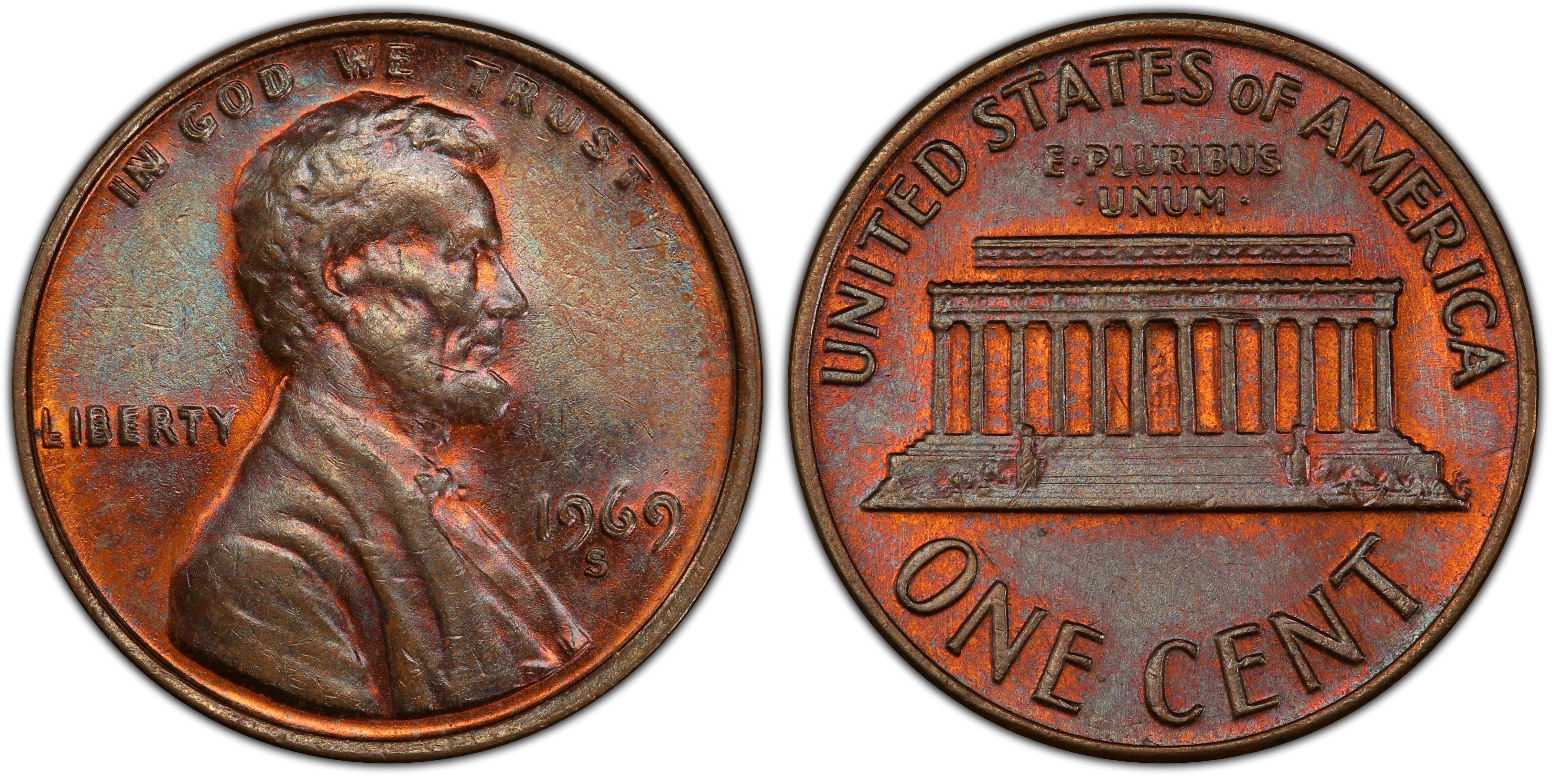
PCGS MS63BN

OBVERSE DETAILS
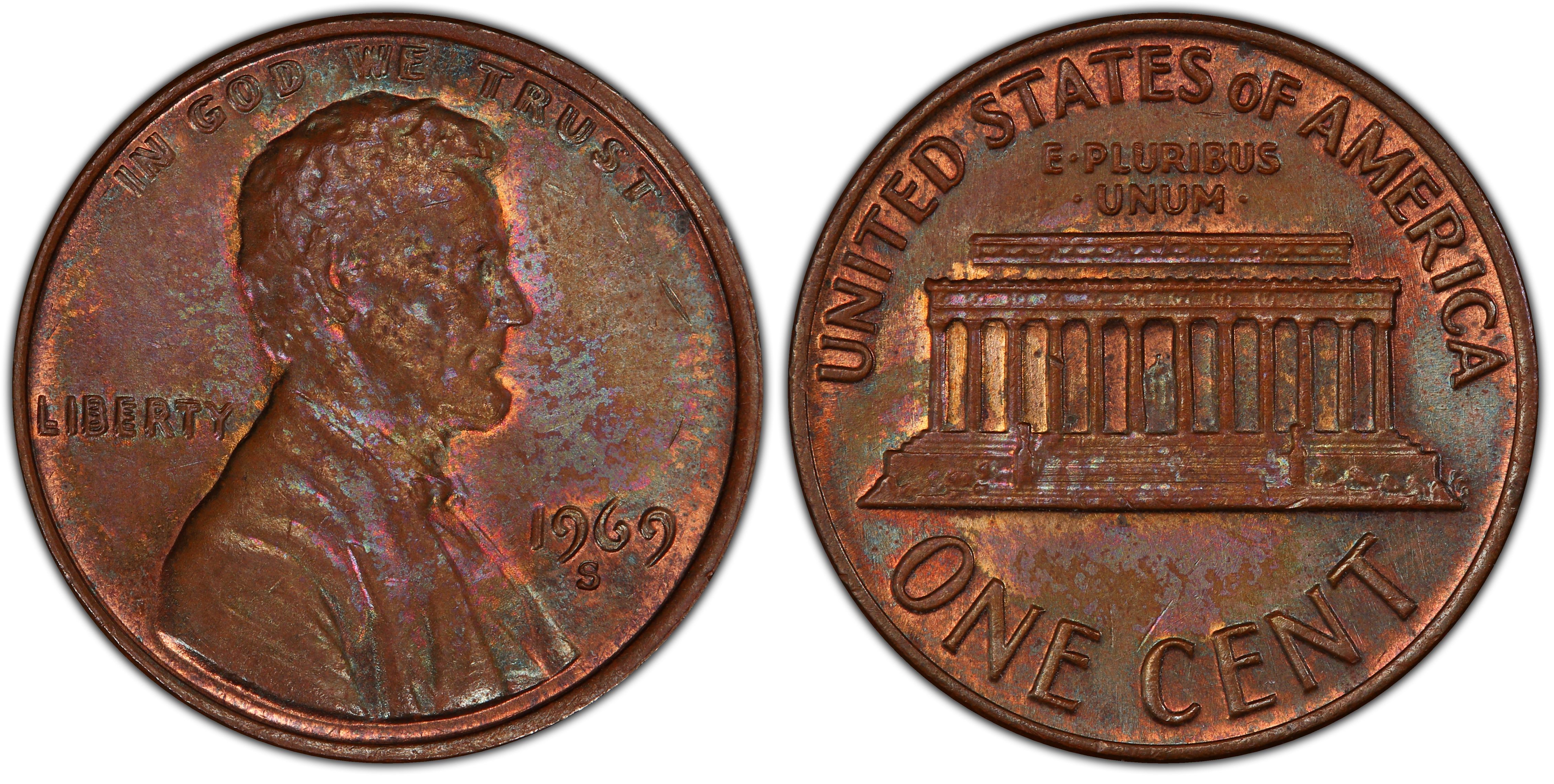
PCGS MS63BN
- PCGS #:
- 2921
- Designer:
- Victor David Brenner/Frank Gasparro
- Edge:
- Plain
- Diameter:
- 19.00 millimeters
- Weight:
- 3.11 grams
- Mintage:
- 15
- Mint:
- San Francisco
- Metal:
- 95% Copper, 5% Zinc
- Auction Record:
- $54,625 • AU55 • 10-22-2009 • Heritage Auctions
Major Varieties
- 1969-S 1C, BN
- 1969-S 1C, RB
- 1969-S 1C, RD
- 1969-S 1C Doubled Die Obverse, BN
- 1969-S 1C Doubled Die Obverse, RB
- 1969-S 1C Doubled Die Obverse, RD
Condition Census What Is This?
|
#1 PCGS MS63BN
Heritage, January 2019, Lot 3525 - $36,000; Heritage Auctions, August 14, 2019, Lot 3705 - $40,800; "The Siesta Key Collection," Heritage Auctions, August 26, 2025, Lot 3060 - $28,800. |
|
#1 PCGS MS63BN
As PCGS MS62BN #50085541. Heritage Auctions, March 25, 2004, Lot 5260 - $43,700. As PCGS MS62BN #34597681. Stack's Bowers, October 25, 2018, Lot 2040 - $40.000 Reserve Not Met; Heritage Auctions, January 10, 2019, Lot 4367 - $48,000. |
| #1 PCGS MS63BN |
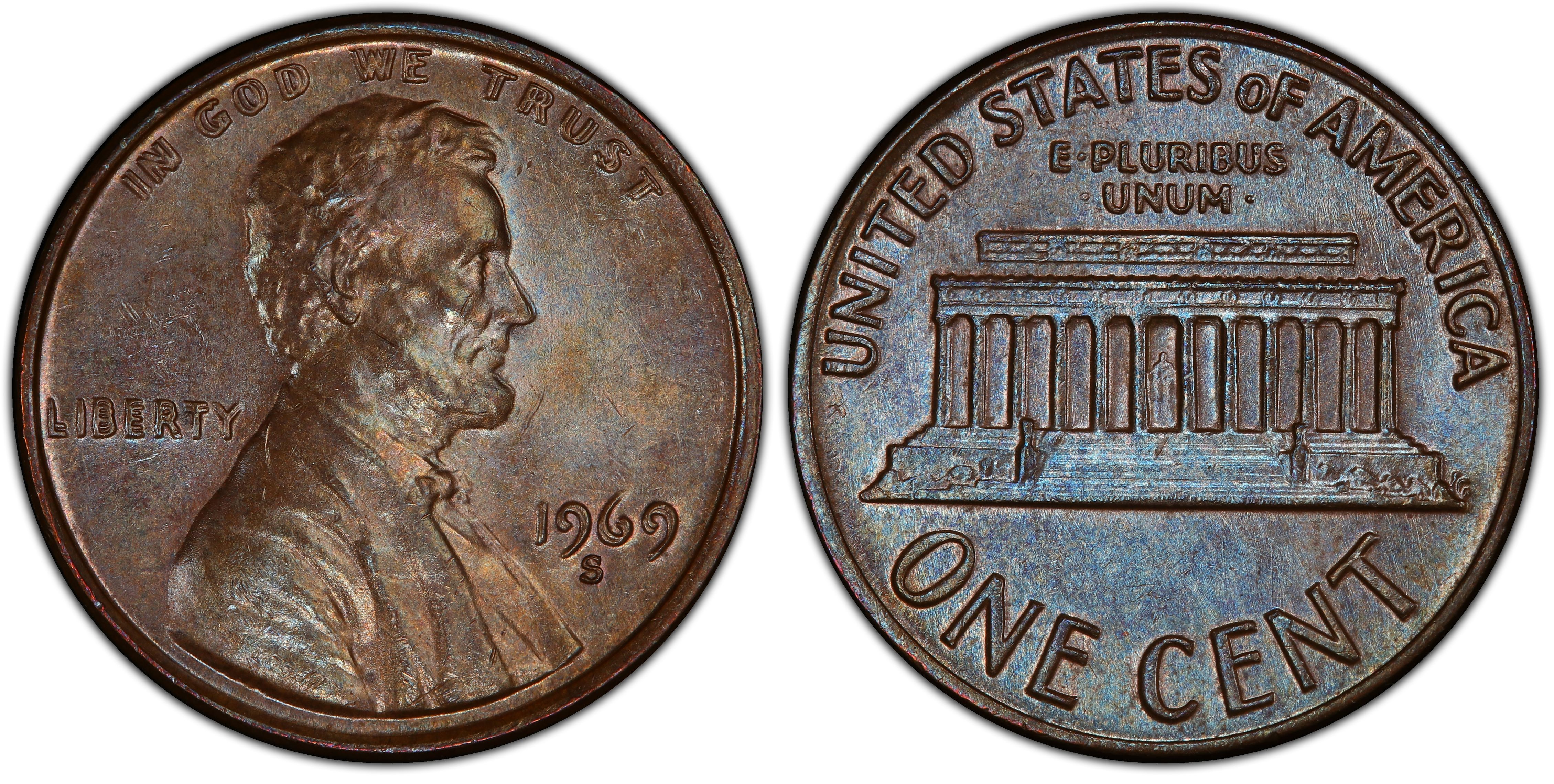 #4 PCGS MS62BN
Stack's Bowers, November 2018, Lot 91066 - $37,200. |
| #4 PCGS MS62BN |
| #4 PCGS MS62BN |
|
#7 PCGS MS61BN
Heritage Auctions, September 7, 2017, Lot 3748 - $27,600. |
 #7 PCGS MS61BN
William E Corum "bulincs" (PCGS Set Registry). |
 #7 PCGS MS61BN
|
 #7 PCGS MS61BN
|
 #7 Est. MS61BN
As PCGS MS61BN #25236739. Heritage, July 2015, Lot 3023 - $37,600; "The Aberg Collection," Stack's Bowers, November 23, 2021, Lot 4017 - $21,600. |
The 1969-S Doubled Die and the 1969 Doubled Die Counterfeiting Scandal
The authenticated discovery of the 1969-S Lincoln Memorial Cent, Doubled Die Obverse (DDO), was immediately overshadowed by a major counterfeiting investigation. The U.S. Secret Service was already targeting Morton Christopher Goodman and Roy Gray, who had fabricated a non-existent 1969 (P) Doubled Die error coin.
Goodman and Gray operated a sophisticated scheme utilizing an Agietron Electrical Discharge Machine (EDM), which Gray had acquired and whose manufacturer (Alina Corporation) had trained Goodman to operate. Goodman used the EDM, which employs a spark erosion process, to produce fake coin dies. He famously created counterfeit 1969 (P) Lincoln Cents and enlisted collector Robert Teitelbaum to market them and circulate 85 examples in Washington, D.C.,
Teitelbaum secured $100 for one of the first pieces offered to the public and later received $92,000 for a lot of 2,900 counterfeit cents.
Goodman’s scheme extended beyond cents; he also produced dies with the intent to counterfeit 1942/1 Mercury Dimes. He had silver sheets specially re-rolled to the correct thickness and created punching dies and a collar die for his dimes, although his collar had 120 serrations, two more than a genuine dime’s 118.
Goodman's plan failed when Teitelbaum turned the 85 cents earmarked for D.C. circulation over to the United States Secret Service. Following a raid on Gray's residence, a Secret Service agent (identified as Miller in court documents) successfully used the same Agietron machine to produce identical counterfeit 1969 doubled dies, solidifying the evidence. Goodman was ultimately convicted on seven counts of a nine-count indictment, facing charges of counterfeiting and conspiracy under 18 U.S.C. §§ 371, 485, 487, and 490.
The Authentic 1969-S Lincoln Cent, Double Die Discovery
Coincidentally, while the Goodman investigation was ongoing, the authentic 1969-S DDO was first found by Cecil Moorhouse and Bill Hudson in five coin rolls from a Bank of America branch in Belmont, California.
Due to the intense focus on the DDO counterfeits, the Secret Service immediately seized the genuine discovery coin. It was only after a definitive analysis confirmed the coin's authenticity—proving it was a legitimate mint error and not one of Goodman's fakes—that it was returned, establishing the error's place in numismatic history.
Rarity and Market Performance
The 1969-S DDO is one of the most elusive modern coin varieties. Early estimates reflected its extreme scarcity:
- Early Census: As late as 1988, only 15 examples were officially known. This figure increased only slightly when numismatic author David Lange published his reference on the Lincoln cent series.
- Original Estimate: The total number of pieces struck with the doubled die is believed to be around 100, an estimate David Lange supported in 2005.
- Today's Estimate: The opportunity for collectors to find circulated versions of the 1969-S Doubled Die Obverse (DDO) Lincoln Cent is dwindling as the denomination gradually disappears from active commerce. However, because uncirculated rolls of 1969 cents are still plentiful, it is reasonable to expect that additional DDO examples will continue to be discovered. Even after more than 50 years of active searching, the 1969-S DDO has firmly established itself as a genuinely rare mint error. The coin's future population could follow one of two paths. It is entirely possible that another 100 examples may surface over the next few decades as old, unsearched original rolls are finally opened. On the other hand, it is also highly possible that most of the high-quality, Mint State examples have already appeared on the market, meaning that future discoveries will predominantly be lower-grade, circulated pieces.
Market History of a Key Example
The coin’s public profile and value exploded after a major discovery in 1994. A collector in New York found a near-gem Red example in an uncirculated roll and sold it to dealer Sam Lukes of Visalia, California. As reported by Lukes in Numismatic News (December 4, 2007), that specific coin changed hands several times between 1994 and 2001, rocketing in value from $10,000 in 1994 to $35,000 in 2001. As more examples entered the market, the coin's collectibility and public profile increased significantly.
Record Sales
Mint State Red examples remain incredibly rare, leading to phenomenal auction results: A near-Gem PCGS MS64RD sold in 2018 for $126,000. Stewart Blay's premier PCGS MS66RD example (the top-graded coin, pop one) was sold by GreatCollections on January 22, 2023, for a record-shattering $601,875.
Regency XI Preview | Legend Rare Coin Auctions | February 19, 2015
(Starts at 10:51)
Regency XIX Preview | Legend Rare Coin Auctions | December 15, 2016
(Starts at 2:08)