1809 10C (Regular Strike)
Series: Capped Bust Dimes 1809-1837

PCGS MS64+
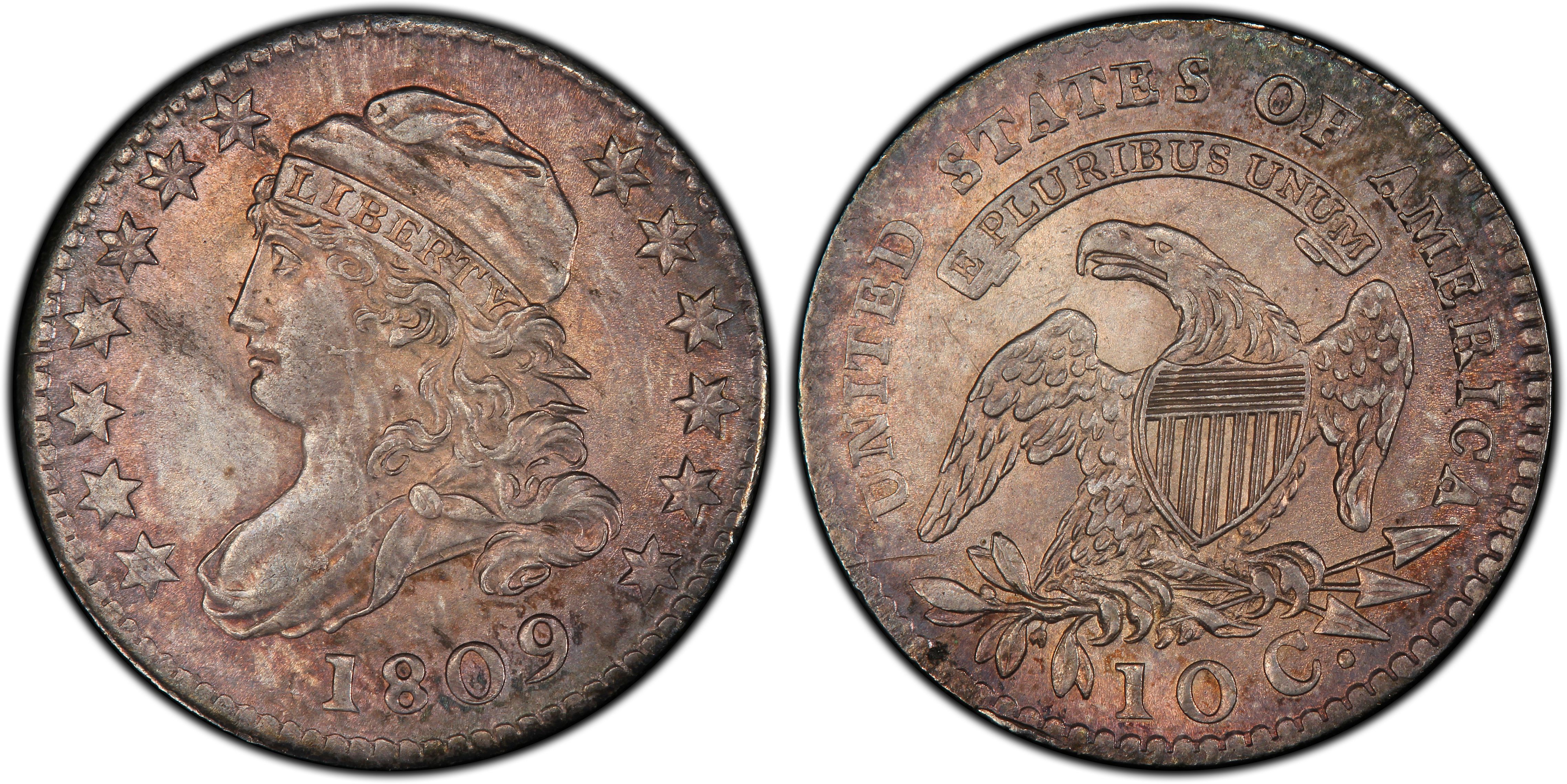
PCGS MS64
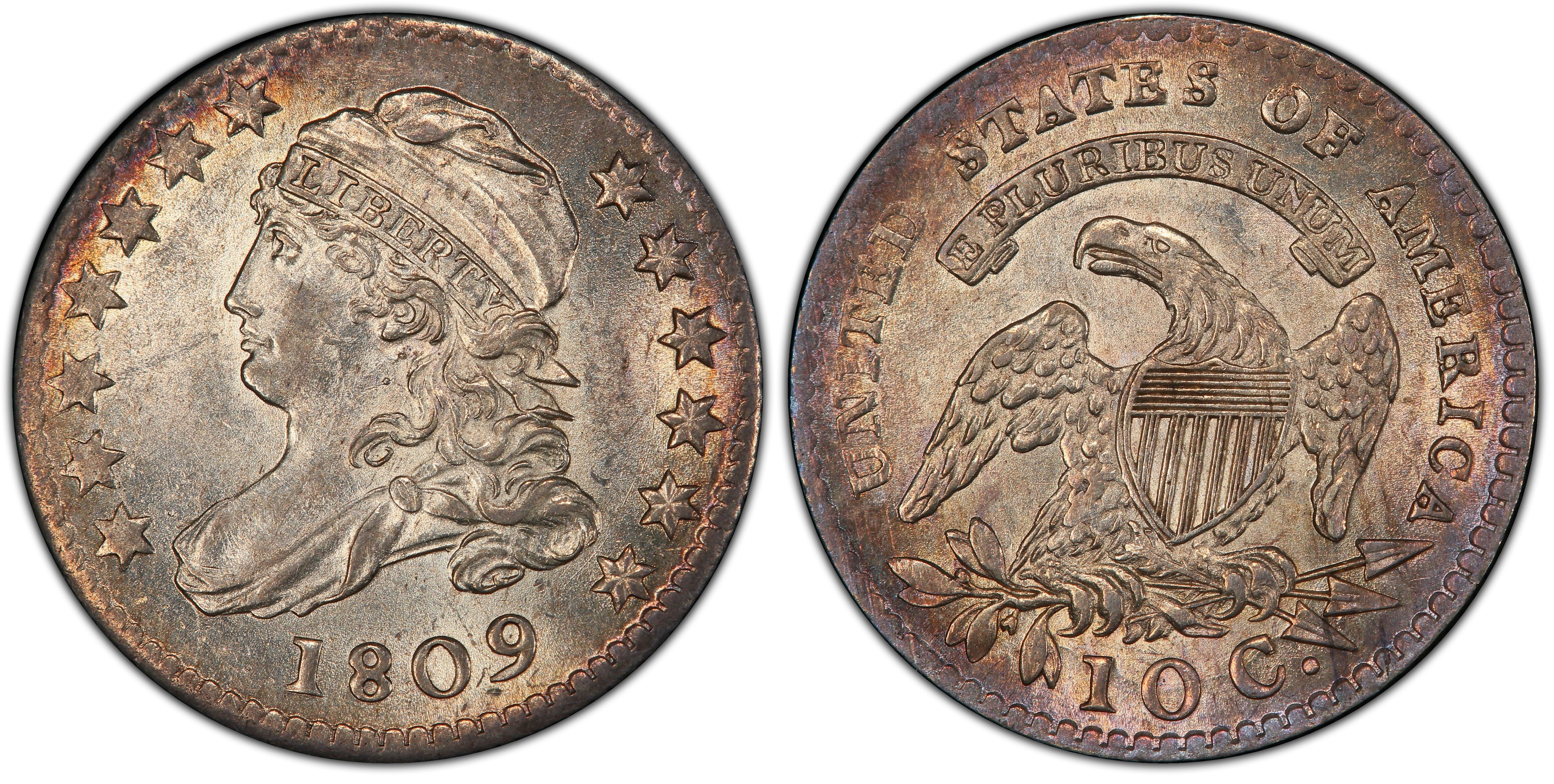
PCGS MS64
- PCGS #:
- 4486
- Designer:
- John Reich
- Edge:
- Reeded
- Diameter:
- 19.00 millimeters
- Weight:
- 2.70 grams
- Mintage:
- 51,065
- Mint:
- Philadelphia
- Metal:
- 89.2% Silver, 10.8% Copper
- Auction Record:
- $60,000 • MS66 • 12-21-2020 • Stack's Bowers
Major Varieties
- 1809 10C
Rarity and Survival Estimates Learn More
| Survival Estimate | |
|---|---|
| All Grades | 200 |
| 60 or Better | 20 |
| 65 or Better | 6 |
| Numismatic Rarity | |
|---|---|
| All Grades | R-7.0 |
| 60 or Better | R-9.1 |
| 65 or Better | R-9.7 |
| Relative Rarity By Type All Specs in this Type | |
|---|---|
| All Grades | 4 / 17 TIE |
| 60 or Better | 8 / 17 TIE |
| 65 or Better | 10 / 17 TIE |
| Relative Rarity By Series All Specs in this Series | |
|---|---|
| All Grades | 6 / 35 TIE |
| 60 or Better | 11 / 35 TIE |
| 65 or Better | 15 / 35 TIE |
Condition Census What Is This?
|
#1 PCGS MS66
"The Larry H. Miller Collection, Part Two," Stack's Bowers, December 21, 2020, Lot 1048 - $60,000. JR-1. Old Green Holder (OGH). Brilliant satin texture. While Stars 1–4 are flatly struck, full radials are present on Stars 5–13. Small tick on the bottom tip of star 7. A thin, arced die line is visible on the inside of Stars 11–13, and a diagonal streak is noted above the 80 in the date. The reverse is virtually flawless, save for two spots under the eagle's right wing and a diagonal streak extending from the ribbon below the M to the shield. Prominent die cracks are present on the reverse, extending through the first A in AMERICA to the ribbon and through the second A in AMERICA to the talon. |
| #1 PCGS MS66 |
| #3 PCGS MS65 |
| #3 PCGS MS65 |
|
#5 PCGS MS64+
As NGC MS65 #3318678-003. Heritage Auctions, February 2012, Lot 3311 - $23,000. As PCGS MS64+ #46265214. Stack's Bowers, May 4, 2025, Lot 3128 - $28,800. Orange-gold centers are bordered by vibrant blue and amaranth-purple toning. Two pin-sized blue toning spots appear on a horizontal axis from Liberty’s chin to the right of Star 3. A thin, arced die line is noted on the inside of Stars 11–13. Prominent die cracks are present on the reverse, extending through the first A in AMERICA to the ribbon and through the second A in AMERICA to the talon. |
|
#6 PCGS MS64
As NGC MS64+ #3413550-001. Heritage Auctions, January 2013, Lot 3931 - $10,575. As PCGS MS64 #25040216. "The Bender Family Collection, Part III," Heritage Auctions, February 12, 2023, Lot 3625 - $16,800. JR-1. Stars 1–4 are weak (typical), while Stars 5–13 exhibit full radials. A diagonal streak of grease is visible in the upper-left obverse field, running through Stars 4 and 5. A thin, arced die line is noted on the inside of Stars 11–13. The coin displays peach and rose-gold toning throughout, with hints of iridescent green and orange-red color along the reverse periphery. Denticles are weak to absent in the upper-left of the reverse. Prominent die cracks are present on the reverse, running through the first A in AMERICA to the ribbon, and through the second A in AMERICA to the talon. |
|
#6 PCGS MS64
Barney Bluestone, June 1946; "The John Jay Pittman Collection," David W. Akers, October 1997, Lot 544; "The Eugene H. Gardner Collection," Heritage Auctions, June 2014, Lot 30234; "The Easton Collection" (PCGS Set Registry). JR-1. |
|
#6 PCGS MS64
As PCGS MS64 #90098232. Heritage Auctions, November 8, 2003, Lot 5954 - Passed; "The Haig A. Koshkarian Collection," American Numismatic Rarities, March 9, 2004, Lot 489 - Passed; "The Kennywood Collection," American Numismatic Rarities, January 10, 2025, Lot 344 - Passed; As PCGS MS64 #08888775. "The Troy Wiseman Collection," Heritage Auctions, September 13, 2006, Lot 1270 - $11,500; "The Charleston Collection," Heritage Auctions, June 26, 2008, Lot 713 - $11,500; "The MJ Sullivan Collection" (PCGS Set Registry). JR-1. Peach-rose centers blend into vibrant blue, green, and gold along the periphery. Stars 1-4 are weak, with some softness noted on other stars as well. A toning spot is visible to the left of the obverse compass mark. Prominent die cracks are present on the reverse, extending through the first A in AMERICA to the ribbon. |
| #6 PCGS MS64 |
The 1809 Capped Bust Dime
Bavarian-born engraver John Reich arrived in the United States as an indentured laborer, working to pay off the cost of his passage under silversmith John Brown. Reich’s debt was eventually settled by Henry Voigt in 1801; that same year, Reich was credited with designing the Thomas Jefferson Inauguration Medal (#518703). The medal was Voigt’s concept; he had written to Jefferson in December 1801, suggesting the President support the creation of a medal to honor the 25th anniversary of the Declaration of Independence and Jefferson's victory over John Adams in the contentious election of 1800.
Jefferson approved the project, and the finished medal, produced by Reich at the Philadelphia Mint, was delivered to the President. Jefferson was so impressed that he purchased several more examples to give to his daughters. Despite this early success, Reich’s official tenure at the Mint did not begin until 1807, when Mint Director Robert Patterson appointed him as Second Engraver.
There is a growing historical dispute regarding the origin of the Capped Bust Liberty designs. While it has been held for decades that Reich was brought in specifically to modernize American coinage and deserves sole credit for the type, some scholars are re-evaluating the timeline. However, it remains true that Reich’s tenure perfectly coincides with the staged release of these iconic designs.
In Walter Breen’s oft-repeated account, Chief Engraver Robert Scot viewed the talented Reich as a threat to his position. However, due to Scot’s failing eyesight in 1807, Reich was hired as Assistant Engraver. In this role, Reich focused on creating new designs while Scot was utilized for the more mechanical tasks of die production and striking coins. According to Breen, Scot ensured that Reich never received official credit for his work. Reich eventually left the Mint in 1817 due to his own failing health and is not credited with any major works following his departure. Scot, meanwhile, retained his position as Chief Engraver until his death in 1823.
It is difficult to imagine that the Mint would have retained Robert Scot’s services for another sixteen years—spanning multiple presidential administrations—if he were indeed going blind by 1807. Furthermore, it would be a mistake to assert that Scot lacked the talent or experience of John Reich; the designs unequivocally credited to Scot remain among the most iconic in the history of American coinage. Regardless of the debate over their respective contributions, the Capped Bust design was introduced to the dime in 1809.
The design features a left-facing portrait of Liberty wearing a pileus cap, surrounded by thirteen stars and the date. The reverse depicts a naturalistic heraldic eagle perched on an olive branch and holding three arrows, with the denomination "10 C." below.
Collecting the 1809 Capped Bust Dime
Only one die pair (JR-1) was used to strike the 51,065 1809 Capped Bust Dimes (PCGS #4486); of these, 6,355 were delivered in 1810. Mint State examples are frequently toned, and many exhibit characteristic grease stains. A compass mark is present at the center of the obverse, and a small horizontal raised element often seen on Liberty's cheek is the result of die damage. This connects to a vertical crack that runs down Liberty's neck, and on nearly all examples, the lower-left stars lack their radials. Additionally, a thin, arced die line appears within the stars 10–13. On the reverse, most examples exhibit die cracks extending from the dentils through both A's in AMERICA. A final diagnostic marker is noted within the counter of the first A in STATES.
Gem examples are exceedingly rare; the two PCGS MS65 specimens listed in the Condition Census were graded in the 1980s and leave no public auction records. One of the two existing PCGS MS66 examples surfaced in 2020 as part of the Larry H. Miller Collection, realizing a record-breaking price of $60,000.
Most examples survive in the VF or lower grade range. I estimate that approximately 350 gradable examples survie.
* * *