1846 10C (Proof)
Series: Liberty Seated Dimes 1837-1891

PCGS PR65+
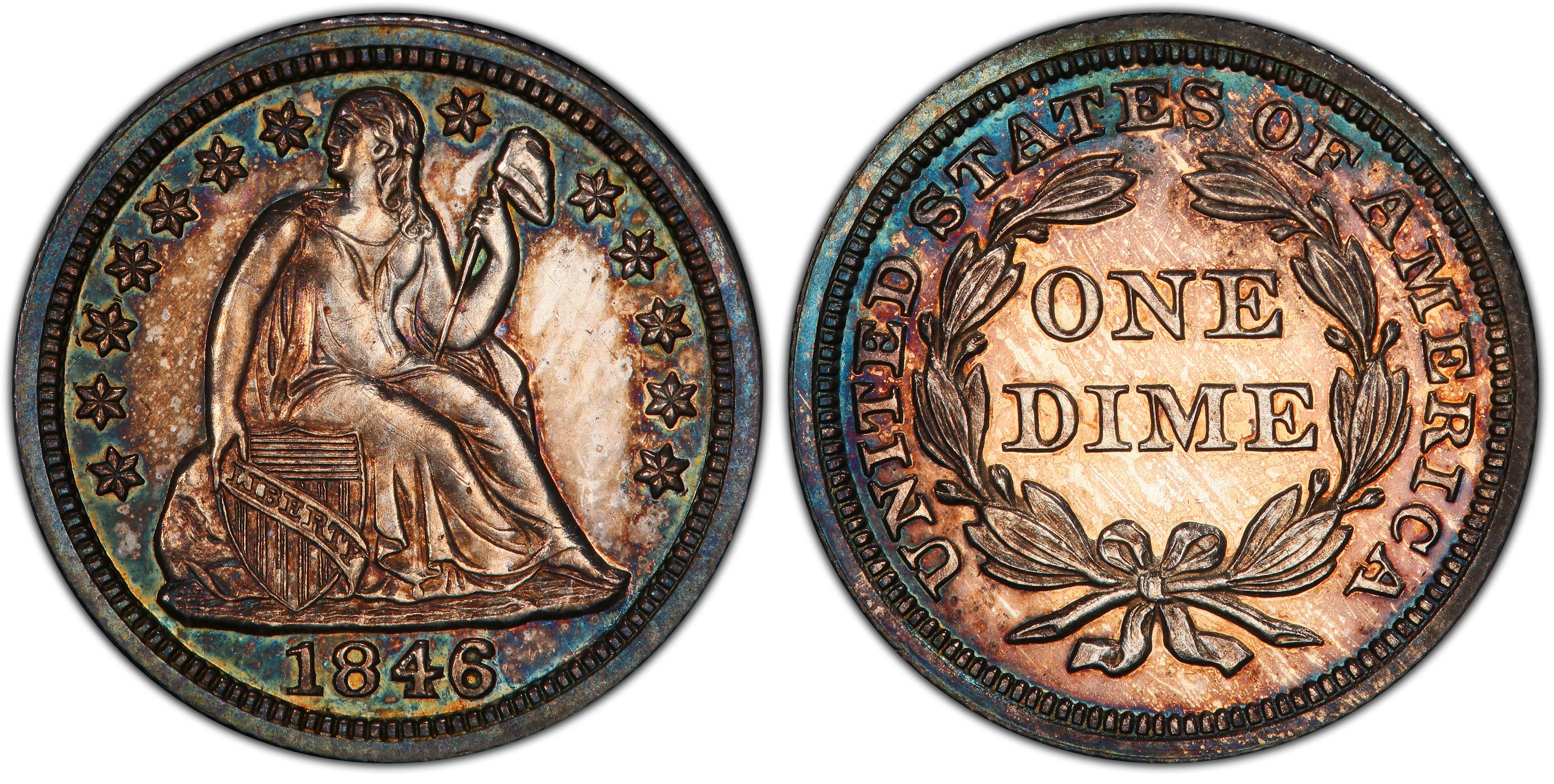
PCGS PR64
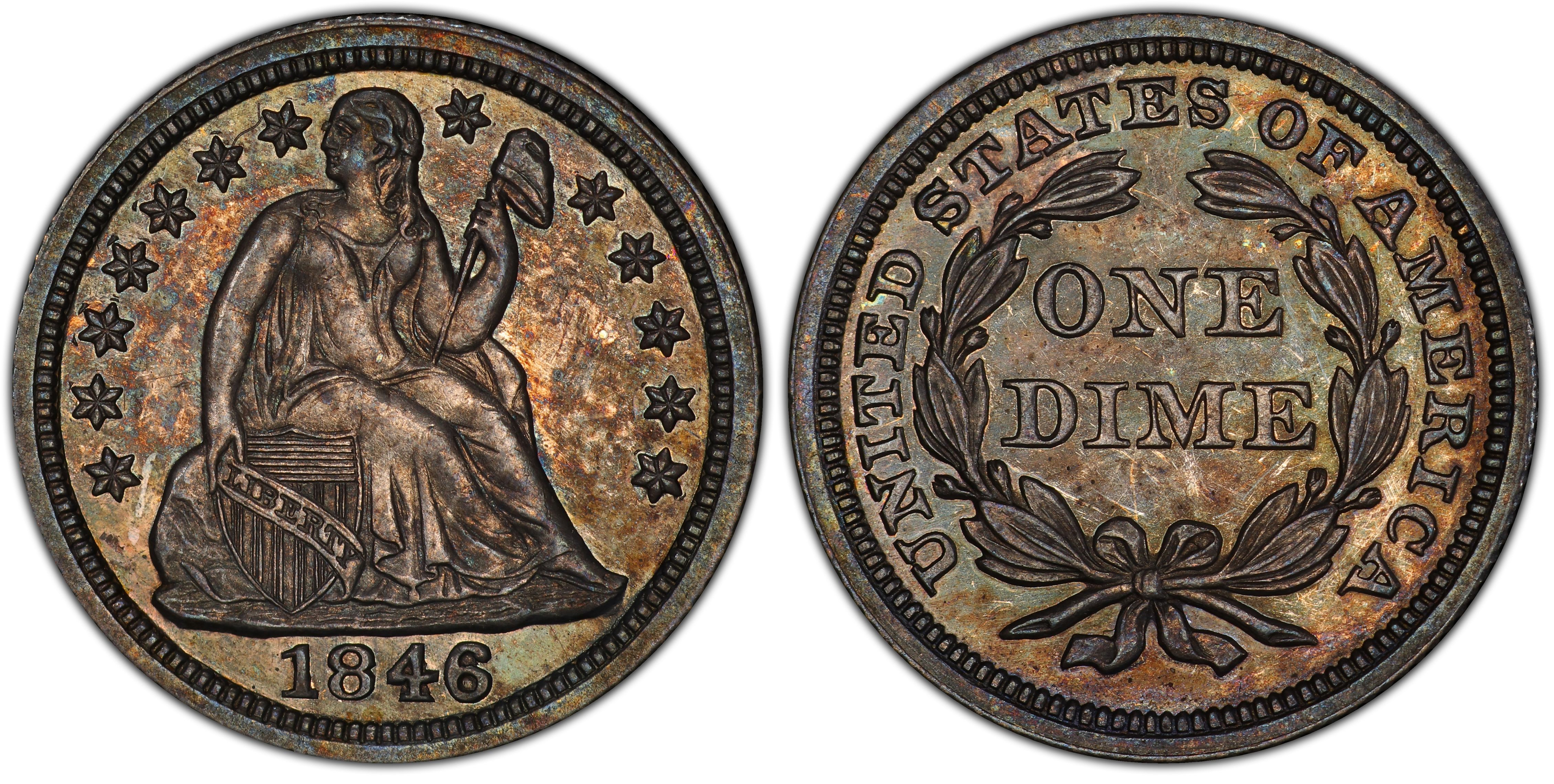
PCGS PR63
- PCGS #:
- 4733
- Designer:
- Robert Ball Hughes/Christian Gobrecht
- Edge:
- Reeded
- Diameter:
- 17.90 millimeters
- Weight:
- 2.67 grams
- Mintage:
- 10
- Mint:
- Philadelphia
- Metal:
- 90% Silver, 10% Copper
- Auction Record:
- $74,750 • PR65 • 04-01-2008 • Heritage Auctions
Rarity and Survival Estimates Learn More
| Survival Estimate | |
|---|---|
| All Grades | 12 |
| 60 or Better | 12 |
| 65 or Better | 3 |
| Numismatic Rarity | |
|---|---|
| All Grades | R-9.5 |
| 60 or Better | R-9.5 |
| 65 or Better | R-9.8 |
| Relative Rarity By Type All Specs in this Type | |
|---|---|
| All Grades | 11 / 18 TIE |
| 60 or Better | 11 / 18 TIE |
| 65 or Better | 7 / 18 TIE |
| Relative Rarity By Series All Specs in this Series | |
|---|---|
| All Grades | 15 / 58 TIE |
| 60 or Better | 15 / 58 TIE |
| 65 or Better | 11 / 58 TIE |
Condition Census What Is This?
|
#1 PCGS PR65+
Fortin-102. Rose, acqua, and aubergine toning. |
|
#2 Est. PR65
(possibly) Édouard Frossard, November 4, 1892, Lot 502 (as part of a complete 1846 Proof Set); Numismatic Gallery, 1949; "The John Jay Pittman Collection," David W. Akers, May 1998, Lot 1712. As NGC PF65 #1898957-029. April 17, 2008, Lot 2384 - $74,750; "The Greensboro Collection," Heritage Auctions, October 18, 2012, Lot 3945 - $32,900; Heritage Auctions, March 21, 2013, Lot 3306 - $31,725. Fortin-102. Russet, gold, and blue toning. |
|
#3 PCGS PR64
Bill Nagle to Eugene H. Gardner, December 2003; "The Eugene H. Gardner Collection of US Coins," Heritage Auctions, June 23, 2014, Lot 30288 - $18,800. Fortin-102. Mint and aqua patination. |
|
#3 PCGS PR64
Stack's Bowers, November 4, 2010, Lot 1514 - $19,550. Fortin-102. Gold and Russet toning in the centers, with green, blue, and aubergine toning along the borders. The reverse toning pattern exhibits diagonal streaks running through the center. Curved lintmark to the right of Star 2. |
|
#5 PCGS PR63
As "Brilliant Proof." "The William Cutler Atwater Collection," B. Max Mehl, June 11, 1946, Lot 939 - $61; "The Floyd T. Starr Collection," October 1992, Lot 363. As PCGS PR63 #4976496. Stack's Bowers, August 2015, Lot 10061 - Passed. Fortin-102. Deep grey with mottled toning. Lintmark between Stars 6 and 7. |
|
#5 PCGS PR63
Heritage Auctions, August 5, 2014, Lot 3487 - $10,576. Fortin-102. Gold and russet toning. |
|
#5 PCGS PR63
Stacks, July 30, 2009, Lot 387 - $10,000; Stack's Bowers, August 7, 2012, Lot 11311 - $14,100. Fortin-102. Gold, and champagne patination. Staple scratch at rim at Star 9. Scratches to the right of Stars 2 and 3. |
|
#5 PCGS PR63
Heritage Auctions, May 2, 2003, Lot 5912 - $10,350. Fortin-102. |
 #9 PCGS PR62
|
|
#9 Est. PR62
Mint Cabinet; National Numismatic Collection at the Smithsonian Institution - View. Fortin-102. Silvery grey with gold patination. Cut across Liberty's breast. |
1846 Liberty Seated Dime Proof
The 1846 Liberty Seated Dime Proof (#4733) is a rare coin with an estimated mintage of only 10 to 15 pieces. The PCGS Condition Census currently identifies 10 distinct surviving examples.
The Era of "Master Coins"
The United States Mint did not officially market Proof coins to the public until 1858—a move prompted by the surge in collecting interest following the discontinuation of the Large Cents and Half Cents. Prior to this "official" era, the Mint produced a limited number of high-quality strikes known as "Master Coins." Deep dives into the National Archives continue to shed light on why these were created. We know, for instance, that 1834 Proof Sets were struck as diplomatic gifts. Similarly, "Master Coins" struck in 1841 appear to have been commissioned by the State Department for coin exchanges to bolster the Mint Cabinet’s collection of foreign specimens. This diplomatic purpose likely explains the unusually large production of the 1841 $2.50 "Little Princess" Proofs (#7867).
If early Proofs were struck for international exchange and later released into domestic circulation once the dates became obsolete, it would explain how they trickled into the market without explicit marketing. While "connected" individuals certainly had access to these rarities, diplomatic utility likely provided the original catalyst for their creation.
Advancing the Reference Library
For decades, Walter Breen’s Encyclopedia of United States and Colonial Proof Coins, 1722-1989 was the definitive resource. However, 2026 marks a significant shift for advanced collectors with the release of John Dannreuther’s comprehensive two-volume study on American silver Proofs.
Technical Analysis and Corrections
Regarding the 1846 Liberty Seated Dime Proof, Breen’s original analysis was somewhat incomplete. He traced nine examples but identified a specific diagnostic—a lint mark between the 6th and 7th stars—as unique to the "Balboa Bank Set" specimen. Current research indicates this is not an isolated occurrence; rather, the lint mark appears on the majority of known examples. Other recurring die characteristics include: Raised elements surrounding several stars. A distinct curved mark to the right of Star 2, visible on multiple specimens.
* * *