
PCGS MS67+FB

PCGS MS67FB
- PCGS #:
- 5057
- Designer:
- Adolph Alexander Weinman
- Edge:
- Reeded
- Diameter:
- 17.90 millimeters
- Weight:
- 2.50 grams
- Mintage:
- 159,130,000
- Mint:
- Philadelphia
- Metal:
- 90% Silver, 10% Copper
- Auction Record:
- $96,000 • MS67+FB • 01-03-2018 • Heritage Auctions
Rarity and Survival Estimates Learn More
| Survival Estimate | |
|---|---|
| All Grades | 400 |
| 60 or Better | 400 |
| 65 or Better | 100 |
| Numismatic Rarity | |
|---|---|
| All Grades | R-6.2 |
| 60 or Better | R-6.2 |
| 65 or Better | R-8.0 |
| Relative Rarity By Type All Specs in this Type | |
|---|---|
| All Grades | 12 / 80 TIE |
| 60 or Better | 12 / 80 TIE |
| 65 or Better | 18 / 80 TIE |
| Relative Rarity By Series All Specs in this Series | |
|---|---|
| All Grades | 12 / 80 TIE |
| 60 or Better | 12 / 80 TIE |
| 65 or Better | 18 / 80 TIE |
Condition Census What Is This?
 #1 PCGS MS67+FB
David Lawrence, June 2019, Lot 1794582 - $90,000; Dell Loy Hansen; "The D.L. Hansen Mercury Dimes FB / Major Varieties Collection" (PCGS Set Registry). Pearlescent toning on both sides. Dark spots on the reverse at E of UNITED, between E and branch, on N of ONE, and near rim to the left of 6 o’clock. |
|
#1 PCGS MS67+FB
Heritage Auctions, January 4, 2018, Lot 4810 – $96,000; MADHATTER; "MERC MADNESS Collection" (PCGS Set Registry). Predominately brilliant, with hints of green-gold and rose on the reverse. Diagonal mark near the rim under the TR of TRUST. |
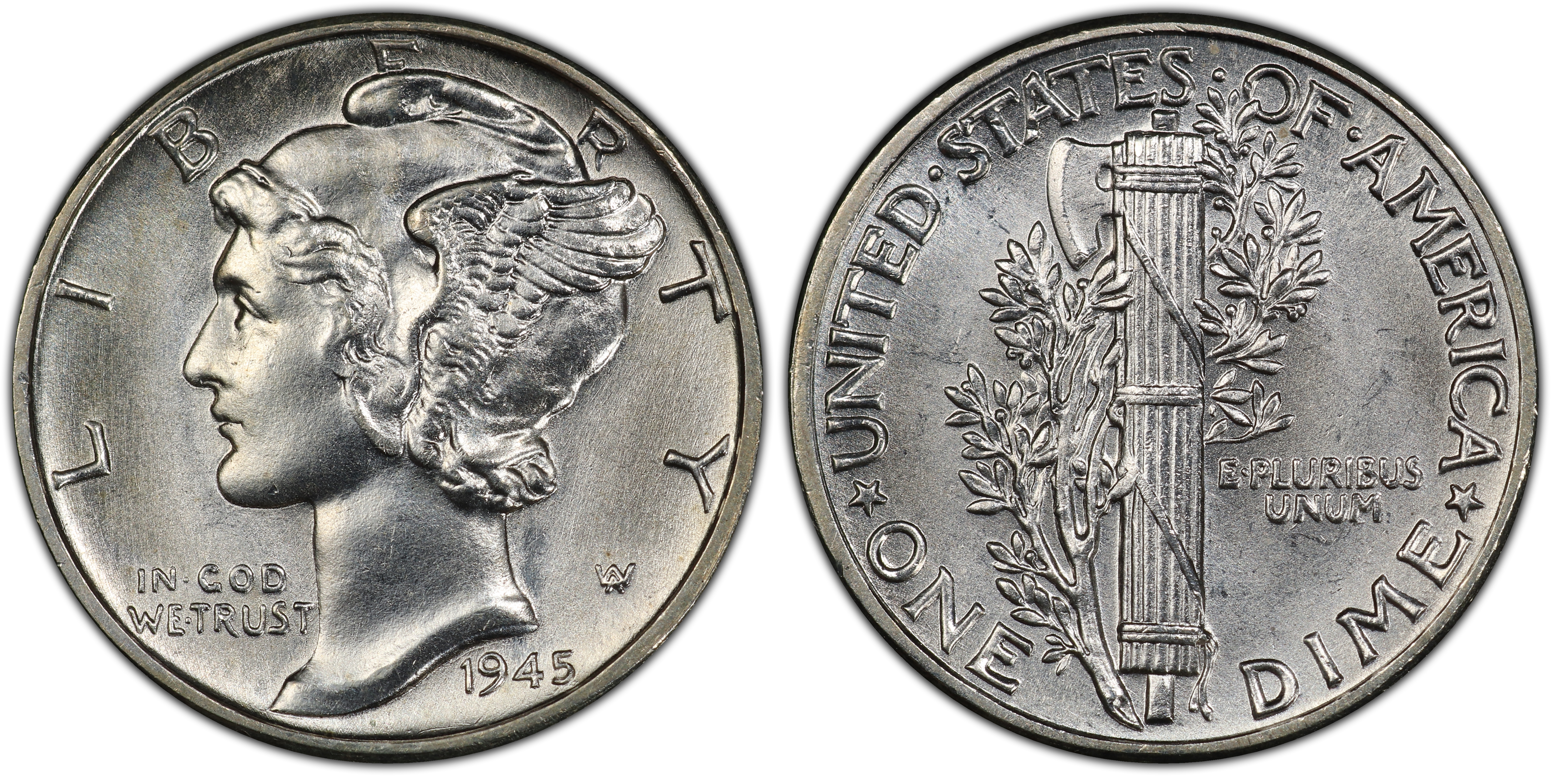
 #3 PCGS MS67FB
As PCGS MS67FB. “The Louis Bassano Collection,” Heritage Auctions, August 7, 2000, Lot 7054 - $24,150. As PCGS MS67FB #43778065. Obverse toned with diagonal rust-brown streaks. Similar coloration on the reverse. Spot on the edge of the axe blade. |
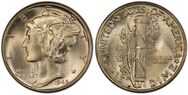 #3 PCGS MS67FB
|
| #3 PCGS MS67FB |
 #6 PCGS MS66+FB
As NGC MS66FB #3754221-002. Stack's Bowers, March 2015, Lot 5399 - $12,925. As NGC MS66+FB #3643758-004. Stack's Bowers, March 31, 2016, Lot 13049 - $11,750. As PCGS MS66+FB #42352270. "The remumc Collection" (PCGS Set Registry). Predominantly brilliant with faint toning in the left obverse field and a small spot above the AW monogram. A minor tick is noted on Liberty's jaw. |
The Mercury Dime reached its final year of production in 1945. Adolph A. Weinman’s celebrated design was first issued in 1916, a year before the United States entered World War I; its production concluded only after America detonated a pair of atomic bombs over Japan to hasten the end of World War II. The world the design entered was vastly different from the one it left.
Despite the transition from the "Winged Liberty" motif to the Roosevelt Dime, the Mercury design remained a fixture in American life for another two decades, appearing regularly in the back-page ads of Silver Age comic books. When the era of circulating silver coinage ended in the mid-1960s, the era of finding Mercury Dimes in pocket change vanished along with it.
Collecting the Full Bands 1945 Mercury Dime
With a massive mintage of 159,130,000 pieces, the 1945 Philadelphia issue is one of only five dates in the series to surpass the 100-million-coin threshold. Because of this abundance, the date was long dismissed as a common coin and ncirculated specimens were frequently traded as mere bullion well into the 1980s.
However, a select group of astute dealers- including the late Tom McAfee of Winter Park, Florida, remained keenly aware of the date’s profound scarcity with Full Bands (FB). To bring this anomaly to light, David Hall, then a prominent dealer, educated Coin Dealer Newsletter (CDN) editor Allen Harriman on the situation, convincing him to include Full Band pricing in the "Greysheet."
A dedicated market for the strike attribution soon followed. While 1945 Full Band dimes seemed scarce at the time, it was only with the advent of PCGS grading and the subsequent transparency of population data that the market's opinion was truly solidified—particularly regarding Gem-grade examples (MS65 or better) with the coveted FB designation.
In this context, the 1945 Mercury Dime (#5056, #5057) reveals itself to be a nearly impossible strike rarity. In fact, a mere 1.26% of the 1945 Philadelphia dimes graded by PCGS qualify for the Full Bands designation, with the few survivors concentrated primarily in the MS64 and MS65 range. The scarcity is so profound that a collector may have a better statistical chance of securing a Gem Full Bands 1916-D (#4907)- the series undisputed key date- than finding a 1945-P with fully struck bands. Only the lingering impression that vast quantities of uncertified 1945 Dimes exist prevents this conditional rarity from reaching price parity with the 1916-D.
Vintage Market Snippets
- Coin dealer Lu Riggs offered uncirculated rolls for $6 in the August 1948 issue of The Numismatist.
- At an April 2016 online auction, Stack’s Bowers sold a BU roll of 1945 Mercury Dimes for $493.50.
* * *