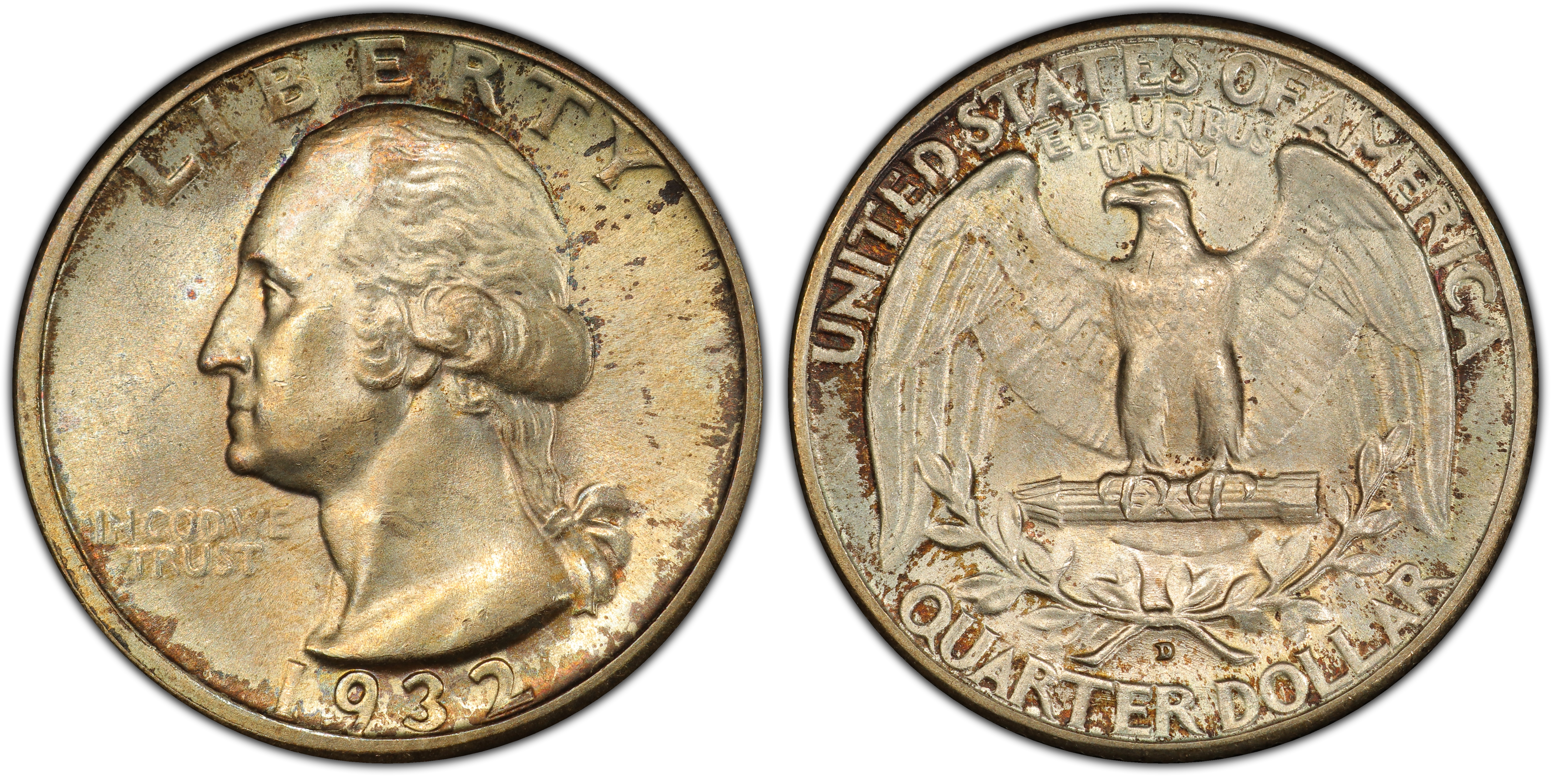
PCGS MS65+

PCGS MS65+
- PCGS #:
- 5791
- Designer:
- John Flanagan
- Edge:
- Reeded
- Diameter:
- 24.30 millimeters
- Weight:
- 6.30 grams
- Mintage:
- 436,800
- Mint:
- Denver
- Metal:
- 90% Silver, 10% Copper
- Auction Record:
- $143,750 • MS66 • 04-01-2008 • Bowers & Merena
Major Varieties
- 1932-D 25C
Rarity and Survival Estimates Learn More
| Survival Estimate | |
|---|---|
| All Grades | 44,000 |
| 60 or Better | 10,000 |
| 65 or Better | 650 |
| Numismatic Rarity | |
|---|---|
| All Grades | R-2.5 |
| 60 or Better | R-3.0 |
| 65 or Better | R-5.7 |
| Relative Rarity By Type All Specs in this Type | |
|---|---|
| All Grades | 8 / 93 |
| 60 or Better | 11 / 93 |
| 65 or Better | 8 / 93 TIE |
| Relative Rarity By Series All Specs in this Series | |
|---|---|
| All Grades | 8 / 93 |
| 60 or Better | 11 / 93 |
| 65 or Better | 8 / 93 TIE |
Condition Census What Is This?
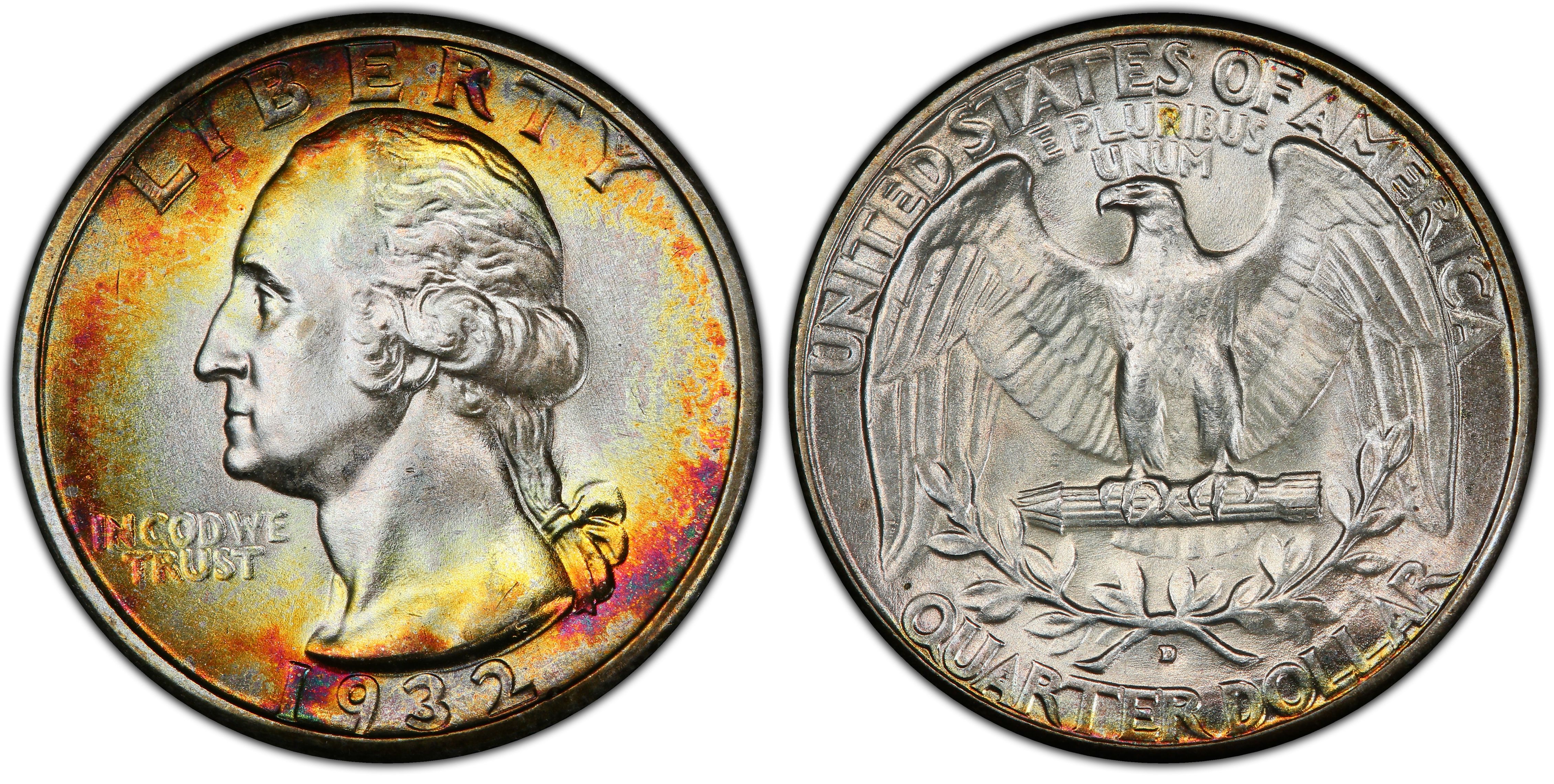 #1 PCGS MS66
Heritage Auctions, August 9, 2001, Lot 6044 – $89,125; “The Marquette-Yakima Registry Set of Washington Quarters,” Bowers and Merena, April 2008, Lot 322 – $143,750; “The Burgess Lee Berlin, M.D., J.D. Collection of Important United States Rarities,” Heritage Auctions, January 4, 2018, Lot 4837 – $74,400; Dell Loy Hansen; "The D.L. Hansen Washington Quarter Complete Variety Set" (PCGS Set Registry). Magenta, gold, and orange toning along the obverse rim. |
 #1 Est. MS66
As PCGS MS65+ #25318850. Stack's Bowers, Februay 2015, Lot 1600 - $41,125. As PCGS MS66 #25696037. Heritage Auctions, June 4, 2015, Lot 3936 - $82,250; As CACG MS66 #996764126. Heritage Auctions, October 2, 2025, Lot 3047 - $78,000. Blast white obverse and reverse. Pinsized tick in Washington's hair. |
|
#3 PCGS MS65+
"The Dr. Steven Duckor Collection of Washington Quarters," GreatCollections, April 2, 2023, Lot 1342346 – $29,250. Orange gold patination throughout with patches of golden-green toning along the right and lower obverse periphery and in various places on the reverse. |
 #3 PCGS MS65+
GreatCollections, October 5, 2025, Lot #1929545 - $21,487.50. Champagne gold toning on both sides with scattered patches of russet toning along the periphery. |
 #3 PCGS MS65+
Legend Rare Coin Auctions, July 15, 2021, Lot 152 - $29,375. Iridescent pearly gold surfaces with a thin band of emerald green and russet toning along the upper obverse periphery. A thin arced mark near 3 o'clock serves as a pedigree marker. |
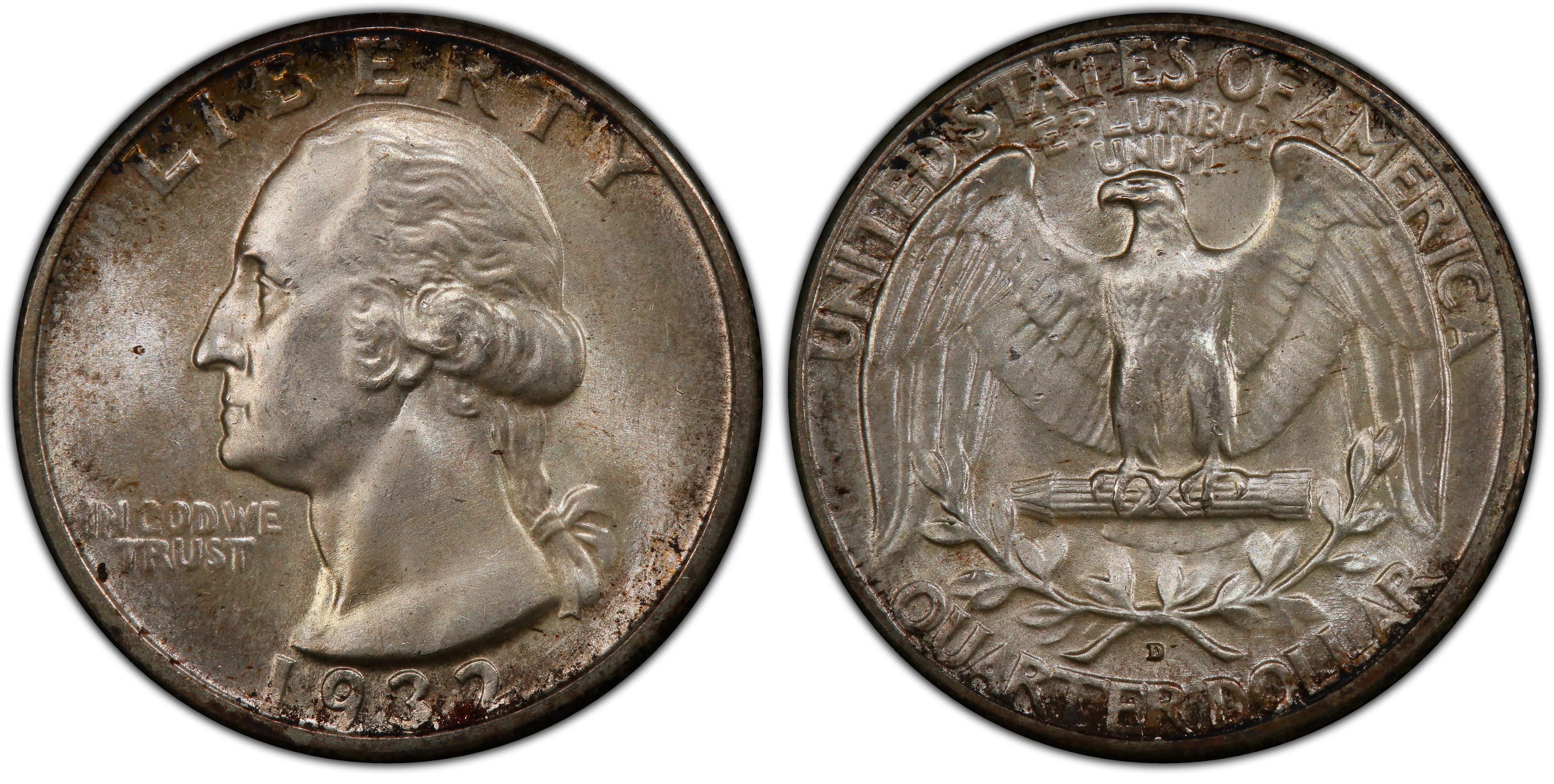 #3 PCGS MS65+
Heritage Auctions, April 25, 2021, Lot 5031 - $16,200. Frosty surfaces with wispy sand-colored toning with flecks of russet along the periphery. There is a faint diagonal reed mark in Washington's hair. |
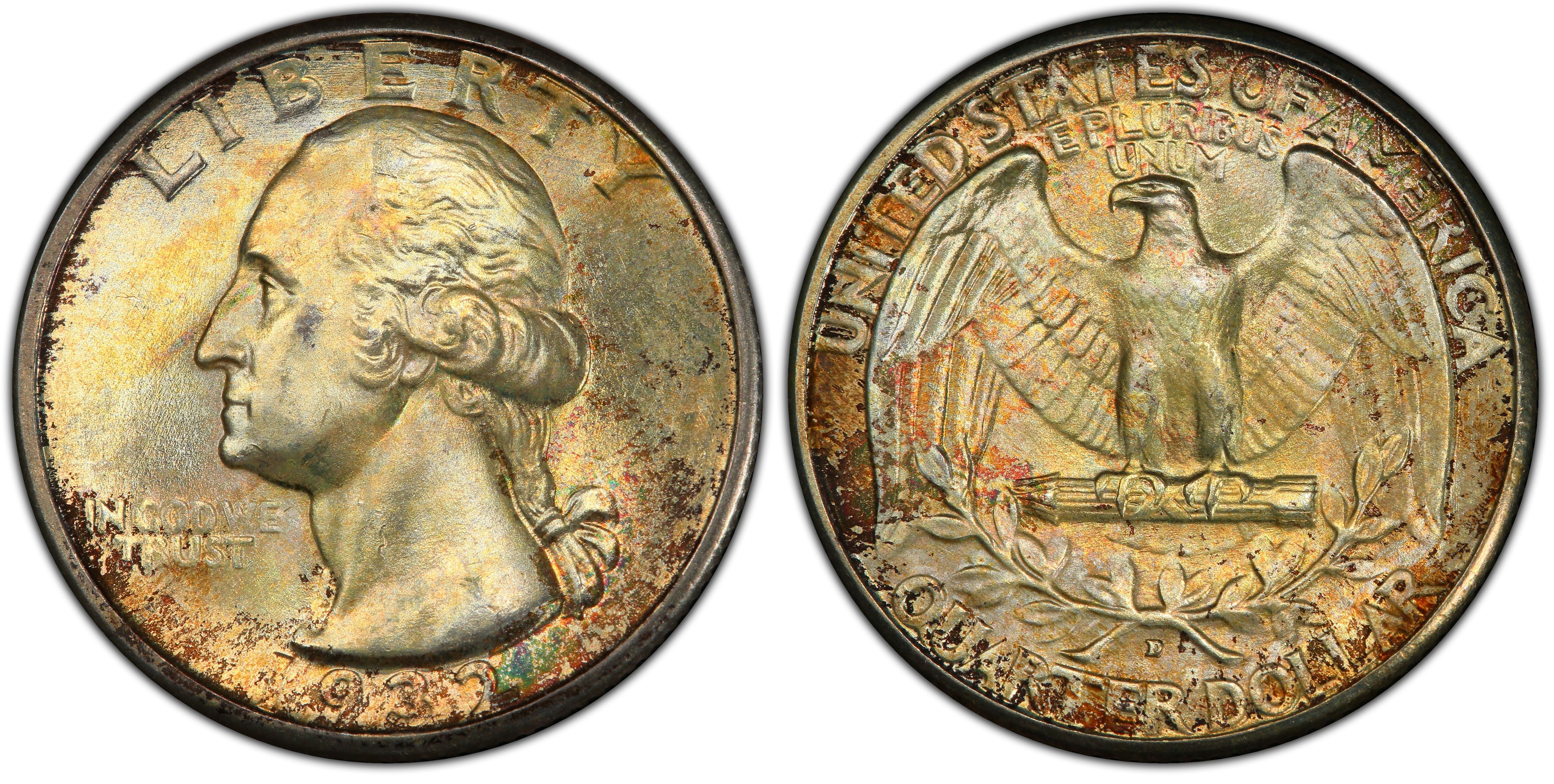 #3 PCGS MS65+
As PCGS MS65 #60055473. Heritage Auctions, January 2003, Lot 6974 - $16,800; "The Houston Collection of Washington Quarters," Heritage Auctions, March 2006, Lot 680 - $17,250. As PCGS MS65+ #38559948. "The D. Brent Pogue Collection, Part VII," Stack's Bowers, March 25, 2020, Lot 7182 - $19,200. Lustrous gold and apricot patination with flecks of russet and green toning along the borders. |
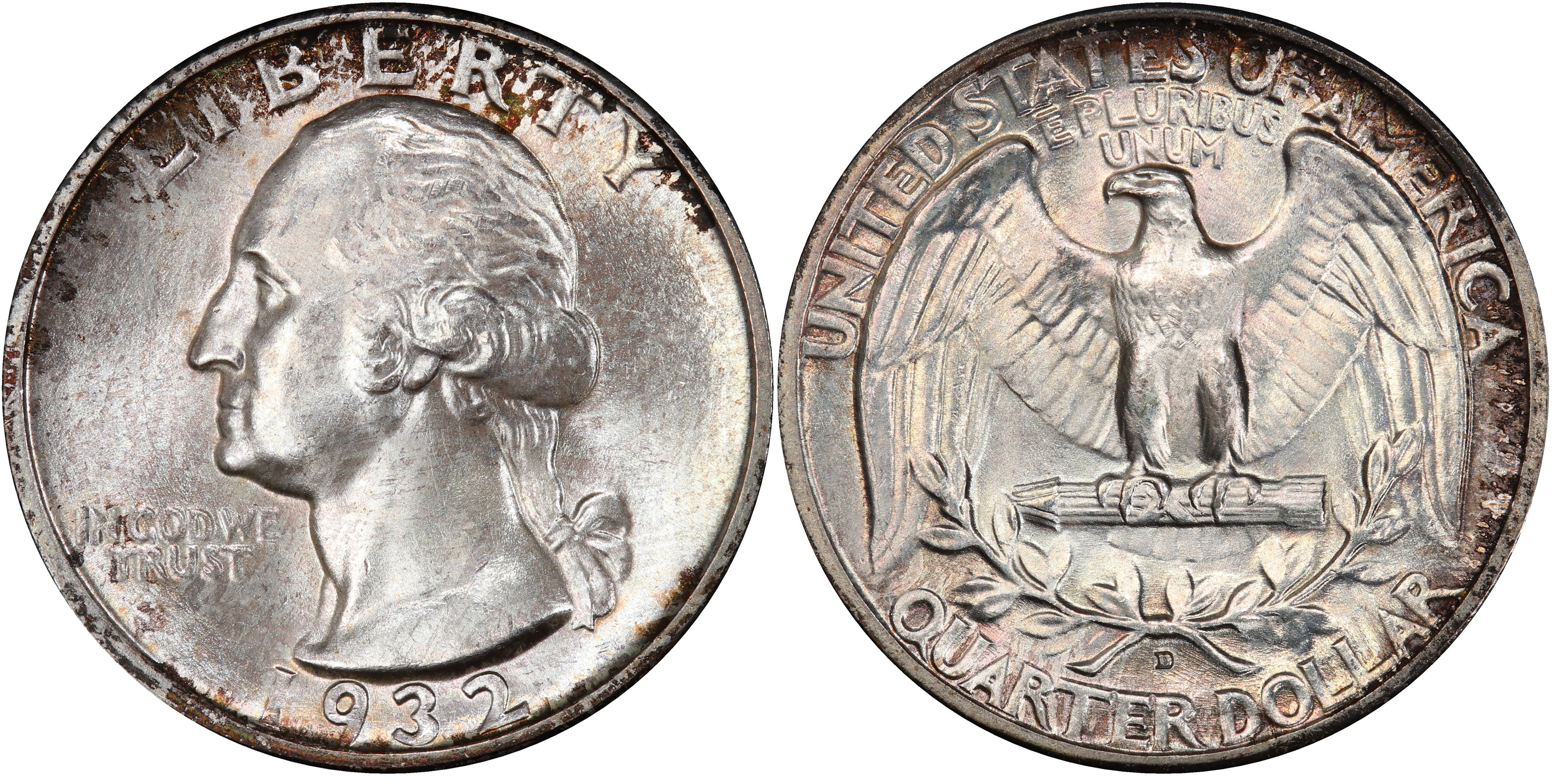 #3 PCGS MS65+
Legend Rare Coin Auctions, May 17, 2018, Lot 534 - $19,387.50. Frost centers with flecks of russet toning scattered along the edges. A tiny tick near Washington's Adam's apple serves as a pedigree marker. |
 #3 PCGS MS65+
Heritage Auctions, December 3, 2015, Lot 3163 - $21,737.50. Frosty, brilliant surfaces with a dollop of coppery-orange toning at the top of Washington's head and the word LIBERTY. Flecks of this toning carry over to the reverse rim at the bottom of QUAR. Pin-sized reed marks run vertically below TRUST. |
| #3 PCGS MS65+ |
The 1932-D Washington Quarter
No quarters were produced in 1931. With the Great Depression severely constricting economic activity, there was simply no demand. When production resumed in 1932, Hermon Atkins MacNeil's Standing Liberty design had been replaced by John Flanagan's Washington Quarter, a numismatic commemoration of the nation's first President on the bicentennial of his birth.
The MacNeil design had endured a troubled production history. It eventually took an Act of Congress to circumvent federal law, which normally required coin designs to remain in production for a minimum of 25 years. The law, signed on March 4, 1931, left the particulars of the design to the Secretary of the Treasury, simply calling for a new quarter featuring Washington on the obverse and "appropriate devices" on the reverse.
A design competition was held in July 1931, and artists were required to follow strict guidelines. For the portrait, contestants had to model their work after Jean-Antoine Houdon’s 1785 bust, considered the most authentic likeness of Washington.
Ninety-eight artists submitted a total of 100 designs. The Commission of Fine Arts (CFA), led by Chairman Charles Moore, was tasked with reviewing the models and recommending a winner. The CFA was unanimous in its choice: Laura Gardin Fraser. Fraser was already a significant figure in the numismatic world, having designed several acclaimed coins, including the Oregon Trail Memorial Half Dollar. Her submission featured a powerful, high-relief portrait of Washington and a majestic, spread-winged eagle. The CFA praised its "artistic excellence" and its spirited interpretation of the Houdon bust. However, by law, the final decision rested solely with the Secretary of the Treasury, Andrew Mellon.
Mellon's Choice
Despite the CFA’s enthusiastic recommendation, Secretary Mellon exercised his legal authority to select the model submitted by John Flanagan. While the CFA, arguing from a purely aesthetic point of view, formally protested the decision, Mellon’s refusal to yield was grounded in the harsh technical realities of the Mint. Having served as Secretary since 1921, Mellon had overseen the production of numerous "artistic" coins, such as the Mercury Dime and Walking Liberty Half Dollar, which were notorious for weak strikes and rapid die failure due to their high relief. Even the Standing Liberty Quarter, which the Washington Quarter was scheduled to replace, had proven to be a technical nightmare for the Mint.
When Mellon departed in February 1932 to serve as Ambassador to the United Kingdom, the CFA appealed to the new Secretary, Ogden Mills, hoping for a reversal. Mills, however, stood by the original decision. His refusal to "insult" Mellon was likely less about personal ego and more about respecting a predecessor’s seasoned technical judgment regarding what actually worked on a high-speed coin press.
Modern theories often attribute Mellon’s rejection of Fraser’s design to chauvinism, yet this narrative lacks a foundation in the historical record. In fact, Mellon had personally approved three of Laura Gardin Fraser’s designs during his tenure. He was well aware of her immense talent; his objection was not to the artist, but to the relief of the specific model. Mellon prioritized "Mint utility" - the ability to strike millions of durable, stackable coins - over the CFA’s preference for high-relief sculpture.
Furthermore, the common dismissal of Flanagan’s design as "inferior" ignores both his professional pedigree and the coin’s enduring success. Flanagan was a highly respected sculptor who, like Fraser's husband James Earle Fraser, trained under the legendary Augustus Saint-Gaudens. As a senior assistant in the St.-Gaudens studio from 1885-1890, Flanagan helped the master execute several of his most important early works.
In the Washington Quarter, Flanagan produced a design that Mellon believed was better suited for the technology of the era; this remained true even though the Mint later performed revisions to improve the lettering in 1934 and to accommodate the production of Proof coins in 1937. The historical evidence demonstrates that the Flanagan design possessed significant merit, serving the country for nearly 90 years. The Mint's eventual issuance of the Fraser design, first as the 1999-W Washington $5 Gold Coin (#9777) and later as the obverse for the American Women Quarter series, has allowed collectors to appreciate the merits of both designs.
The Washington Quarter Debuts
The release of the Washington Quarter could not have come at a worse time. By 1932, U.S. unemployment reached nearly 25 percent, meaning one out of every four workers had no income to spend. The velocity of money slowed to a crawl, and the Treasury held massive stockpiles of unneeded coins. From 1930 to 1932, the Mint saw a 91 percent decrease in Cent production and a complete suspension of Nickel, Dime, Half Dollar, and Silver Dollar production. The Treasury did undertake a mass striking of gold eagles; however, one year later, President Roosevelt would issue Executive Order 6102, ending the era of circulating American gold that had begun in 1795.
Production of the new quarter commenced at the Philadelphia Mint in July and at the Denver and San Francisco Mints in September. Philadelphia struck 5,404,000 coins, while Denver struck only 436,800 and San Francisco only 408,000. The 1932-D (#5791) and 1932-S Washington Quarters (#5792) were not intended to be low-mintage rarities; it was simply that regional banks had little need for new coins. Quarter production was suspended again in 1933. Remarkably, despite now being recognized as a key date, the 1932-D Washington Quarter was still available for purchase directly from the U.S. Treasury at face value plus postage as late as 1934.
Collecting the 1932-D Washington Quarter
In time, the entire mintage of the 1932-D was released into circulation, where the coin freely changed hands for decades as the scarcity of the issue went largely unnoticed. By the 1950s and early 1960s, the coin-collecting hobby was booming, thanks in part to the proliferation of penny boards and coin albums and the annual release of R.S. Yeoman’s Official Blue Book and Red Book Guide to United States Coins. At this point, even beginner collectors had become aware of the issue's scarcity. Any 1932-D Washington Quarter, regardless of its state of preservation, became a sought-after collectible. Despite having a slightly higher mintage than the 1932-S, the survival rate of 1932-D quarters—especially in higher grades—is noticeably lower. The number of Mint State coins held back was surprisingly low for the period, and once again, the Depression was to blame.
Whether you are looking for a "hole filler" or a PCGS Set Registry quality coin, certification is a must. The deceptive application of a "D" mintmark on a Philadelphia-strike 1932 Washington Quarter (#5790) has been a prevalent counterfeiting method for this issue since the 1950s. In more recent times, sophisticated counterfeits from Asia have entered the market as well. This explains why 70 percent of all 1932-D Washington Quarters submitted to PCGS for authentication and encapsulation are circulated examples. Contrast this with the 1932 Philadelphia "Plain" issue, in which 85 percent of all coins certified by PCGS are in Mint State.
Unfortunately, uncirculated 1932-D Washington Quarters do not typically possess great eye appeal and are rare in any grade finer than PCGS MS65. Over the course of 40 years of grading, PCGS has bestowed the PCGS MS66 grade on only two examples: one fully brilliant and one with impressive toning. A small number of coins just miss that mark at PCGS MS65+.
* * *
The 1932-D is by far the rarest of the Washington quarters. There are only two Washington quarters with mintages of under one million coins. The 1932-D has an original mintage of 436,800 coins and the 1932-S has a mintage of 408,000 coins. Both coins have been highly sought after in all grades for the past 60 years. They are the key dates of the Washington quarter series and actually are two of the better known rare coins of the twentieth century.
The post World War II coin boom (starting in the 1950s) saw a lot of collectors looking for coins in circulation that they needed for their various sets. At the time, it was possible to find most of the copper, nickel, and silver coins of the 20th century in circulation. They may have been low grades, but at the time most collectors just wanted to "fill the hole" and condition was a secondary consideration. The coins that were more difficult to find were the lower mintage coins such as the 1909-S VDB cent, the 1916-D dime, and the 1932-D and 1932-S quarters. They were nearly impossible to find in circulation and were relatively expensive even in low grades.
Nowadays, condition is much more important, but the 1932-D and 1932-S quarters are still very desirable in all grades. I believe they are very similar in rarity in circulated grades. But Uncirculated examples of the 1932-S was apparently saved a little more than the 1932-D in the year of issue as the 1932-D is definitely rarer than the 1932-S in mint state condition. The 1932-D has the lowest MS65 population of any Washington quarter. As I'm writing this there is one lone PCGS MS66, a marvelous coin that sold at auction for $143,000 in 2008.