1999-P 25C Delaware (Regular Strike)
Series: (None)
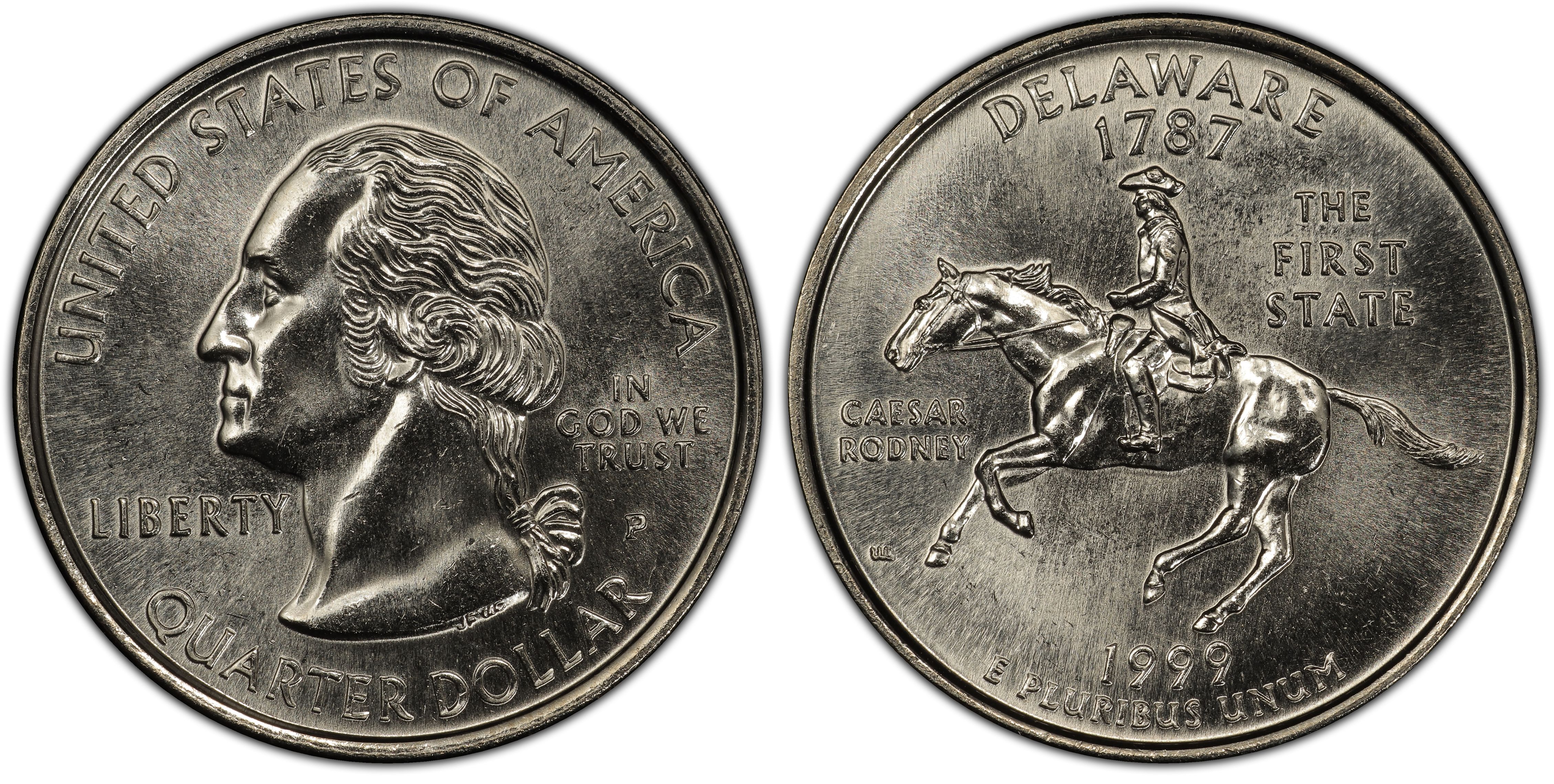
PCGS MS69
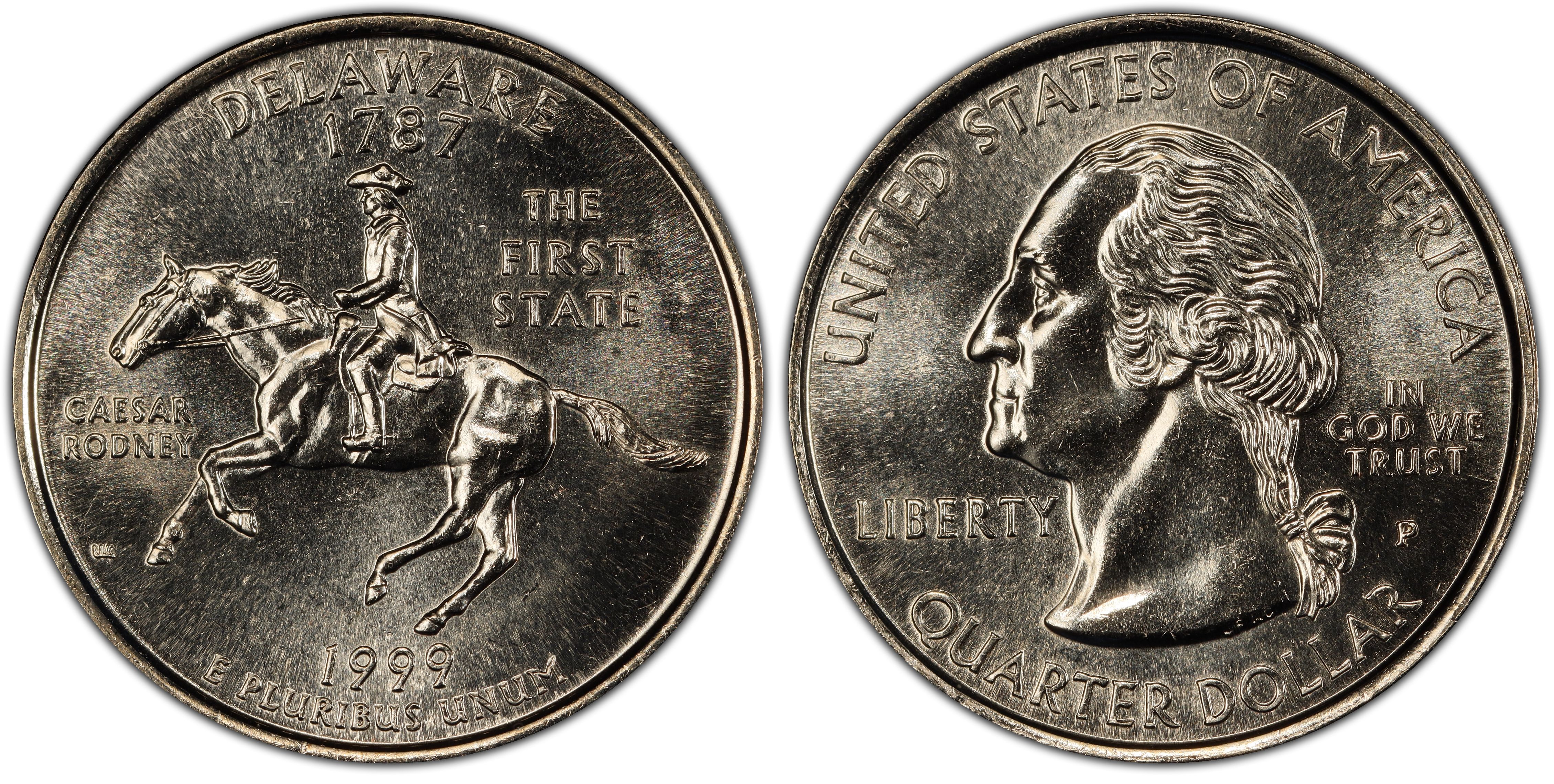
PCGS MS68

PCGS MS68
- PCGS #:
- 5944
- Designer:
- John Flanagan/William Cousins
- Edge:
- Reeded
- Diameter:
- 24.30 millimeters
- Weight:
- 5.67 grams
- Mintage:
- 373,400,000
- Mint:
- Philadelphia
- Metal:
- 75% Copper, 25% Nickel
- Auction Record:
- $4,888 • MS66 • 05-28-2008 • Heritage Auctions
Rarity and Survival Estimates Learn More
| Survival Estimate | |
|---|---|
| All Grades | 280,050,000 |
| 60 or Better | 84,015,000 |
| 65 or Better | 74,680,000 |
| Numismatic Rarity | |
|---|---|
| All Grades | R-1.0 |
| 60 or Better | R-1.0 |
| 65 or Better | R-1.0 |
| Relative Rarity By Type All Specs in this Type | |
|---|---|
| All Grades | N/A |
| 60 or Better | N/A |
| 65 or Better | N/A |
| Relative Rarity By Series All Specs in this Series | |
|---|---|
| All Grades | N/A |
| 60 or Better | N/A |
| 65 or Better | N/A |
Condition Census What Is This?
|
#1 PCGS MS69
Alan Epstein; "The Arthur V. Epstein State Quarter Collection" (PCGS Set Registry - Retired); "The Elite Collection" (PCGS Set Registry). The Arthur V. Epstein set was assembled by his son, Alan. |
|
#2 PCGS MS68
"The Stephenville Collection," Heritage Auctions, April 15, 2024, Lot 93240 - $660; "The Mike's Extra State Quarters Collection" (PCGS Set Registry). |
|
#2 PCGS MS68
GreatCollections, October 31, 2021, Lot 1071733 - $871.88; John O. Phillips; "The Brodie Collection" (PCGS Set Registry). |
|
#2 PCGS MS68
Heritage Auctions, December 13, 2018, Lot 3390 - $960. |
|
#2 PCGS MS68
Michael Fuller; Heritage Auctions, December 4, 2007, Lot 67509 - $1,472; R. Lewis; "The Lewis Washington Quarters Basic Set" (PCGS Set Registry). |
|
#2 PCGS MS68
"The dhhank (2) Collection" (PCGS Set Registry). |
The 1999 Delaware State Quarter
Released on January 1, 1999, the Delaware State Quarter holds the distinction of being the first issue in the ambitious 50 State Quarters Program.. The coin honors Delaware's status as the "First State"—the first to ratify the U.S. Constitution on December 7, 1787.
The 50 State Quarters program utilized a modified version of John Flanagan’s iconic 1932 Washington portrait, though the series required a significant structural overhaul to accommodate the new commemorative reverses. To clear space for the state-specific artwork, mandated inscriptions such as UNITED STATES OF AMERICA and the QUARTER DOLLAR denomination were moved from the reverse to the obverse, necessitating a reduction in the size of Washington’s bust. Additionally, the mottos LIBERTY and IN GOD WE TRUST were repositioned, while the mintage date was moved to the bottom of the reverse just above E PLURIBUS UNUM. This reorganization left the upper portion of the reverse open for the state’s name and its year of admission to the Union.
Caesar Rodney’s Midnight Ride
The reverse of the coin depicts Founding Father Caesar Rodney. A militia officer and member of the Continental Congress, Rodney is celebrated for his legendary 70-mile ride from Dover to Philadelphia.
On July 1, 1776, upon learning that the vote for independence was deadlocked, Rodney braved a thunderstorm and severe illness to reach Philadelphia by July 2. His tie-breaking vote was instrumental in the passage of the Declaration of Independence, which he later signed on August 2.
The First "Quartergate" Controversy
The 1999 Delaware State Quarter launched to immense public fanfare, yet the debut of the program—which honored five states annually—was not without controversy. Disputes regarding design attribution and the inclusion of specific engravers' initials began with this first release and persisted through subsequent issues. This ongoing friction eventually evolved into a national scandal that collectors and the media famously dubbed "Quartergate." In hindsight, this was predictable.
On February 2, 1998, Delaware Governor Tom R. Carper launched a statewide design contest. Among the 300 entries submitted to the Delaware State Arts Council were 40 from Caesar Rodney High School, including a concept by art teacher Eddy Seger. Seger’s original design featured Caesar Rodney facing right on a galloping horse, set against an outline of the state.
The Council forwarded the 20 best entries to the United States Mint with their recommendations. The selected artists were required to sign a release waiving the rights to their work and acknowledging the Mint’s authority to revise or alter the designs for production. Seger, whose work was among those chosen, signed the agreement.
After evaluating the entries for technical and artistic merit, the Mint returned three finalists to Governor Carper, who invited the public to vote for the winner:
- The Quill and Parchment: A symbolic representation of Delaware's ratification of the U.S. Constitution.
- Lady Liberty: A puzzling concept featuring Liberty holding "Baby Delaware" alongside a torch and a rising sun.
- Caesar Rodney: A design closely mirroring Seger's concept, though it had been reversed to face left and modified by Mint engraver William Cousins. Seger pointed out that Rodney avoided being shown from the left, as that side of his face was disfigured due to cancerous growth. It was a historical nuance that Cousins, and the Mint, seemingly failed to consider when they mirrored the design.
While the U.S. Mint initially credited Seger for the winning concept, they later removed his name from official records. Mint Engraver William Cousins, who adapted the artwork for production, is the only person officially credited on the coin (noted by his initials "WC" near the horse’s front hoof).
By 2002, the controversy gained national attention as media outlets highlighted a pattern of the U.S. Mint marginalizing state artists in favor of staff engravers. In recognition of his role, the third-party grading service PCGS released a limited-edition, numbered to 10,000, Eddy Seger "Artist Edition" signature label for Delaware State Quarters.
Launch and Early Bubble
Before the public release, a First Strike Ceremony took place at the Philadelphia Mint on December 7, 1998. VIPs in attendance received two quarters housed in a unique, official U.S. Mint plastic holder. These sets remained virtually unknown to the numismatic community for over two decades until an original ceremony set finally surfaced in 2019.
When the quarter launched, the public was eager to get their hands on the new designs. On TV coin shows, original bank-rapped rolls were selling for many multiples of their $10 face value. The secondary market bubble quickly subsided as coins entered circulation and on May 14, the Mint opened public sales of the 1999 Delaware State Quarter in 100 coin bags for $29.95 and 1,000 coin bags for $289.95. Examples were also available for purchase in the 1999 United States Mint Uncirculated Coin Set.
Collecting PCGS-Certified 1999-P Delaware Quarters
The 1999-P Delaware Quarter features a robust mintage of 373,400,000 coins. While the vast majority entered circulation and remain in use decades later, these circulated examples generally hold little interest for collectors. Instead, the focus remains on Mint State specimens in Superb Gem grades.
The Delaware design is classic yet minimalist in its use of the "canvas," resulting in a surface area dominated by large, flat fields. Consequently, incidental marks in these fields are focally visible and often limit the grade. Because these coins were struck on high-speed presses and dumped into massive totes—often weighing over a thousand pounds—they suffered constant impact. From the presses to the counting machines, contact with other coins and sorting equipment was guaranteed.
By chance, some coins fared better than others. For the perfectionist collector, 1999-P Delaware State Quarters in grades of PCGS MS68 or finer are the most desirable. To date, PCGS has certified only a single example in PCGS MS69.
* * *