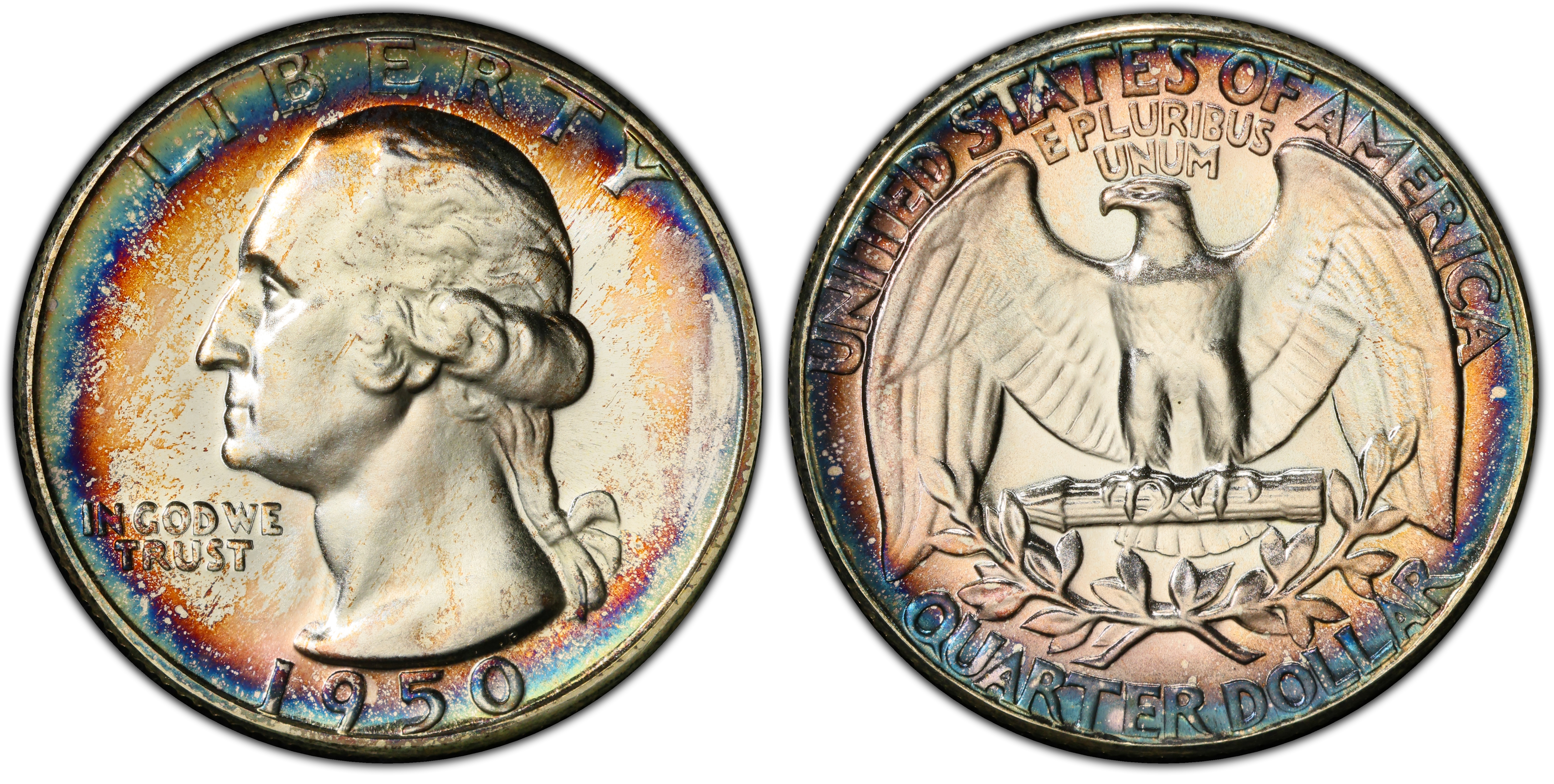
PCGS PR68+

PCGS PR68+
- PCGS #:
- 5982
- Designer:
- John Flanagan
- Edge:
- Reeded
- Diameter:
- 24.30 millimeters
- Weight:
- 6.30 grams
- Mintage:
- 51,386
- Mint:
- Philadelphia
- Metal:
- 90% Silver, 10% Copper
- Auction Record:
- $3,720 • PR68+ • 12-07-2019 • Heritage Auctions
Rarity and Survival Estimates Learn More
| Survival Estimate | |
|---|---|
| All Grades | 39,000 |
| 60 or Better | 39,000 |
| 65 or Better | 30,000 |
| Numismatic Rarity | |
|---|---|
| All Grades | R-2.6 |
| 60 or Better | R-2.6 |
| 65 or Better | R-2.7 |
| Relative Rarity By Type All Specs in this Type | |
|---|---|
| All Grades | 8 / 22 TIE |
| 60 or Better | 8 / 22 TIE |
| 65 or Better | 8 / 22 TIE |
| Relative Rarity By Series All Specs in this Series | |
|---|---|
| All Grades | 8 / 22 TIE |
| 60 or Better | 8 / 22 TIE |
| 65 or Better | 8 / 22 TIE |
Condition Census What Is This?
 #1 PCGS PR69
Crescent shaped rainbow toning on the obverse and reverse. This toning covers the left and top of the obverse and the left and bottom of the reverse. |
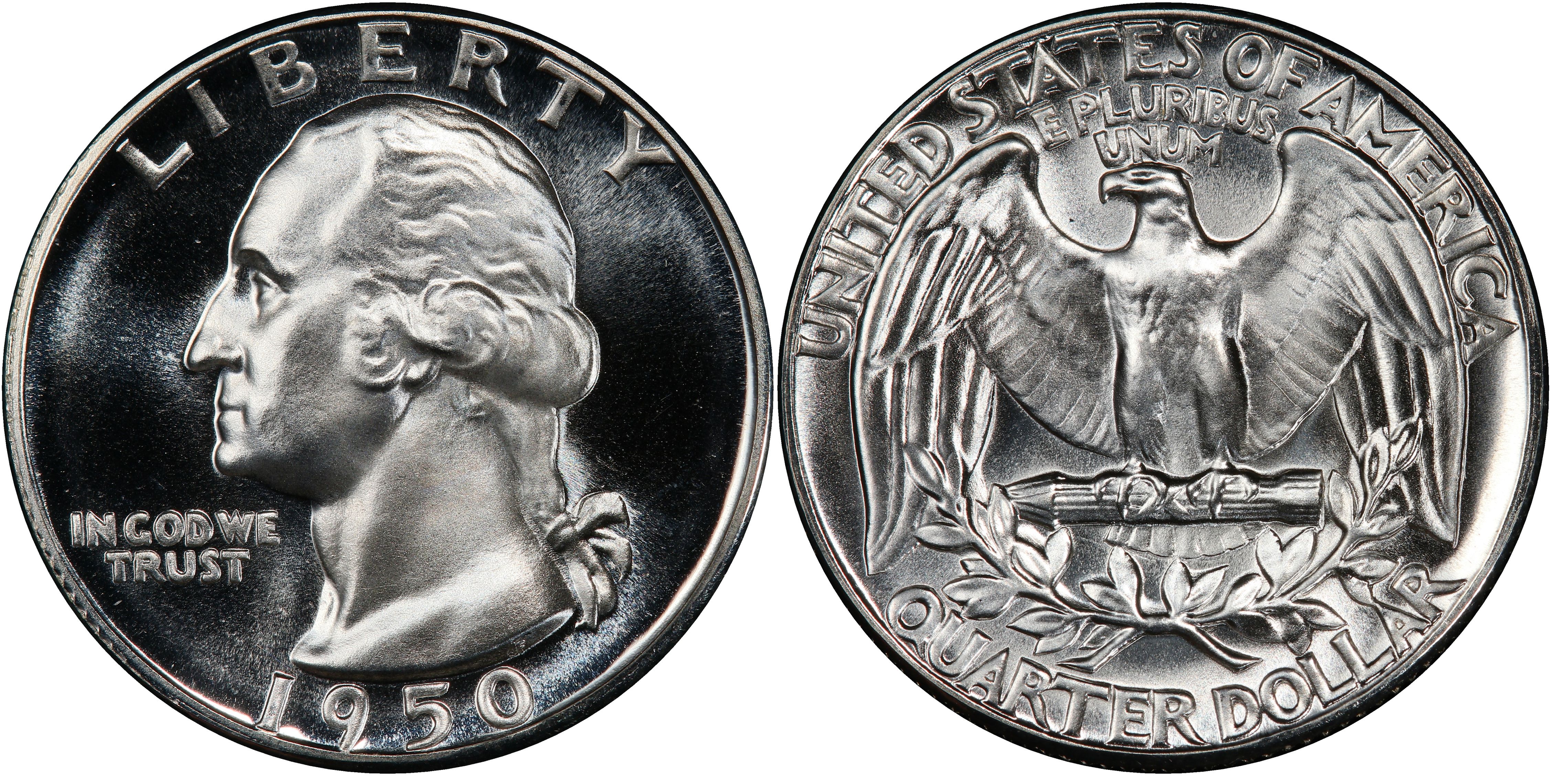 #2 PCGS PR68+
Heritage Auctions, December 7, 2019, Lot 3787 - $3,720; Dell Loy Hansen; "The D.L. Hansen Complete Basic Proof Set" (PCGS Set Registry). Top pop, pop one when offered. |
|
#2 PCGS PR68+
Both sides display an intense band of rainbow toning along the borders, with sunyellow toning at the centers. The obverse is also graced by thin layer of red splash toning. |
|
#2 PCGS PR68+
"The DNFT Collection" (PCGS Set Registry). The obverse exhibits areas of blue-green rainbow toning, which is strongest in the upper-left field. |
1950 Washington Quarter Proof
When the Washington Quarter debuted in 1932, the U.S. Mint had been without a Proof program for 16 years. While production resumed in 1936, it was halted again in 1942 due to the exigencies of World War II. Those early Proof sets were a stylistic "hodgepodge," mixing early 20th-century aesthetics—like the Walking Liberty Half Dollar—with the newer "Presidential" style featuring George Washington and Abraham Lincoln.
It is striking to consider how forward-thinking the Lincoln Cent was. Having served the nation for over 117 years, it will likely be the final design for a denomination that traces its lineage back to the American colonies and, before that, to England itself.
While Washington arrived on the bicentennial of his birth, Thomas Jefferson received the same treatment in 1938 for a different reason: the Buffalo Nickel had reached its statutory minimum service life of 25 years. With the introduction of the Washington Quarter, the die was cast for America to adopt a more "imperial" coinage. Franklin D. Roosevelt followed in 1946 after his passing, and Benjamin Franklin took his place on the half dollar in 1948. When a silver dollar's return was briefly considered in 1964, the Mint actually struck over 316,000 Peace Dollars before Congress blocked its release. Seven years later, when Congress changed course an reintroduced the denomination, they again chose to displace Liberty with a President—this time, Dwight D. Eisenhower. This evolution is what makes the 1950 Proof Set so significant. As the first Proof set issued in the post-war period, it was also the first in American history to feature a roster composed exclusively of American statesmen.
The set’s release also signaled a significant shift in Mint policy: for the first time, collectors were required to purchase the full set rather than being offered the option to buy individual coins. At an issue price of $2.10 (approximately $28.53 in 2026 dollars), the Mint sold a then-record 51,386 sets. This policy change did nothing to dampen enthusiasm; by 1960, the coin-collecting market was in the midst of a massive boom, with the Mint selling nearly 1.7 million sets—a more than 3,000% increase in just one decade.
Collecting the 1950 Washington Quarter Proof
While the typical 1950 Washington Quarter Proof (base #5982) was struck with deep, mirror-like reflectivity, examples featuring Cameo frost are seldom seen. Over the decades, many of these coins have succumbed to hairlines, tarnish, or unsightly haze. For those that survive in a high state of preservation, PCGS PR66 and PCGS PR67 have proven to be the most prevalent grades. In contrast, raw examples are likely to grade lower due to decades of handling and environmental exposure. Cameos and Deep Cameos remain the most elusive prizes in the series, and high-end collectors covet them for their extreme rarity and visual "pop."
* * *