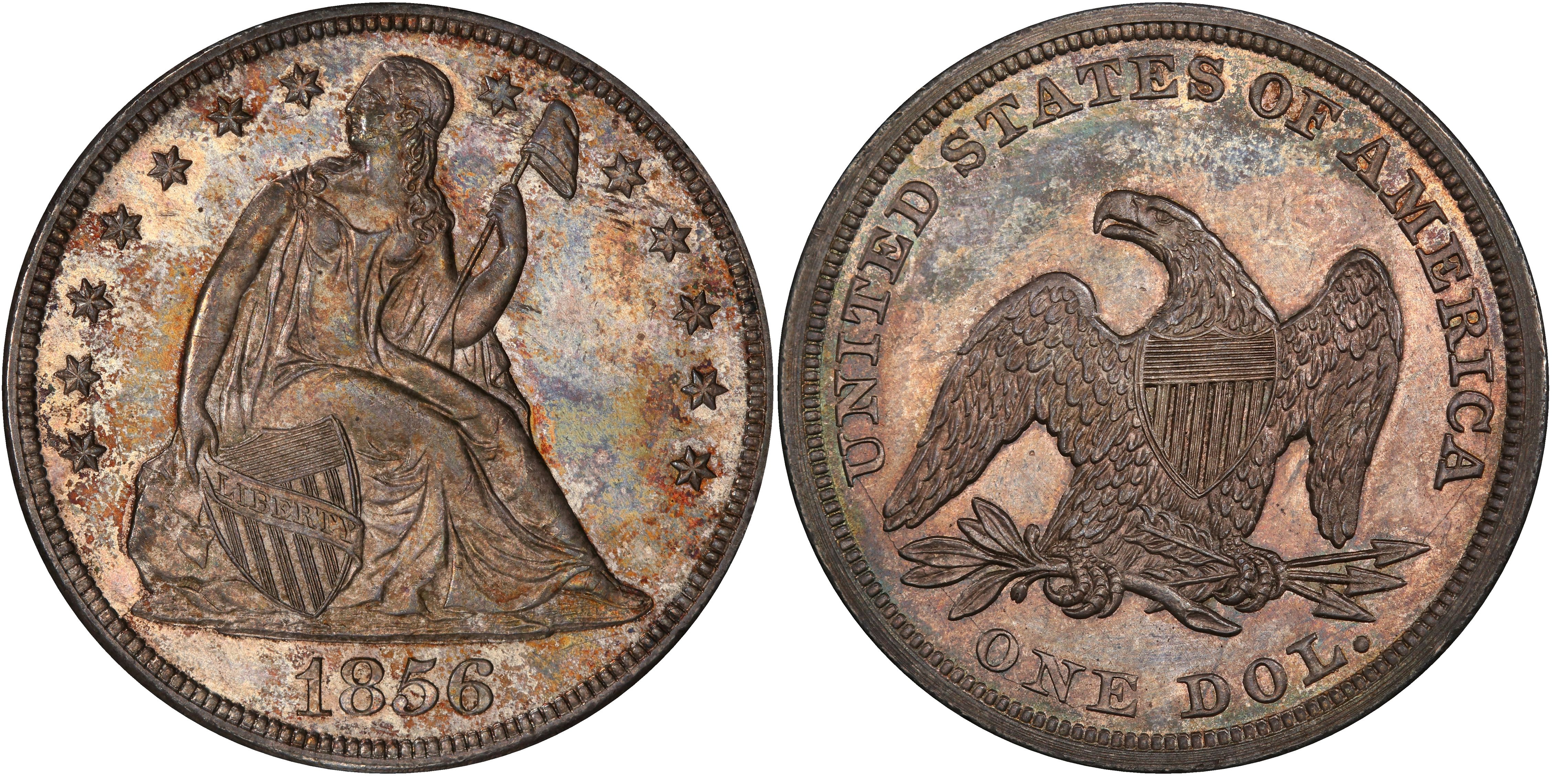
PCGS MS63

PCGS MS63
- PCGS #:
- 6944
- Designer:
- Christian Gobrecht
- Edge:
- Reeded
- Diameter:
- 38.10 millimeters
- Weight:
- 26.73 grams
- Mintage:
- 63,500
- Mint:
- Philadelphia
- Metal:
- 90% Silver, 10% Copper
- Auction Record:
- $14,950 • MS64 • 07-28-2005 • Heritage Auctions
Major Varieties
- 1856 $1
Rarity and Survival Estimates Learn More
| Survival Estimate | |
|---|---|
| All Grades | 1,100 |
| 60 or Better | 50 |
| 65 or Better | |
| Numismatic Rarity | |
|---|---|
| All Grades | R-4.9 |
| 60 or Better | R-8.5 |
| 65 or Better | R-10.1 |
| Relative Rarity By Type All Specs in this Type | |
|---|---|
| All Grades | 5 / 30 TIE |
| 60 or Better | 11 / 30 TIE |
| 65 or Better | 1 / 30 |
| Relative Rarity By Series All Specs in this Series | |
|---|---|
| All Grades | 12 / 45 TIE |
| 60 or Better | 17 / 45 TIE |
| 65 or Better | 1 / 45 |
Condition Census What Is This?
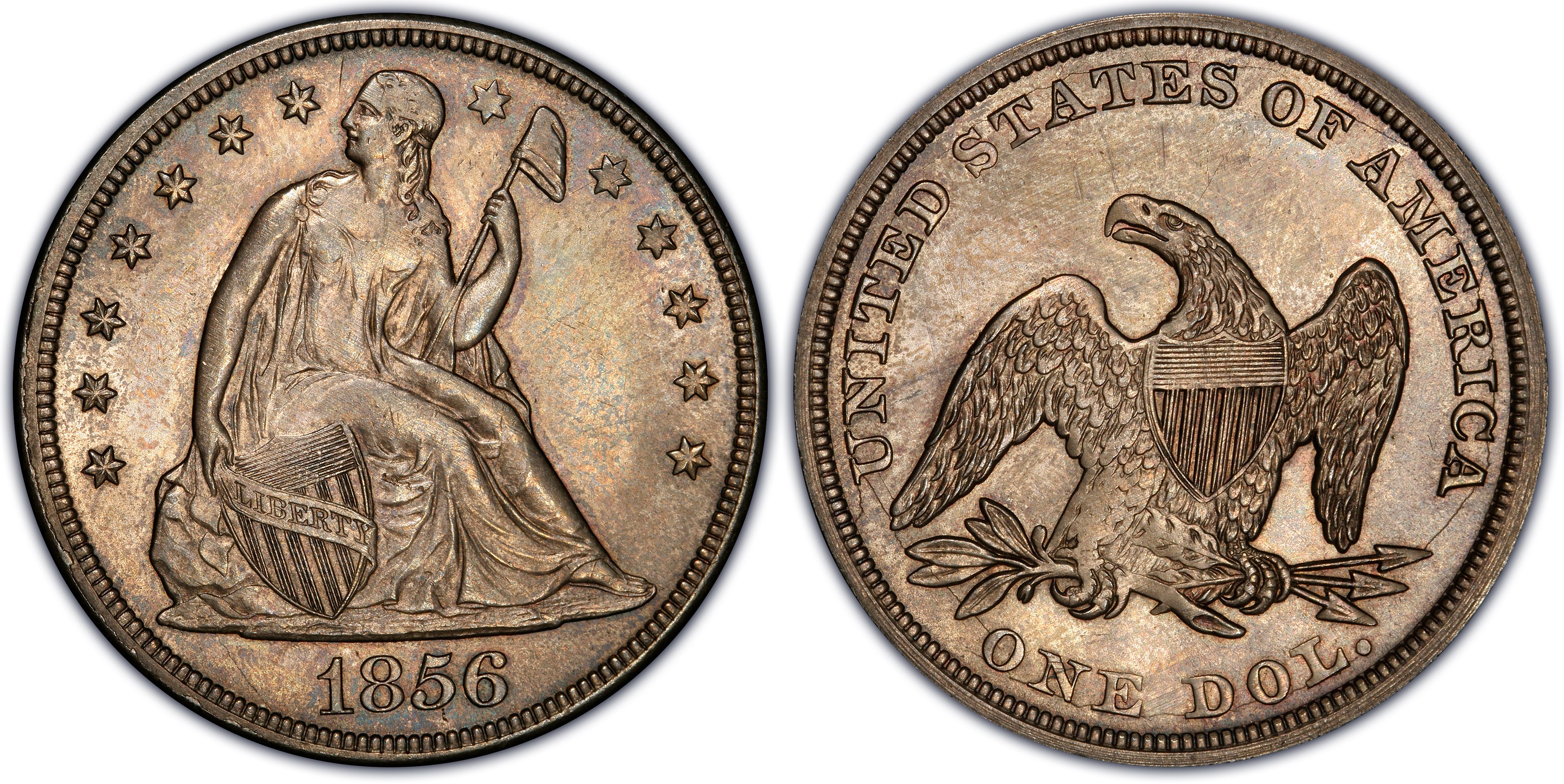 #1 PCGS MS64
As PCGS MS63 #2617684. "The Dr. John L. Pellegrini Collection of Liberty Seated Dollars," Heritage Auctions, July 29, 2005, Lot 6604 - $10,350. As PCGS MS63 #07342753. Dell Loy Hansen; "The D.L. Hansen Liberty Seated Complete Circulation Set" (PCGS Set Registry). Khaki-olive toning. A small vertical mark is noted to the right of Liberty's forehead. Spot of lighter toning to the immediate right of "1" of the date (this and the lighter toning around Star 2 was diagnostic for the pedigree match). A die crack runs through the "5", while another extends from the denticles at 6 o'clock to the base of the design. The reverse exhibits numerous additional die cracks. The eagle's right leg is softly struck. |
 #1 PCGS MS64
Legend Numismatics; "The American Girls Collection" (PCGS Set Registry). Shimmering bronze-gold hues accentuate a layer of olive-toned patina. Hints of red, blue, and green iridescence appear throughout. |
|
#3 PCGS MS63
"The Pelican Bay Collection, Part II," Heritage Auctions, August 31, 2025, Lot 3170 - $16,800. Champagne centers yield to bronze-gold coloration in the obverse fields and along the rims. A splash of steel-blue toning is noted between stars 3 and 4, extending to the denticles. The reverse is more lightly toned. Characteristic die cracks accompany a softly struck right leg on the eagle. |
 #3 PCGS MS63
“The Des Moines Collection,” Stack’s Bowers, August 15, 2018, Lot 1199 – $13,800; Vance Oglesbee; "The Fairfield Collection Liberty Seated Dollars Collection" (PCGS Set Registry). Splash of dark olive toning to the right of Stars 12 and 13. Similar toning from rim to Star 12. Diagonal mark from below the first T of STATES to the eagle. |
|
#3 PCGS MS63
"The American Girls 2 Collection" (PCGS Set Registry). |
|
#3 PCGS MS63
Warren Mills; "The Magical Fruit Collection" (PCGS Set Registry). Collector description: Subtle pastel colors. Typical strike weakness. Superior eye appeal. Wholesome. |
| #3 PCGS MS63 |
The 1856 Liberty Seated Dollar
The 1856 Liberty Seated Dollar (#6944) is a semi-key in a series replete with deceptively tough dates. Following the passage of the Coinage Act of March 3, 1853, the always-tenuous balance between gold and silver in America's bimetallic system was stabilized to the point where silver coins in denominations up to 50 cents again circulated freely. Normalcy had been restored, and the exuberant silver-coin mintages of 1853 returned to predictable levels. Already, however, private banknotes were exerting their influence on the economy. In the 1856 Annual Report of the Director of the Mint, James Ross Snowden advised Congress on this matter, suggesting that the nation would never fully realize the benefits of sound specie circulation so long as banknotes (at least those valued at $20 and under) circulated side-by-side with them.
Snowden's position was rooted in an ideological preference for hard money, but he was also defending the enterprise of the United States Mint against what he must have known was an inevitability. In fact, the very government he counseled would soon issue its own paper currency to fund the Civil War. The nation's sound-money ambitions would not be fully realized until December 1878, when gold, silver, and paper money finally traded at par with one another.
Silver Dollars Remain Unloved Domestically
From 1851 to 1859, the Philadelphia Mint produced silver dollars exclusively in limited numbers. This denomination was struck upon request by depositors, typically for export. Consequently, Liberty Seated Dollars of this period are scarce-to-rare in Mint State and exceptionally rare in grades PCGS MS63 and above. Examples seldom appear at auction; those that do must be judged against the surviving population rather than an aesthetic ideal of a "perfect" coin.
Because of this scarcity, the Liberty Seated series cannot be compared to the later Morgan or Peace Dollars. While those can be collected by the masses in high grades, Seated Dollars—especially at the high end—make themselves available only to a select few.
Diagnostics and Production
While five die pairs were prepared for circulation strikes, researchers Osburn and Cushing have identified only one die marriage for business strikes and a separate marriage for Proofs (OC-1 and OC-P1). All business strikes carry an italicized "5" in the date.
Early strikes exhibit fine die lines under Liberty's chin—a feature specialists have dubbed "Chin Whiskers." As the dies aged, this fine detail wore away.
Strike quality varies dramatically; many examples lack detail in the upper-right stars and the eagle’s left leg. Die cracks are often noted at the bottom of the obverse and can be quite dramatic on the reverse.
|
1856 Liberty Seated Dollar Production |
|||
| January 30, 1856 | 10,000 struck | January 31, 1856 | 18,000 struck |
| February 4, 1856 | 17,000 struck | February 9, 1856 | 18,500 struck |
| Total Mintage: 63,500 coins | |||
Production of the 1856 Liberty Seated Dollar began on January 30 with an emission of 10,000 coins. Another 18,000 were struck the following day. Two additional strikings took place in early February, culminating with 18,500 produced on February 9, for a total mintage of 63,500. By comparison, Philadelphia manufactured 938,000 Liberty Seated Half Dollars and over 7.2 million quarters that same year.
* * *