1873 T$1 Trade (Regular Strike)
Series: Trade Dollars 1873-1878
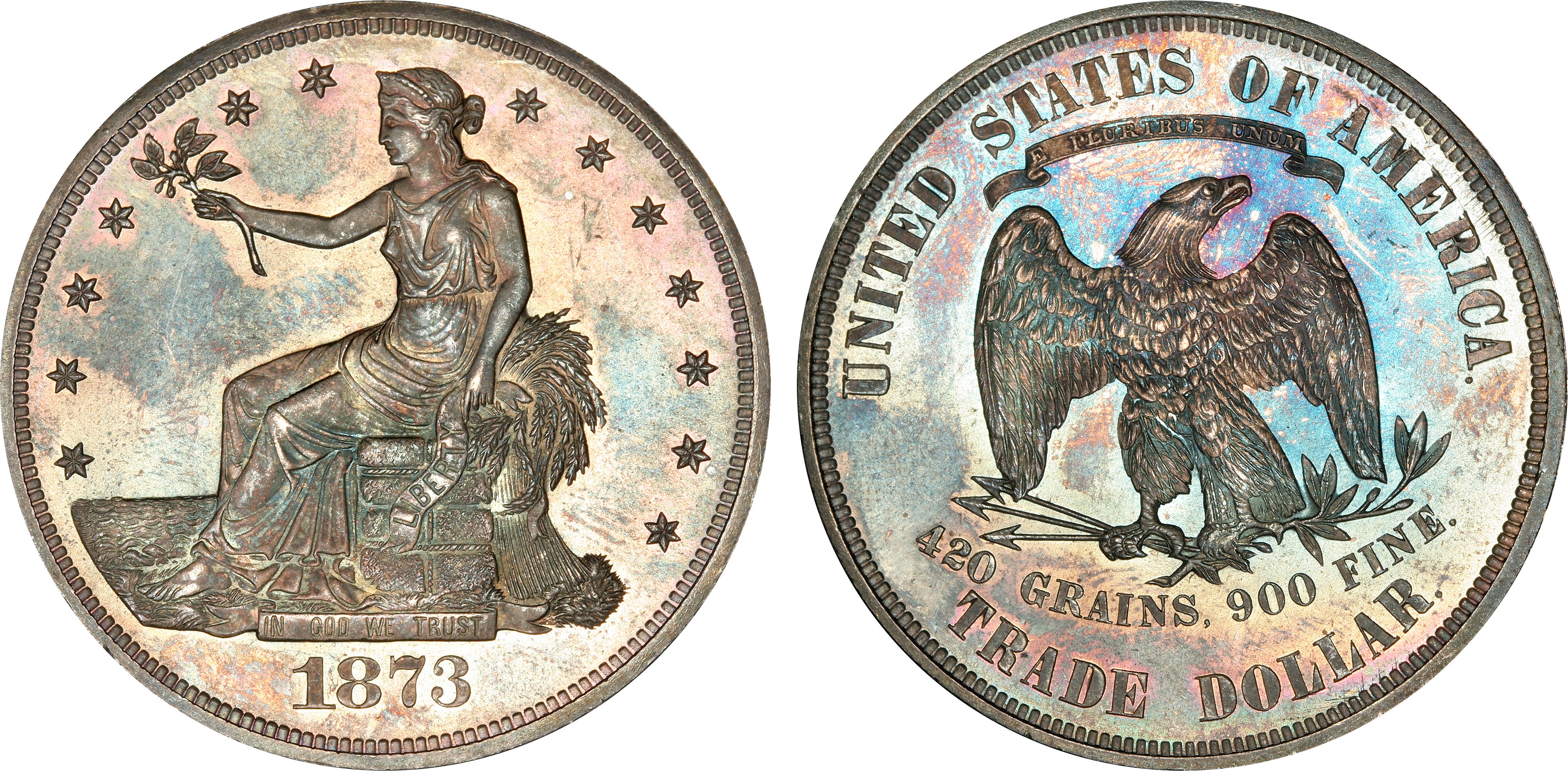
PCGS MS67

PCGS MS66
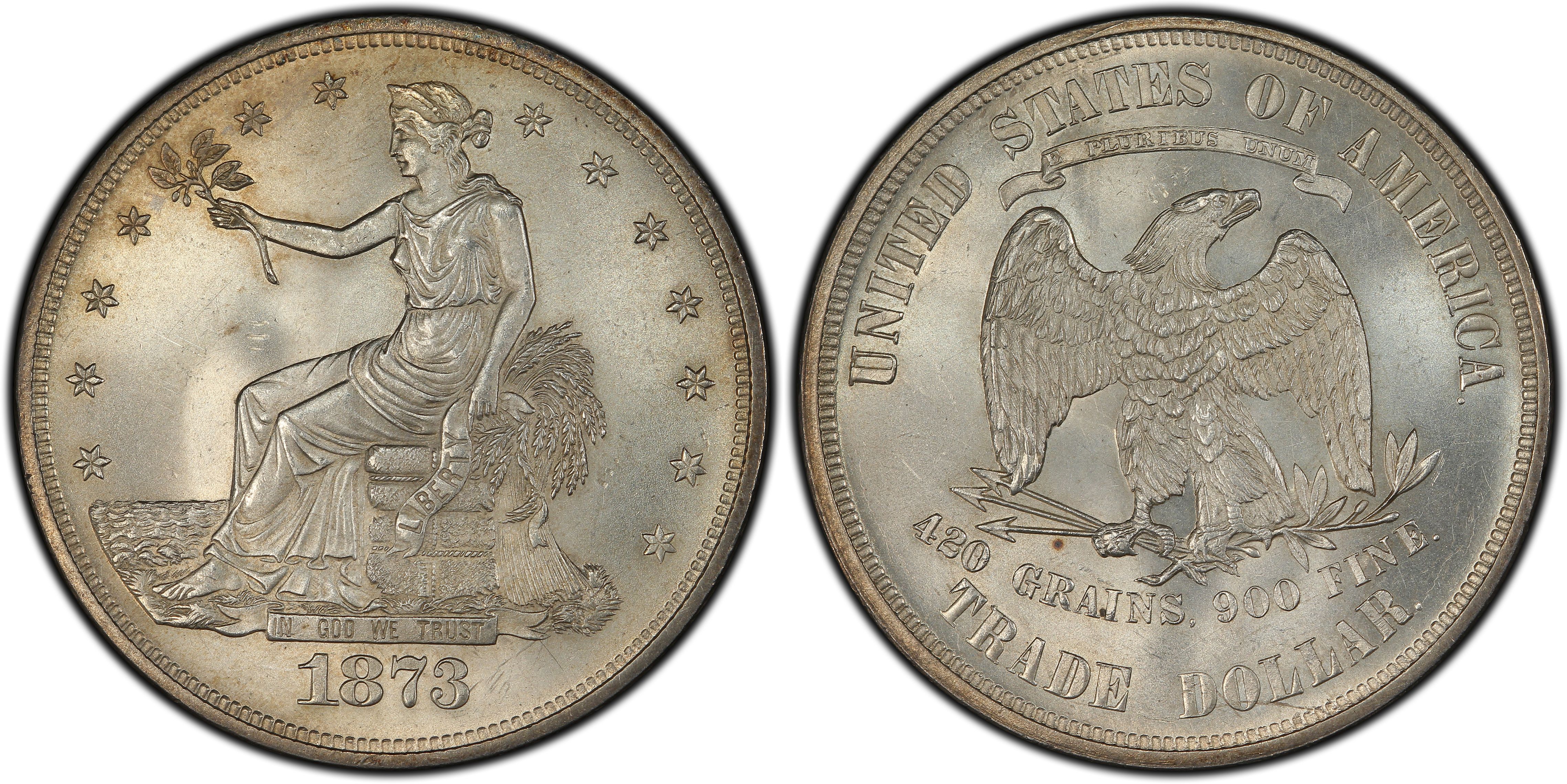
PCGS MS65+
- PCGS #:
- 7031
- Designer:
- William Barber
- Edge:
- Reeded
- Diameter:
- 38.10 millimeters
- Weight:
- 27.20 grams
- Mintage:
- 396,635
- Mint:
- Philadelphia
- Metal:
- 90% Silver, 10% Copper
- Auction Record:
- $60,000 • MS66 • 05-08-2022 • Heritage Auctions
Major Varieties
- 1873 T$1 Trade
Rarity and Survival Estimates Learn More
| Survival Estimate | |
|---|---|
| All Grades | 1,500 |
| 60 or Better | 225 |
| 65 or Better | 22 |
| Numismatic Rarity | |
|---|---|
| All Grades | R-4.8 |
| 60 or Better | R-6.7 |
| 65 or Better | R-9.0 |
| Relative Rarity By Type All Specs in this Type | |
|---|---|
| All Grades | 11 / 18 TIE |
| 60 or Better | 10 / 18 |
| 65 or Better | 14 / 18 |
| Relative Rarity By Series All Specs in this Series | |
|---|---|
| All Grades | 11 / 18 TIE |
| 60 or Better | 10 / 18 |
| 65 or Better | 14 / 18 |
Condition Census What Is This?
|
#1 PCGS MS67
"The Black Cat Trade Dollars, Basic Set Circulation Strikes (1873-1878) Collection" (PCGS Set Registry). Bright toning in pale yallow, robin's egg blue, and green. |
| #2 PCGS MS66 |
|
#2 PCGS MS66
Intense toning on the obverse in rust, red, blue, and purple. Slate green and rose toning on the reverse. |
| #2 PCGS MS66 |
| #2 PCGS MS66 |
| #2 PCGS MS66 |
|
#7 PCGS MS65+
|
The 1873 Trade Dollar: A Silver Bridge to Global Trade
Long before the concept of a global reserve currency, silver coins served as the world’s financial bridge. From the ancient Athenian Owl to the Maria Theresa Thaler, specific issues transcended their borders, winning the trust of foreign merchants through consistent purity and weight. By the eras of Exploration and Imperialism, the Spanish Milled Dollar reigned supreme.
In the United States, a rigid bimetallic system created immediate complications. To forestall the draining of the nation's precious metal reserves, the Jefferson administration halted the production of the Gold Eagle ($10) and the Silver Dollar in 1804.
Following the discovery of gold in the Carolinas and North Georgia—on former Cherokee land—the need for such protectionist measures receded. The Treasury warmed to the resumption of high-denomination coinage; consequently, the Liberty Head Eagle debuted in 1838. After experimentation with Gobrecht designs, the regular-issue Liberty Seated Dollar followed in 1840.
Domestic circulation of the new silver dollar remained erratic, as most were shipped overseas to settle foreign debts. This trend intensified in the 1850s and 60s when California gold flooded the market, driving up the relative value of silver. Because these silver dollars were worth more as bullion than their face value in gold, they were hoarded or exported to Europe and Asia. In China, they were often "chopmarked"—stamped by merchants to verify purity. However, the American coin suffered by comparison to the Spanish 8 Reales and the Mexican Peso; the Liberty Seated Dollar was lighter and slightly less pure, causing it to trade at a disadvantage. Seeking to challenge this dominance and claim a stake in East Asian markets, the United States introduced the Trade Dollar in the late 19th century. Meanwhile, the domestic silver dollar was abolished—a move critics viewed as clear favoritism toward the gold standard.
| 1873 Trade Dollar Deliveries | |||
| July 14 | 40,000 | July 18 | 21,000 |
| July 21 | 11,000 + 100 Proofs | July 23 | 19,000 |
| July 31 | 8,000 + 100 Proofs | August 8 | 21,000 |
| August 11 | 100 Proofs | August 15 | 12,000 |
| August 18 | 12,000 | August 21 | 13,000 |
| August 27 | 8,000 | August 28 | 9,000 |
| August 30 | 19,000 | September 2 | 12,000 |
| September 3 | 16,000 | September 11 | 20,000 |
| September 14 | 20,000 | September 17 | 12,000 |
| September 18 | 14,000 | September 19 | 100 Proofs |
| September 23 | 9,500 | October 23 | 100 Proofs |
| November 4 | 13,000 | November 25 | 3,400 |
| December 9 | 7,000 | December 10 | 13,000 |
| December 12 | 50 Proofs | December 16 | 13,000 |
| December 19 | 15,000 | December 20 | 15,000 |
| December 23 | 15,000 | December 24 | 50 Proofs |
| December 26 | 6,000 | Total: 396,900 + 600 Proofs | |
Struck as a regular issue between 1873 and 1878—with a small number of Proofs created for collectors through 1885—the U.S. Trade Dollar contained 27.22 grams of .900 fine silver.
This was slightly heavier than the 26.73 grams found in the Liberty Seated Dollar previously struck with the intention of domestic use. This extra weight was a strategic move to match the Mexican silver coins then favored by merchants in China and other East Asian nations. Further opening the door for the American coin was the rejection of the Emperor Maximilian portrait on the Mexican Pesos of 1866-7.
The "Crime of ’73" and Demonetization
The U.S. Trade Dollar was authorized by the Coinage Act of 1873. This same legislation famously ended the production of the standard domestic silver dollar, earning it the derogatory nickname the "Crime of ’73."
Section 21 of the Act stated:
That any owner of silver bullion may deposit the same at any mint, to be formed into bars, or into dollars of the weight of 420 grains, troy, designated in this act as trade dollars, and no deposit of silver for other coinage shall be received; but silver bullion contained in gold deposits, and separated there from, may be paid for in silver coin, at such valuation as may be, from time to time, established by the director of the Mint.
Essentially, this provision prohibited the production of silver subsidiary coinage, except as a byproduct of refining gold.
Although the law initially granted the Trade Dollar legal tender status within the United States (up to a $5 limit), the coin’s face value eventually rose significantly higher than its bullion value as silver prices fell. This disparity invited rampant speculation and exploitation, particularly in payroll schemes. To close this loophole, Congress officially demonetized the Trade Dollar in 1876.
Production and Rarity
In its inaugural year, the Philadelphia Mint produced 396,635 business-strike 1873 Trade Dollars (#7031). While records indicate that 865 Proof strikes were made, the Mint’s record-keeping for Proof production was notoriously imprecise; consequently, that figure remains an educated guess.
Production began on July 11, 1873, with 40,000 coins delivered three days later. Demand was steady throughout the remaining summer months, but slowed in September and October.
Collecting the 1873 Trade Dollar
For business strikes, very few Mint State examples were preserved. Because the majority of the mintage was intended for export, the attrition rate for the Trade Dollar is markedly higher than for contemporary domestic issues. Quality remains a significant hurdle for collectors; the few "high-grade" survivors often possess distinct strikes or toning quirks that may not appeal to every numismatist.
In recent years, Trade Dollar specialist Bruce Morelan became well-known for his hyper-focus on eye appeal and technical quality. Morelan was famously discerning—occasionally seeking to "downgrade" coins into holders that he felt more accurately reflected a coin's "look" within his world-class set.
The PCGS Population Report currently lists:
- One coin in PCGS MS67 (the centerpiece of the legendary "Black Cat Collection").
- Four in PCGS MS66.
- One in PCGS MS65+.
- Four in PCGS MS65.
Our condition census reveals scant public data for many of these elite examples. This lack of transparency raises a recurring question in high-end numismatics: are these coins trading exclusively in private treaties, or are the population figures inflated by multiple resubmissions? For the connoisseur operating at the pinnacle of the market, resolving these discrepancies is paramount.
* * *