- PCGS #:
- 82710
- Designer:
- Victor David Brenner
- Edge:
- Plain
- Diameter:
- 19.00 millimeters
- Weight:
- 3.11 grams
- Mintage:
- N/A
- Mint:
- Philadelphia
- Metal:
- 95% Copper, 5% Tin and Zinc
- Auction Record:
- N/A
Rarity and Survival Estimates Learn More
| Survival Estimate | |
|---|---|
| All Grades | 2 |
| 60 or Better | 2 |
| 65 or Better | |
| Numismatic Rarity | |
|---|---|
| All Grades | R-9.9 |
| 60 or Better | R-9.9 |
| 65 or Better | R-10.1 |
| Relative Rarity By Type All Specs in this Type | |
|---|---|
| All Grades | 1 / 3 |
| 60 or Better | 1 / 3 |
| 65 or Better | 1 / 3 |
| Relative Rarity By Series All Specs in this Series | |
|---|---|
| All Grades | 1 / 146 |
| 60 or Better | 1 / 146 |
| 65 or Better | 1 / 146 |
Condition Census What Is This?
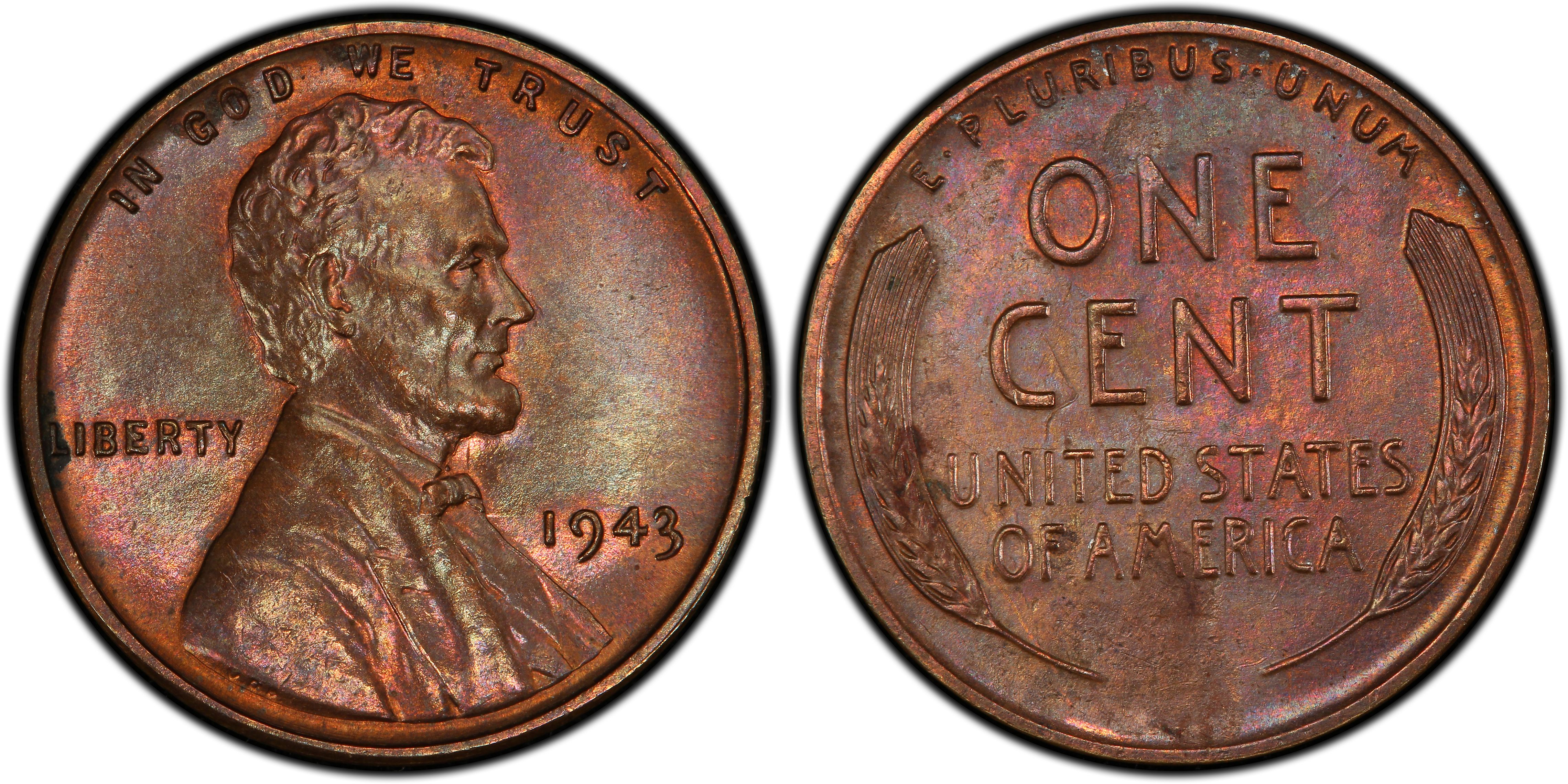 #1 MS61RB PCGS grade
James Schirrippa. |
The 1943 Copper Cent
The 1943 Lincoln Cent struck on a copper planchet (technically a bronze alloy) is the ultimate "find." Genuine examples have been discovered in school cafeterias, gumball machines, and general circulation. One was even held privately by a Mint Chief Engraver, while another is rumored to have been "pocketed" by an employee at the Denver Mint. Despite the astronomical odds, hunters still pour through bags of wheat cents, looking for a coin that resembles any other 1940s cent—save for that improbable "1943" date.
An Emergency Measure Gone Wrong
These coins were struck in error using planchets not intended for production. During 1943, the United States faced a critical copper shortage as the war effort intensified across the African, European, and Pacific theaters. To conserve strategic metals, the Treasury Department authorized public-private experiments to find a substitute material, ranging from plastics to the curious glass cent prototypes (#12255).
Ultimately, the Treasury settled on a zinc-coated steel composition. For one year, the familiar "red" cent turned a silvery-white, leading many to mistake them for dimes. The aesthetic appeal was short-lived; the brilliance of the steel cents quickly gave way to a chalky slate-gray, which eventually oxidized into a rusted black. Dissatisfied, the Treasury ended the emergency issue after 1943 and resumed production using a brass alloy in 1944. Some of these 1944 planchets were sourced from expended shell casings, though the massive mintage required additional virgin metal.
Struck by Accident?
Because the Mint has no official record of mass-striking copper cents in 1943, numismatists believe these were "transitional errors." A few 1942 copper planchets likely remained nestled in the bottom of a tote bin or hopper. When the bins were filled with the new steel blanks, these stray copper planchets eventually worked their way into the presses.
Analysis of known specimens suggests at least five distinct strike qualities:
- Full Detail: Sharp, fully formed lettering.
- Moderate Reverse Weakness: Softness at the bottom of the "P" in PLURIBUS and the "AM" in AMERICA.
- Heavy Reverse Weakness: In addition to the features listed above, softness at the top of the "O" in ONE and "AM" in AMERICA is fully weak.
- Obscured Detail: Weak lettering with "IB" in LIBERTY obscured, likely due to a grease-filled die.
- The "Red" Specimen: A recently surfaced example struck on a novel bronze alloy, featuring weakness at the top of IN GOD WE TRUST and significant softness in PLURI, O of ONE, and AME.
A comprehensive die study comparing these to known 1943 steel cents could further validate the "stray planchet" theory by matching specific production dies.
Population and Distribution
- Philadelphia (#82709): Approximately 15–17 pieces are known. This includes 14 straight-graded by PCGS, the "Dave Berg" VG-Details piece (graffiti), two certified by NGC, and two "raw" examples sold by Heritage Auctions that suffer from environmental damage.
- Denver (#82712): Only one example is known to exist. It is a unique specimen (graded PCGS MS64BN) and is arguably the most valuable small cent in existence. This example is said to have been double struck to bring out detail and may have been purposefully made by a Mint employee.
- San Francisco (#82715): Six examples are currently confirmed. Discovered in the wild as early as 1944.
Authentication: Is Your Copper Penny Genuine?
The fame of the 1943 copper cent has invited decades of fraud. An early rumor claimed Henry Ford would trade a new car for one; Ford never made such an offer, though a genuine 1943 copper cent is now worth far more than a garage filled with the latest lineup of Ford cars and trucks.
How to Spot a Fake:
Because many people try to "create" a 1943 copper cent by plating a steel cent or filing down a 1948, PCGS authentication is mandatory.
To be genuine, the coin must meet these criteria:
- The Magnet Test: A genuine copper cent is non-magnetic. If it sticks to a magnet, it is a plated steel cent.
- Weight: It must weigh approximately 3.11 grams. A plated steel cent will weigh significantly less (2.70 grams).
- The "3" Diagnostic: The "3" in the date must perfectly match the font of a 1943 steel cent. If the "tail" of the 3 looks like it belongs on a 1948 cent, it has likely been altered.
- Author's mark: The designer's initials (VDB) must be present on the truncation of the bust. An altered date 1913 Lincoln Cent (#2459) will not have this feature. The 3 on the 1913 Cent also does not resemble the 3 on a genuine 1943 Cent.
* * *