
PCGS AU58
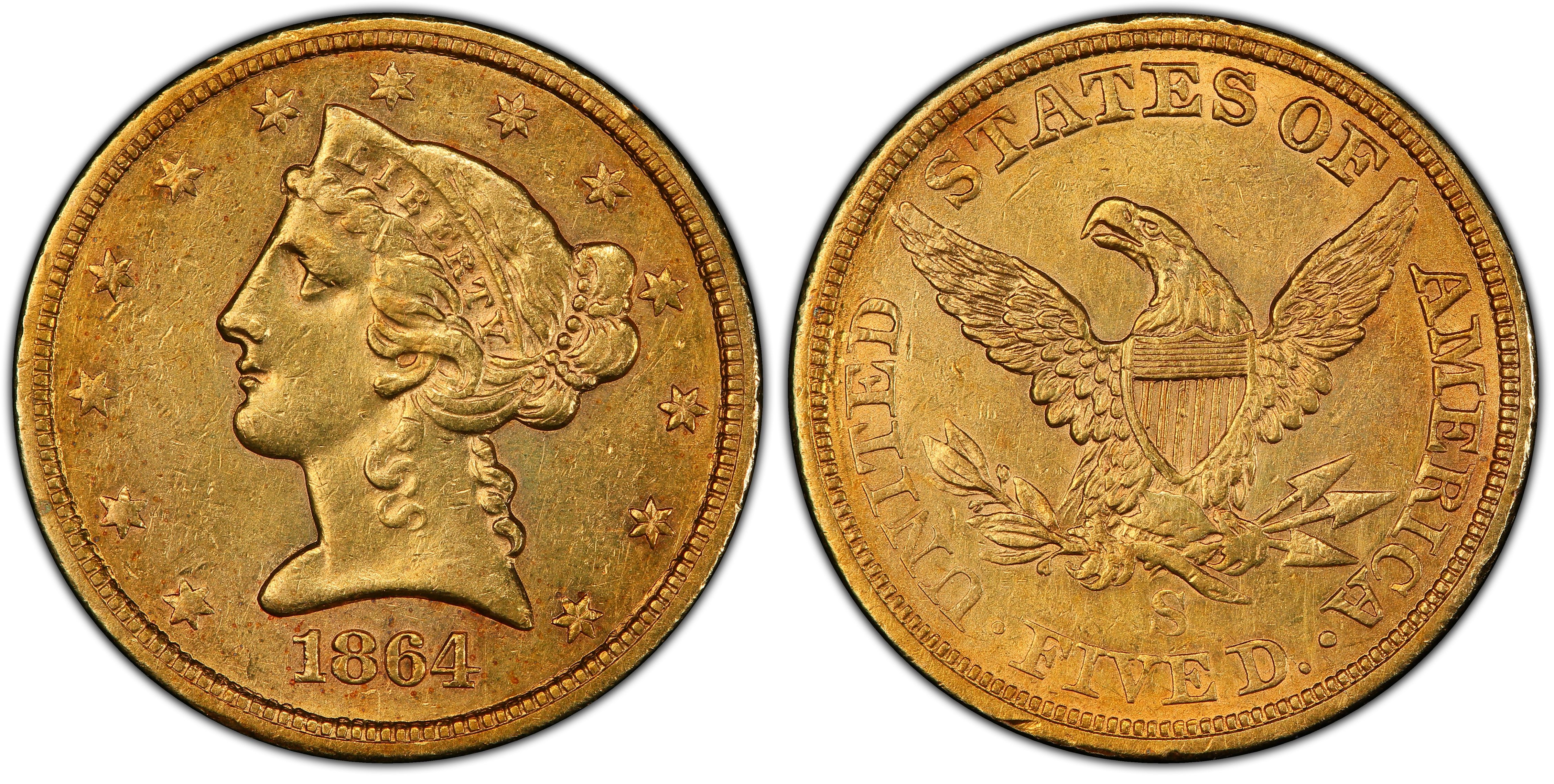
PCGS AU55
- PCGS #:
- 8297
- Designer:
- Christian Gobrecht
- Edge:
- Reeded
- Diameter:
- 21.65 millimeters
- Weight:
- 8.36 grams
- Mintage:
- 3,888
- Mint:
- San Francisco
- Metal:
- 90% Gold, 10% Copper
- Auction Record:
- $264,000 • AU58 • 04-13-2022 • Stack's Bowers
Major Varieties
- 1864-S $5
Rarity and Survival Estimates Learn More
| Survival Estimate | |
|---|---|
| All Grades | 32 |
| 60 or Better | 2 |
| 65 or Better | 1 |
| Numismatic Rarity | |
|---|---|
| All Grades | R-8.8 |
| 60 or Better | R-9.9 |
| 65 or Better | R-10.0 |
| Relative Rarity By Type All Specs in this Type | |
|---|---|
| All Grades | 7 / 112 TIE |
| 60 or Better | 7 / 112 TIE |
| 65 or Better | 1 / 112 TIE |
| Relative Rarity By Series All Specs in this Series | |
|---|---|
| All Grades | 8 / 218 TIE |
| 60 or Better | 13 / 218 TIE |
| 65 or Better | 1 / 218 TIE |
Condition Census What Is This?
 #1 PCGS MS65+
Thomas G. Melish, purchased for $67.50; As "Uncirculated, a choice beauty." "The Thomas G. Melish Collection," Abe Kosoff April 28, 1956, Lot 2122. As "MS-64 or finer." "The Norweb Collection, Part I," Bowers & Merena, October 13, 1987, Lot 875 - $110,000. As PCGS MS65. "The Harry W. Bass, Jr. Collection, Part II," Bowers & Merena, October 4, 1999, Lot 1150 - $178,250. As PCGS MS65+ #28537893. Stellar Collection. Frosty surfaces with blended orange and green gold. Flatness noted on Stars 1,2, 6, and 7. Diagonal hit between stars 4 and 5. Arrow fletching flat. |
|
#2 PCGS AU58
Acquired raw. "The Fairmont Collection-Hendricks Set," Stack's Bowers, April 6, 2022, Lot 5110 - $264,000; "The Drumwight Family Collection," Heritage Auctions, January 16, 2025, Lot 4788 - $192,000. marketed by Doug Winter (March 19, 2026 "Coin of the Week") - $212,000. Original skin. Reed mark to the right of Star 3. Faint, but non-obtrusive marks scattered on the obverse field. Dark toning within the shield's vertical stripes. |
|
#3 PCGS AU55
As "Extremely Fine with frosty mint surface." "The William Cutler Atwater Collection," B. Max Mehl, June 11, 1946, Lot 1828 - $47.50. As "XF40 (obverse)/ VF30 (reverse)." "The Louis E. Eliasberg, Sr. Collection," Bowers and Ruddy, October 1982, Lot 509 - $2,530. As ANA S AU Details. "The Kennywood Collection," American Numismatic Rarities, January 2005, Lot 957 - $17,825; As PCGS AU55 #38081986. Dell Loy Hansen; "The D.L. Hansen U.S. $5 Circulation Strikes Collection" (PCGS Set Registry). Flecks of red toning along the periphery. Small tick in hair under "B" in LIBERTY. Stars weak on the lower left of the obverse. Fletching flat. Small bump in rim above Star 9. Small rim cut below "F" in FIVE. |
|
#4 PCGS AU53
Stanley Kesselman, April 1967. As PCGS AU53 #05652587. "The Harry W. Bass, Jr. Collection, Part III," Bowers & Merena, May 2000, Lot 500 - $23,000; Doug Winter to Chicago-area collector, January 2026. Toning spot between Stars 6 and 7. |
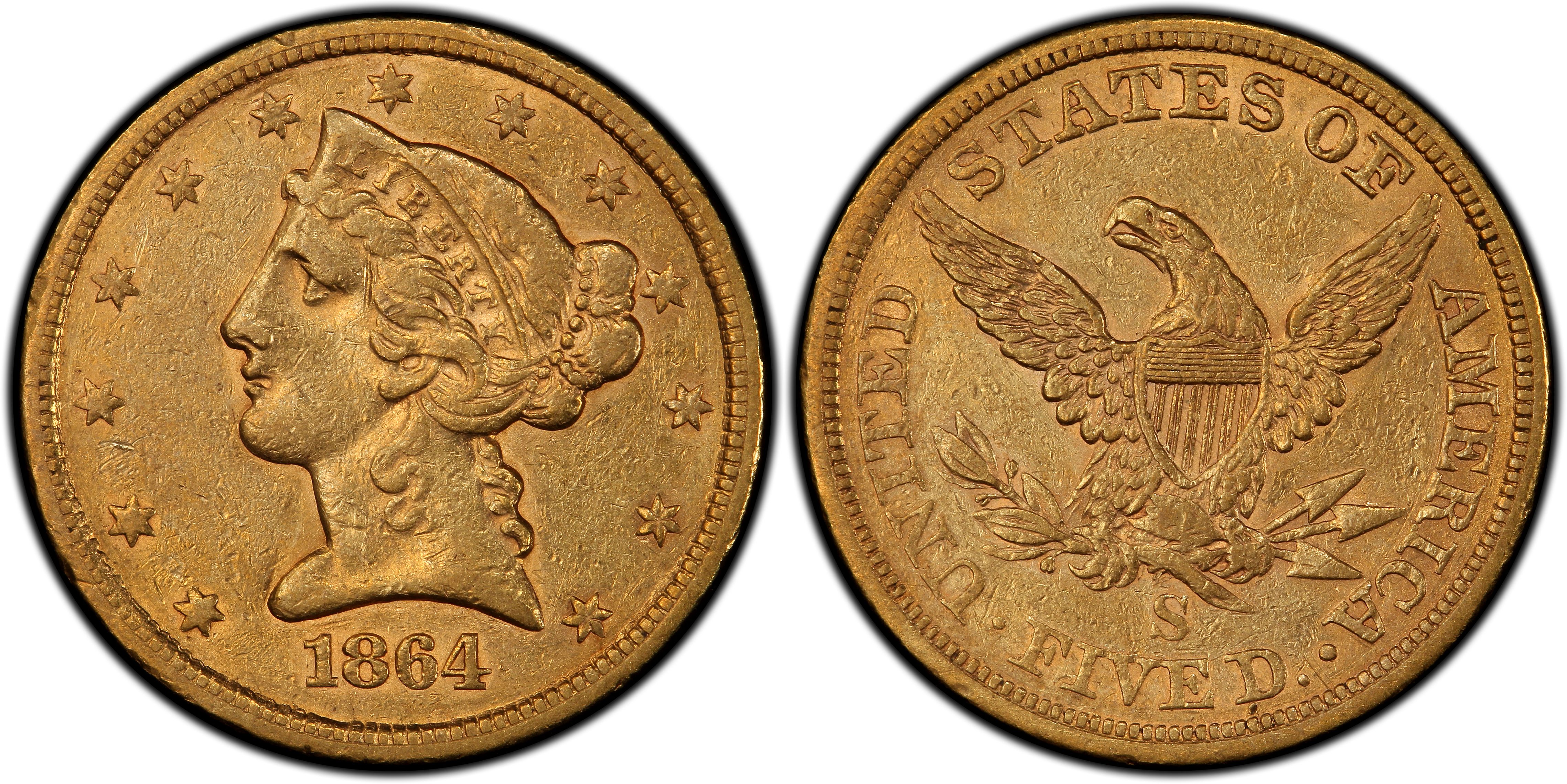 #4 PCGS AU53
As "Extremely Fine." "The H.R. Lee Collection," Stack's, October 1947, lot 1431 - $36. As "Extremely Fine." "The James A. Stack, Sr. Collection," Stack's, October 1994, Lot 1180 - $37,400; Bradley Hirst. As NGC XF45 #1716043-095. "The Richmond Collection, Part I (Hirst)," David Lawrence Rare Coins, July 2004, Lot 1416 - $31,050. "The Donald E. Bently Collection," Heritage Auctions, March 2014, Lot 30318 - $79,312.50. As PCGS AU53 #25256397. "The Drumwight Family Collection," Heritage Auctions, January 16, 2025, Lot 4787 - $72,000. Stack's H.R. Lee sale was made of up Louis E. Eliasberg, Sr. duplicates, largely from the Clapp collection. Thin horizontal mark borders the hair and at Liberty's forehead. Small tick between Stars 2 and 3. Minor rim dings on obverse and reverse. |
|
#6 PCGS AU50
"The Charles Hirsch Collection, Part I," Heritage Auctions, January 14, 2026, Lot 3244 - $94,550. Old Green Holder. Horizontal cut from nostril to mid-cheek. Stars 1,2, 7 and 8 weak. Arrow fletching flat. |
|
#6 Est. AU50
Steve Ivy, April 24, 1974. As PCGS XF40. "The Harry W. Bass, Jr. Collection, Part II," Bowers and Merena, October 1999, Lot 1151 - $12,650. As PCGS XF45 #3539171. "The Guadalupe Collection," Heritage Auctions, January 2006, Lot 3489 - $19,550; As NGC AU55 #1971236-024. "The Dr. William M. Aden Collection," Stack's Bowers, November 14, 2023, Lot 3176 - $90,000. Star 1 and 5 flatly struck. Disturbance in the field under "TED" in UNITED. |
The 1864-S Liberty Head Half Eagle
The 1864-S Liberty Head Half Eagle (#8297) is one of three gold coin denominations struck by the San Francisco Mint during the Civil War’s penultimate year. With a mintage of just 3,888 pieces and a high attrition rate due to heavy circulation, the issue is one of the unquestioned keys to the series, and trails only the 1854-S (#8260), in terms of rarity. To understand the issue fully, one must see American gold coinage in 1864 through the lens of the war.
The Meat Grinder and the Ballot Box
By 1864, the Union’s military approach had shifted toward a relentless war of attrition. General Ulysses S. Grant launched the Overland Campaign with the singular goal of destroying Robert E. Lee’s Army of Northern Virginia, while William Tecumseh Sherman pushed into Georgia to engage Joseph E. Johnston’s Army of Tennessee. However, this strategy quickly devolved into a "meat grinder." The Northern public watched with growing horror as Grant incurred staggering losses in the Western Virginia wilderness, and at Spotsylvania and Cold Harbor. The carnage was so predictable that, before the assault at Cold Harbor, Union soldiers famously sewed slips of paper with their names onto their coats to ensure they would not be buried in unmarked graves. Despite Grant’s grim determination, many loyalists feared the Union effort had finally stalled during the Siege of Petersburg, a grueling stalemate that began in June 1864 and would last nearly a year.
While Grant hammered at the gates of Richmond, Sherman’s forces evolved the Union strategy into "Total War." To dismantle the Confederate infrastructure, his engineers created "Sherman’s Neckties" by heating iron rails over bonfires and twisting them around trees to render Southern railroad lines useless. Meanwhile, foraging troops known as "bummers" looted homes for food and valuables, burning whatever they could not carry. This destructive momentum culminated in the capture of Atlanta in September, after which Sherman’s forces leveled the city’s military and transport hubs before beginning the decisive March to the Sea.
The military deadlock during that long and violent summer caused Abraham Lincoln’s electoral chances to crater, leading him to fully expect a defeat in his re-election bid. The Northern Democrats capitalized on this despair by running General George B. McClellan, the former commander of the Army of the Potomac who had been sidelined since 1862. As a "soldier’s general" and a staunch conservative, McClellan viewed the current campaign as a barrier to future reconciliation. He was particularly horrified by the Emancipation Proclamation, fearing it would force the South to fight to the last man. This sentiment was echoed by the often-bedridden Confederate President Jefferson Davis who, during an unofficial peace mission in July 1864, defiantly told Union intermediaries that the South would accept nothing less than independence or extermination.
Despite the heavy losses under Grant and the conciliatory platform of the Democrats, the narrative shifted rapidly in late 1864. In August, the Union won the Battle of Mobile Bay, closing the last major Confederate port on the Gulf of Mexico and further strangling the Southern economy. The fall of Atlanta in September provided the tangible victory the Northern public craved, and when the votes were finally tallied, Union soldiers overwhelmingly sided with Lincoln over their former general. By November, the "summer of despair" had vanished. Lincoln secured a landslide victory, ensuring the war would be fought to its definitive conclusion.
What Constituted Money
The Civil War’s impact on the American economic system was total. By 1862, the circulation of domestic coinage had ground to a halt as hoarding became widespread. Although the United States Mint operated five “money factories” in 1860, the outbreak of hostilities saw Confederate forces seize control of the Charlotte, Dahlonega, and New Orleans facilities. This left the Union with only the "mother mint" in Philadelphia, tasked with supplying Northern industrial cities with minor coinage, and the San Francisco Mint, built to process the massive gold bullion stores extracted from California’s placer mines.
Despite early efforts to maintain these seized Southern facilities, the Confederacy could not sustain minting operations and eventually resorted to issuing bonds and interest-bearing notes. In the North, the federal government turned to fractional paper currency and “Greenbacks.” This effectively allowed the Union to print money for internal war expenses while reserving gold coins—primarily Double Eagles—to pay for vital international imports such as Enfield rifles, munitions, and medicine.
The California Exception
California resisted the paper economy. Due to its geographic isolation and the high yields of Western mines, the state struck enough gold and silver coins for both local circulation and export. It also shipped substantial quantities of gold east to the Philadelphia Mint. To protect this treasure from Confederate privateers, the Union Navy maintained a consistent presence in the Gulf, escorting merchant ships and attempting, with varying degrees of success, to enforce a naval blockade.
Collecting the 1864-S Liberty Head Half Eagle
In 1864, the San Francisco Mint struck 800,048 gold coins in three denominations. More than 99% of which were 1864-S Liberty Head Double Eagles (#8942). The remaining two denominations, the the 1864-S Liberty Head Half Eagle, with a mintage of just 3,888, and the 1864-S Liberty Head Eagle (#8640), with only 2,500 coins, remain significant rarities. Most surviving examples of these two low-mintage issues show signs of heavy commercial use.
The undisputed finest known example of the 1864-S Half Eagle is the PCGS MS65+ specimen from the Norweb and Harry W. Bass, Jr. collections. Thomas G. Melish, best known as the driving force behind the 1936 Cincinnati Music Center Half Dollar (#9283), was the first recorded owner of the coin, reportedly paying just $67.50 for it. Today, held in the Stellar Collection, the coin would likely command well in excess of $550,000 at auction.
No other known example matches the visual appeal of the Norweb-Stellar coin. A more recent discovery surfaced in the 2022 Stack’s Bowers offering of the Fairmont-Hendricks sale; unknown to collectors for decades, it graded PCGS AU58. This coin originated from a massive hoard of mid-19th-century American gold, likely held by a South or Central American financial institution. Other notable specimens boast pedigrees to some of the hobby’s greatest collectors, yet almost all show the physical evidence of their service during this pivotal era in American history.
1864-S Liberty Head Half Eagle Strike Characteristics
While most surviving examples show significant wear, the finest known specimens share several distinct characteristics. The gold color varies, but many exhibit a creamy gold or deep goldenrod hue. Strike weakness is frequently observed in the lower stars, particularly where the radials at Star 1 and Star 2 are often absent. Additionally, the arrow fletching, the neighboring branch stem, and the eagle’s talons are commonly flatly struck and lack sharp definition.
* * *
The "unc" mentioned by David Akers in his 1979 book was subsequently sold in the Norweb Sale (Bowers and Merena, 1987) and then in the Harry Bass Sale (Bowers and Merena, 1999). It is graded MS65 by PCGS and it is the finest known by an incredible 10 points!