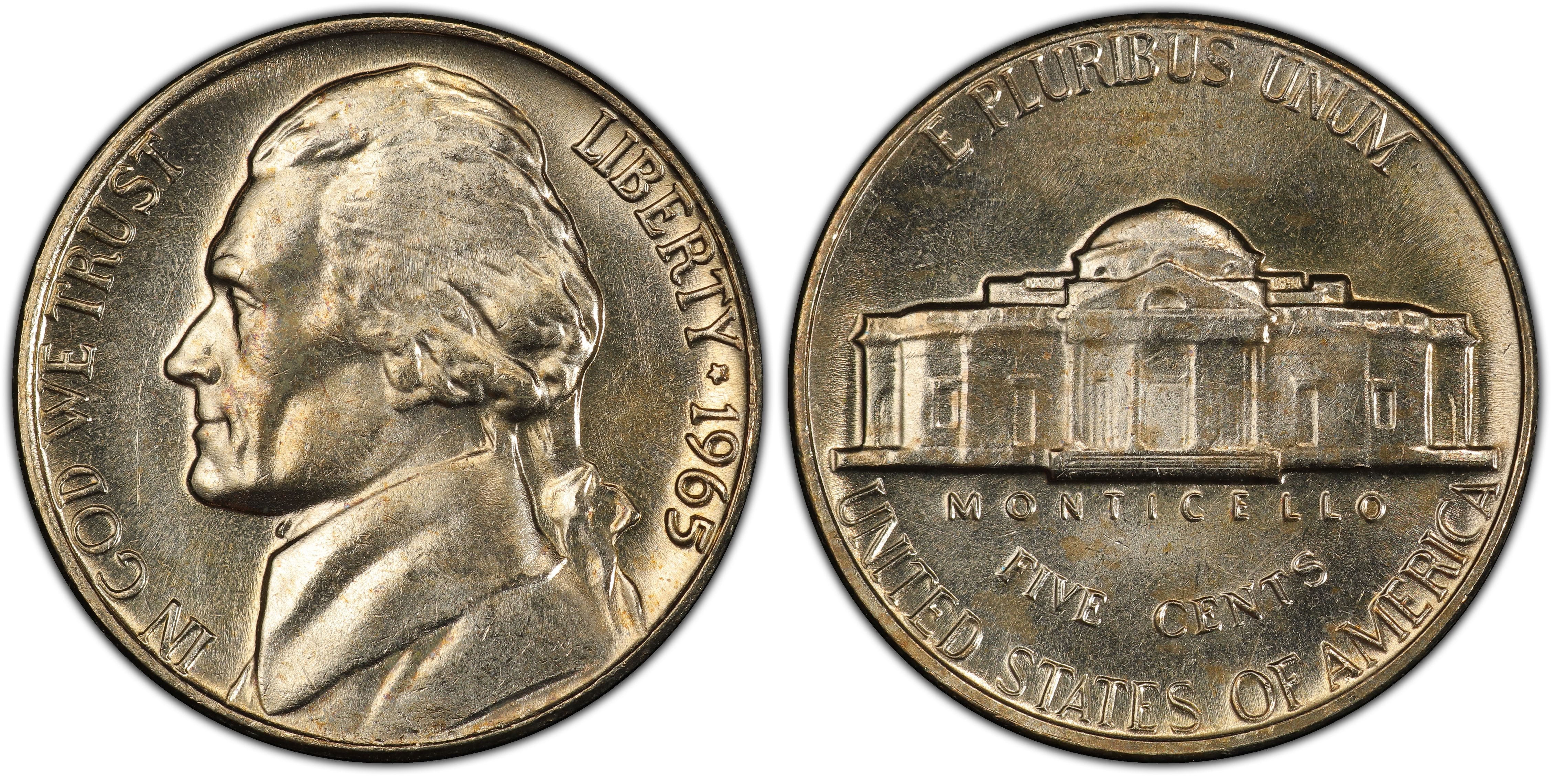
PCGS MS66FS

PCGS MS64FS
- PCGS #:
- 84077
- Designer:
- Felix Schlag
- Edge:
- Plain
- Diameter:
- 21.20 millimeters
- Weight:
- 5.00 grams
- Mintage:
- 136,131,380
- Mint:
- Philadelphia
- Metal:
- 75% Copper, 25% Nickel
- Auction Record:
- $3,840 • MS66FS • 04-09-2025 • Stack's Bowers
Rarity and Survival Estimates Learn More
| Survival Estimate | |
|---|---|
| All Grades | 1,000 |
| 60 or Better | 1,000 |
| 65 or Better | 150 |
| Numismatic Rarity | |
|---|---|
| All Grades | R-5.0 |
| 60 or Better | R-5.0 |
| 65 or Better | R-7.5 |
| Relative Rarity By Type All Specs in this Type | |
|---|---|
| All Grades | 3 / 73 TIE |
| 60 or Better | 3 / 73 TIE |
| 65 or Better | 3 / 73 TIE |
| Relative Rarity By Series All Specs in this Series | |
|---|---|
| All Grades | 3 / 73 TIE |
| 60 or Better | 3 / 73 TIE |
| 65 or Better | 3 / 73 TIE |
Condition Census What Is This?
 #1 PCGS MS66FS
"The Tapps Collection of Jefferson Nickels," GreatCollections, December 14, 2025, Lot 1970244 - $29,250; "The Quantumnavy Collection" (PCGS Set Registry). Faint gold toning is present at the obverse center. Two small diagonal ticks are noted below the TR in TRUST, with a small horizontal tick visible in Jefferson's hair to the right of the ear. The surfaces are frosty. |
|
#1 PCGS MS66FS
Golden patination is present with scattered patches of goldenrod. A long, thin, vertical mark is visible to the left of Jefferson's face. |
|
#3 PCGS MS65FS
"The Ray Overby Collection" (PCGS Set Registry). |
|
#3 PCGS MS64FS
Slightly cloudy surfaces exhibit a yellowish tint. A horizontal mark is noted on Jefferson’s collar, with scattered marks visible on the jaw. |
The 1965 Jefferson Nickel
On September 3, 1964, President Lyndon Johnson signed Public Law 88-580, authorizing the United States Mint to continue striking coins dated "1964" until an adequate supply was available to resume the standard practice of inscribing the current year of manufacture. This was not an open-ended mandate; according to the law, the Treasury Secretary could continue the "1964" date freeze until July 1 or January 1, "whichever date first occurs after the date on which the Secretary of the Treasury determines that adequate supplies of coins are available."
At the time, the Treasury recognized it could no longer satisfy national demand while using 90% silver for dimes, quarters, and half dollars. It advocated for this legislation in anticipation of the Coinage Act of 1965, which ultimately eliminated silver from the Roosevelt Dime and Washington Quarter while reducing the silver content of the Kennedy Half Dollar to 40%.
The national coin shortage was not limited to silver issues; Lincoln Cents and Jefferson Nickels were also in short supply and subject to the date freeze. The first coins to bear the "1965" date were the new clad Washington Quarters (#5878), which began production at the Philadelphia Mint on August 23, 1965.
On September 1, the Mint reactivated the San Francisco Assay Office to strike 1965-dated Lincoln Cents (RD #2896) and to prepare one-cent and five-cent coin blanks for the Denver Mint, which had recently renovated an adjacent building specifically to increase its coinage capacity. Despite these efforts, the first minor coins (the cent and nickel) were not struck with the "1965" date until December 29.
This era was defined by a surge in demand unprecedented in the nation's history. To meet these needs, the Mint broke ground on September 17 for a new Philadelphia Mint. Designed in the Brutalist architectural style by Vincent G. Kling and outfitted with state-of-the-art coinage equipment, the new facility opened in 1969.
Collecting the 1965 Jefferson Nickel
The business-strike 1965 Jefferson Nickel (Base #4077) was produced from December 29, 1965, to July 31, 1966, with a total mintage of 136,131,380 pieces. Because the Mint did not produce official Uncirculated Coin Sets (Mint Sets) in 1965, the available stock of Mint State examples must be sourced from original rolls or "speculator" stock preserved at the time.
Coin quality varies significantly based on die state, strike, and incidental contact marks. Many high-grade examples exhibit planchet chatter along Jefferson's jawline and characteristic weakness at the center of Monticello.
Full Steps (FS) examples are exceedingly rare for this date. Furthermore, Gems and Premium Gems remain underrated in the current market; the supply of raw coins capable of achieving PCGS MS66 or PCGS MS67 is likely much lower than commonly realized. Nickels of this vintage typically exhibit champagne or golden patination, though rare iridescent examples with intense color command significant premiums.
* * *