1883 5C With CENTS, DCAM (Proof)
Series: Liberty Head Five Cents 1883-1913
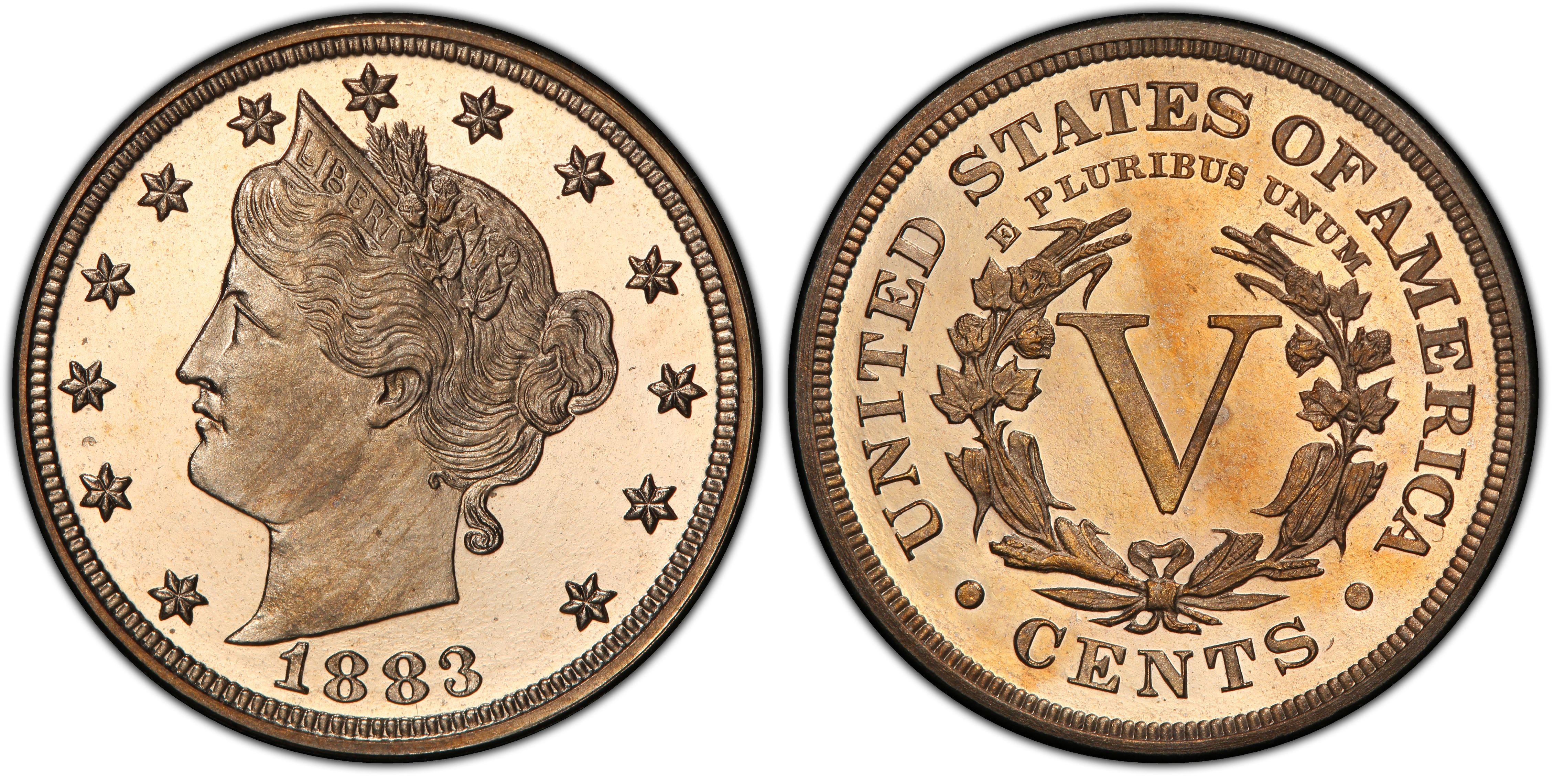
PCGS PR67DCAM
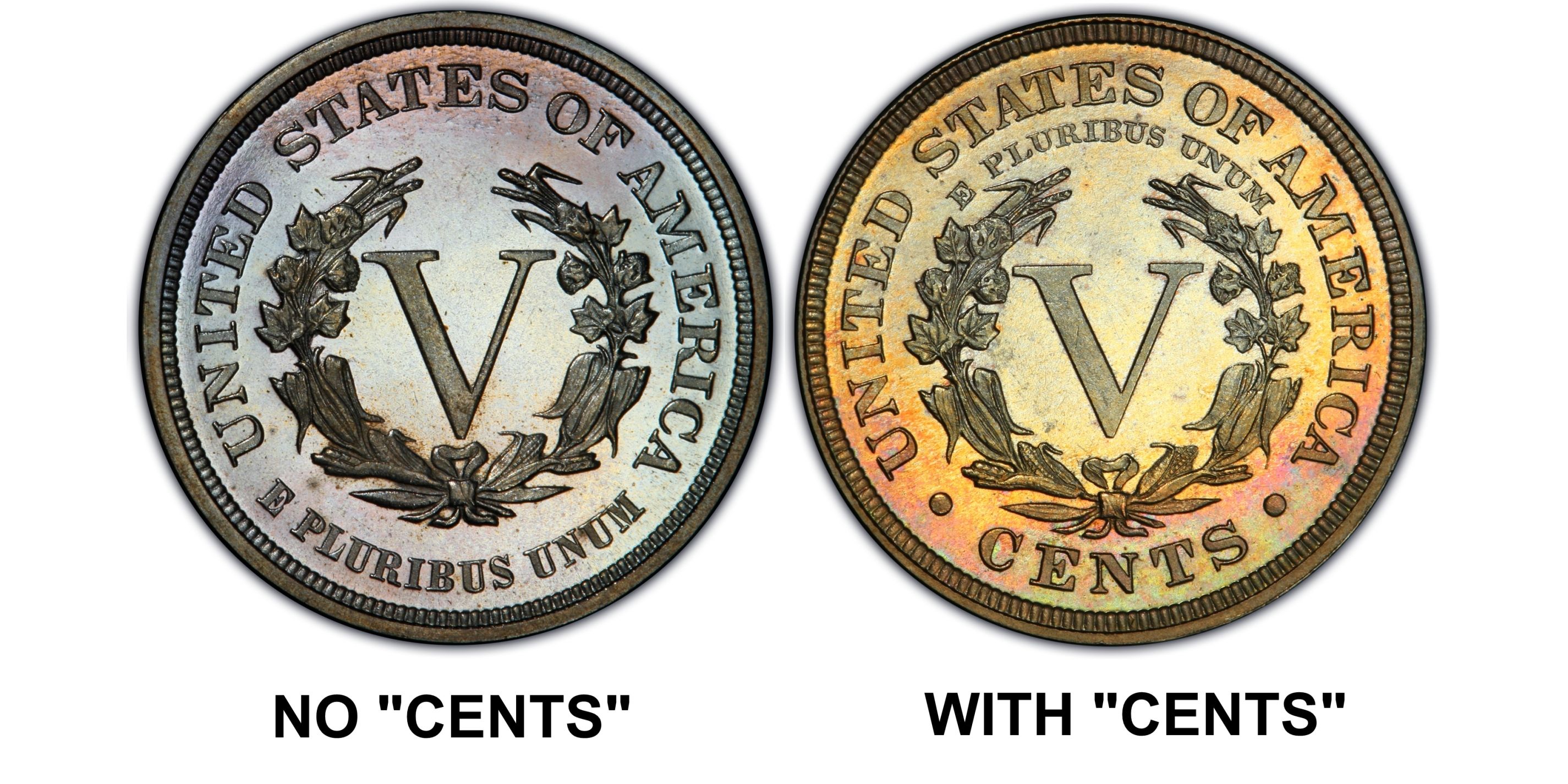
REVERSE COMPARISON
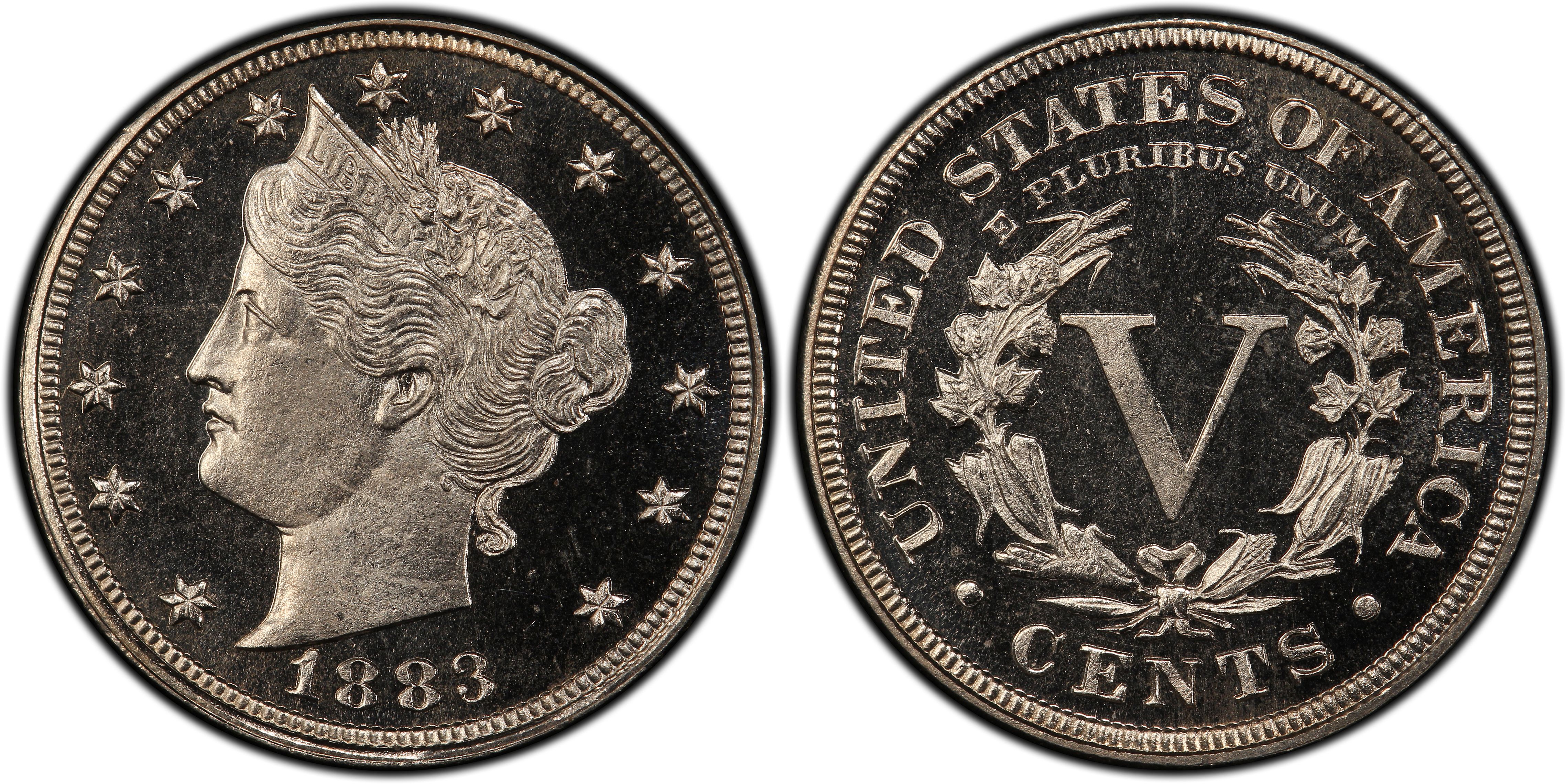
PCGS PR67DCAM
- PCGS #:
- 93881
- Designer:
- Charles E. Barber
- Edge:
- Plain
- Diameter:
- 21.20 millimeters
- Weight:
- 5.00 grams
- Mintage:
- 6,783
- Mint:
- Philadelphia
- Metal:
- 75% Copper, 25% Nickel
- Auction Record:
- $9,400 • PR66DCAM • 06-29-2012 • Stack's Bowers
Condition Census What Is This?
|
#1 PCGS PR67DCAM
As PCGS PR66DCAM #31091566. "The Land of Smiles Collection," Stack's Bowers, June 27, 2012, Lot 2303 - $9,400. As PCGS PR67DCAM #81296881. Stack’s Bowers, August 11, 2016, Lot 3041 – $7,637.50; “The Boulder City Collection,” Heritage Auctions, May 23, 2022, Lot 44167 – $9,000. Golden toning throughout. Darker toning over V. Planchet flaw between stars 2 and 3. Small curved lintmark to the right of star 7. Small mark to the right of the "S" of "CENTS." |
|
#1 PCGS PR67DCAM
|
 #3 PCGS PR66DCAM
Heritage Auctions, August 10, 2016, Lot 3424 - $3,760; Heritage Auctions, February 7, 2017, Lot 21375 - $3,525; Legend Rare Coin Auctions, December 17, 2017, Lot 24 - $2,090; Heritage Auctions, June 16, 2024, Lot 3295 - $2,640. Thin hairline below Liberty's chin. "Joker-esque" toning streak across Liberty's jaw. |
|
#3 PCGS PR66DCAM
Heritage Auctions, April 29, 2018, Lot 4664 - $3,720. |
 #3 PCGS PR66DCAM
As PCGS PR66DCAM #29542427. Heritage Auctions, June 5, 2014, Lot 4350 – $7,637.50. As PCGS PR66DAM #30492019. Heritage Auctions, October 9, 2014, Lot 4661 – $6,462.50; Heritage Auctions, January 29, 2015, Lot 3047 – $6,462.50. Small vertical mark on the back of Liberty's jaw. Toning spot in the field between stars 2 and 3. Russet and aubergine toning along the periphery on the upper right of the obverse. Small mark above the Serif of the left stroke of "V." |
1883 Liberty Head Nickel, With Cents Proof
For enthusiasts of the five-cent coin, 1883 was a year without equal. The Philadelphia Mint began the year with a respectable emission of 1,451,500 1883 Shield Nickels (#3813) before transitioning to Charles E. Barber’s new Liberty Head design. On January 30, Philadelphia Mint Superintendent A. Loudon Snowden unveiled the design to an audience of guests and VIPs.
For Snowden, the event was a source of personal and professional pride. He had sought to reimagining the nation’s minor coinage as a uniform series: coins struck in the same composition, carrying the same design, and denominated solely with Roman numerals on the reverse. However, the Treasury Department opposed his proposal, noting that changing the cent's composition would require an Act of Congress and that the Three-Cent piece was likely nearing retirement.
While Snowden’s grand vision of "aesthetic and mechanical uniformity" never fully materialized, he did succeed in updating the nickel. Yet, the new design famously triggered a public scandal, leading to an immediate production stoppage and a mandatory redesign.
A Tale of Two Types
Following Snowden's original vision, the new nickel's value was initially denoted only by its physical size and a large Roman numeral "V." While this lack of a "CENTS" inscription seems unusual today, the public was already accustomed to the Three-Cent Silver and Three-Cent Nickel, neither of which featured the word "Cents." Had Snowden’s project been fully realized, all minor coinage would have shared this Liberty Head obverse and a reverse featuring a Roman numeral enclosed within a vegetal wreath.
The scandal erupted when rumors spread that fraudsters were gold-plating the new nickels to pass them off as $5 gold Half Eagles. In numismatic lore, the name Josh Tatum is often linked to these "Racketeer Nickels," though no credible evidence confirms his existence. However, newspaper reports from February and April 1883 confirm that genuine fraud was occurring and that local authorities were making arrests. Even the United States Secret Service deemed the "No CENTS" design a public danger—a risk that, for reasons of size and color, had never applied to the smaller Three-Cent nickel.
Before production was halted for the design change, the Philadelphia Mint struck 5,474,300 business-strike 1883 Liberty Head, "No Cents" Nickels (#3841), along with 5,219 1883 "No Cents" Proofs (#3878), though noted expert and PCGS co-founder John W. Dannreuther estimates the actual number was closer to 4,000 pieces.
The revised "With Cents" version (#3844) entered production in late March and continued uninterupted throughout the remainder of the year. This resulted in a significantly higher mintage of 16,026,200 business strikes and 6,783 Proofs (#3881).
However, Dannreuther also questions these figures, citing discrepancies in the Mint's internal die-use and destruction documents. The reported 6,783 Proof mintage is derived from the total Proof deliveries recorded on June 26, October 11, and December 31.
Collecting the 1883 Liberty Head Nickel, With Cents Proof
All three types of 1883 Proof nickels are highly collectible and remain affordable through the Gem grade of PCGS PR65. The coins are conditionally scarce in finer grades; while coins with Cameo or Deep Cameo contrast are not rare, they are also not typical for the issue. In fact, throughout the entire run of Liberty Head nickels, Cameo Proofs comprise a little more than 10% of the total issue, according to the PCGS Population Report. Having said this, one does not need to seek out a Cameo example to find a beautiful Liberty Head nickel Proof coin, as many of the finest known examples are fully brilliant—some with spectacular toning.
As for the 1883 Liberty Head Nickel Proofs, the "No Cents" version is slightly the more common of the two. The quality barrier is shared between the two issues: anything above PCGS PR65 is scarce, and a spectacularly preserved example from the legendary PCGS Set Registry set of Richard Groman remains the sole example to date certified as PCGS PR68.
In his 2023 reference, United States Proof Coins Volume II: Nickel, Dannreuther enumerates three die marriages for the 1883 "With Cents" Proof. The most common is the JD-1, which Dannreuther estimates makes up 88% of the total population. Each of the three varieties is struck with different obverse dies; however, Dannreuther is uncertain whether these are coupled with unique or shared reverses. In a January 2026 telephone conversation with John, he told me that the 1883 issues are the issues he was least sure about in his book. Given the scope and the scale of his research, that comment really says something.
* * *