1925 AR Medal Norse American, Thin (Regular Strike)
Series: (None)

PCGS MS66+

PCGS MS66

PCGS MS66
- PCGS #:
- 9451
- Designer:
- N/A
- Edge:
- N/A
- Diameter:
- N/A
- Weight:
- N/A
- Mintage:
- N/A
- Mint:
- N/A
- Metal:
- Silver
- Auction Record:
- $19,388 • MS66 • 04-27-2016 • Heritage Auctions
Condition Census What Is This?
|
#1 PCGS MS66+
"The Cary & Cheryl Porter Collection," Heritage Auctions, May 1, 2007, Lot 2567 - $4,600; Heritage Auctions, November 29, 2012, Lot 4541 - $8,519; "The J&L Norse Set" (PCGS Set Registry). Rose-silver surfaces featuring splashes of rainbow toning, most prominent in the upper-right obverse field |
 #2 PCGS MS66
Heritage Auctions, January 14, 2024, Lot 4782 - $5,280; Heritage Auctions, August 18, 2024, Lot 5349 - $5,160. Beige and olive toning covers both the obverse and reverse. A small olive spot positioned below and to the right of the "5," along with a minor contact mark on the chieftain’s breastplate, serve as pedigree markers. |
 #2 PCGS MS66
|
 #2 PCGS MS66
|
 #2 PCGS MS66
GreatCollections, April 24, 2022, Lot 1137861 - $4,203. Bold toning that hues towards gold and green on the obverse and gold, orange, and russet on the reverse. |
 #2 PCGS MS66
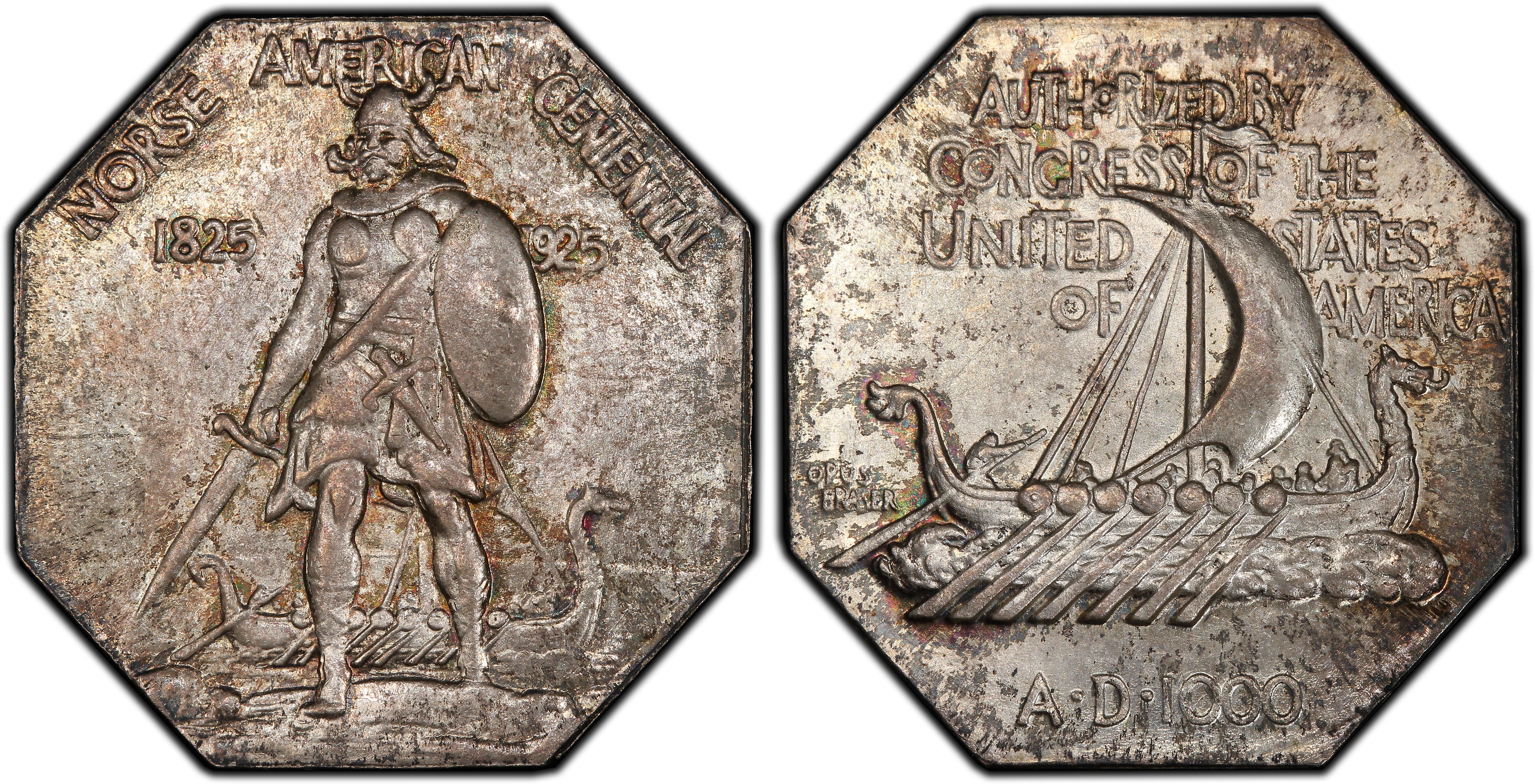
Heritage Auctions, January 16, 2022, Lot 4250 - $4,920. Silvery-gold patina with patches of iridescent green, blue, and russet toning. |
 #2 PCGS MS66
"The Usedcatman Collection" (PCGS Set Registry). Mottled toning. |
 #2 PCGS MS66
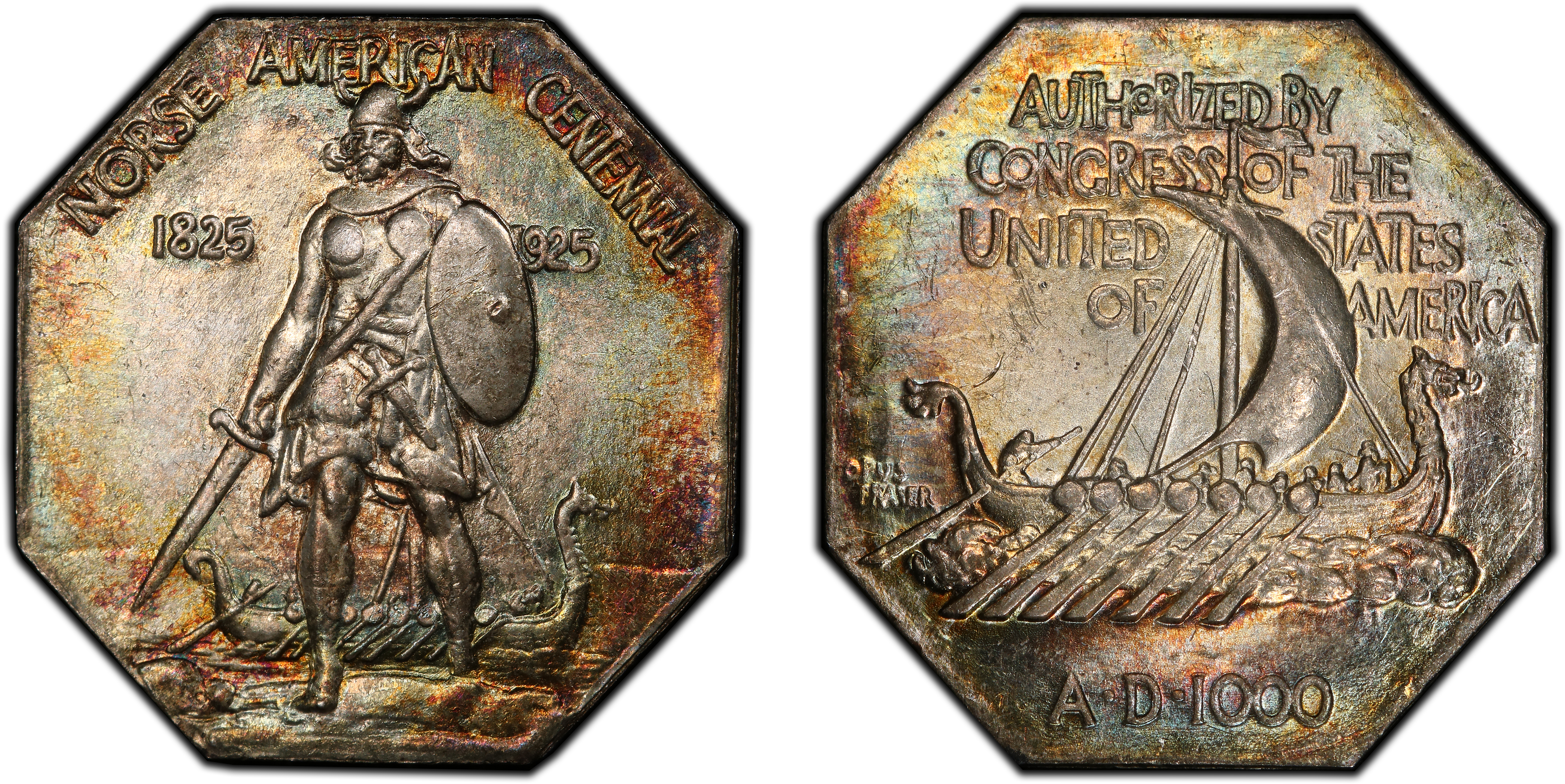
Obverse displays brilliant surfaces with bold rainbow toning along the periphery. Reverse also displays a tighter toning pattern. |
 #2 PCGS MS66
Iridescent rainbow toning on the obverse and reverse. |
The 1925 Norse American Centennial AR Medal, Thin Planchet
The 1925 Norse American Centennial AR Medal (Thin Planchet, #9451) is the scarcer of the two silver Norse American Medals. As a type, the Norse American Medal holds a unique distinction: it is the only United States Mint medal commonly collected as a "member" of the classic commemorative coin series (1892–1954). Designed by James Earle Fraser, the medal celebrates Norse exploration, depicting an armor-clad chieftain on the obverse and a Viking longship on the reverse.
The program was the brainchild of Congressman Ole Juulson “O.J.” Kvale of Minnesota’s 7th District. Kvale originally sought a commemorative half dollar to mark the centennial of the ship Restauration’s arrival. However, "commemorative fatigue" had already taken hold at the Treasury Department. Despite Kvale’s influential seat on the Committee on Coinage, Weights, and Measures, he could not secure support for another coin. He pivoted when the Treasury indicated it would instead approve a commemorative medal.
A primary obstacle was the physical specifications of the piece. To prevent the medals from being confused with legal tender, the Treasury insisted they be distinctly larger, thicker, or heavier than standard circulating coinage. The medal's iconic octagonal shape is widely attributed to Kvale’s son and secretary, Paul Kvale, who suggested the polygonal design as a clear visual differentiator.
The authorization of the 1925 Norse American Centennial Medal occurred amidst an unprecedented "commemorative craze" that overwhelmed the Treasury’s established rhythm of approving only one program per year. Although the controversial Stone Mountain Half Dollar (#9378) had been authorized in 1924, its million-plus mintage entered the market in early 1925, just as Congress unleashed a flurry of new bills for the Lexington-Concord (#9318), California Diamond Jubilee (#9281), Fort Vancouver (#9399), and Vermont-Bennington (#9401) commemorative halves. At the same time, the Walking Liberty Half Dollar had not been struck for circulation since 1923.
Production Costs and Distribution
The Norse Centennial Commission received the medals at cost, paying the Mint 30¢ for the thin silver, 45¢ for the thick silver, and $10.14 for the gold. The thick silver medals were the primary retail offering at $1.25, while the scarcer thin silver examples reportedly commanded a higher premium. The gold medals were offered at approximately $20.00 each.
Distribution patterns varied; the thick silver medals were sold first, primarily during the June celebration. The gold and thin silver versions were not widely offered until later in the year, often marketed to non-collectors. While the Commission sold the majority of its silver stock—returning only 2,000 thick pieces and a few thin examples to the Mint—the gold medal proved a more difficult sell. Ultimately, 53 of the 100 gold pieces were returned for melting.
Collecting the AR 1925 Norse American Medals
PCGS Hall of Fame coin dealer Wayte Raymond is largely responsible for the inclusion of the 1925 Norse American Centennial Medal in the "classic" commemorative half dollar series. By providing a dedicated space for it in his popular National Coin Albums, he cemented its status as an honorary member of the silver commemorative set. However, specialists recognize that this issue is far more complex than a single album hole; collecting the Norse American can be as straightforward or as specialized as a collector desires.
The Silver Variants: Thick vs. Thin
For those focusing on silver, the Thick Planchet variety is the most accessible. These medals measure 30 mm x 29 mm, with a 2.0 mm thickness and a weight of 14.74 grams. Struck between May 29 and June 13, 1925, the total mintage reached 33,750 pieces.
The Thin Planchet variety (#9451) shares the same dimensions but is 0.4 mm thinner and 4.54 grams lighter. These were struck over a three-day window:
- May 21: 2,000 struck
- May 22: 3,000 struck
- May 23: 1,000 struck
Data from the Grading Room
The PCGS Population Report provides a clear snapshot of the issue's state of preservation. The bulk of surviving examples grade between PCGS MS63 and PCGS MS64, a result of many pieces being originally purchased by non-numismatists and stored improperly.
The Thin Planchet variety is significantly more difficult to locate in PCGS MS66 or higher compared to its thicker counterpart. While most of these medals were struck with strong luster, many have suffered from heavy tarnish or environmental contaminants over the last century. A small minority of survivors exhibit pleasing iridescence, rainbow toning, and exceptionally bold design features.
* * *