1958 25C Type B Reverse, FS-901 (Regular Strike)
Series: Washington Quarters 1932-1964
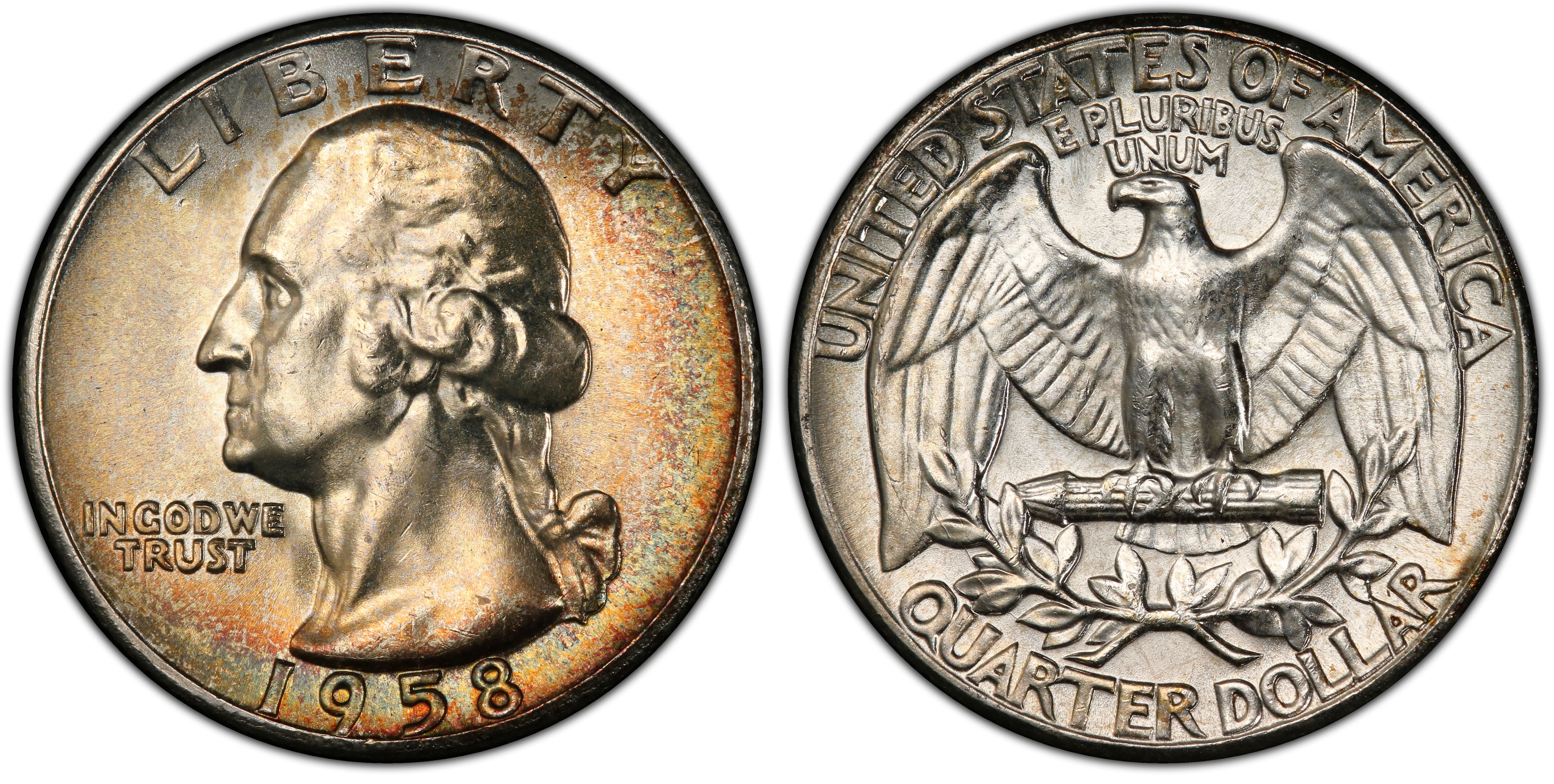
PCGS MS67

PCGS MS66+

PCGS MS66+
- PCGS #:
- 146067
- Designer:
- John Flanagan
- Edge:
- Reeded
- Diameter:
- 24.30 millimeters
- Weight:
- 6.30 grams
- Mintage:
- 6,360,000
- Mint:
- Philadelphia
- Metal:
- 90% Silver, 10% Copper
- Auction Record:
- $4,800 • MS67+ • 03-16-2019 • Heritage Auctions
Die Varieties
- 1958 25C Type B Reverse, FS-901
Condition Census What Is This?
|
#1 PCGS MS67
GreatCollections, May 19, 2019, Lot 670770 – Listing Removed. Gold, green, and orange obverse toning. Reverse is brilliant with wispy gold accents. |
|
#2 Est. MS67
As PCGS MS67+ #36192384. Heritage Auctions, March 14, 2019, Lot 3107 – $4,800. Dell Loy Hansen. As CACG MS67 #60258490. Type B Reverse. Peach surfaces accented by deeper peripheral toning in shades of green and maroon. |
|
#3 PCGS MS66+
GreatCollections, October 12, 2025, Lot 1943615 - $666. Coated in a delicate, marbleized olive-green patina. |
|
#3 PCGS MS66+
GreatCollections, November 6, 2022, Lot 1253759 - $471.24; GreatCollections, November 17, 2024, Lot 1698231 - $665.62. Apricot coloration blends into blue along the obverse border. The reverse exhibits more intense apricot toning, punctuated by circular untoned 'spots' along the eagle's wings and between the arrows and the right wing. |
|
#3 PCGS MS66+
GreatCollections, November 5, 2017, Lot 508414 - $376.89. Marbleized patina in olive-grey and gold. |
|
#3 PCGS MS66+
"The CoinEuphoria Collection" (PCGS Set Registry). Mint set toning in hues of green, gold, and red. |
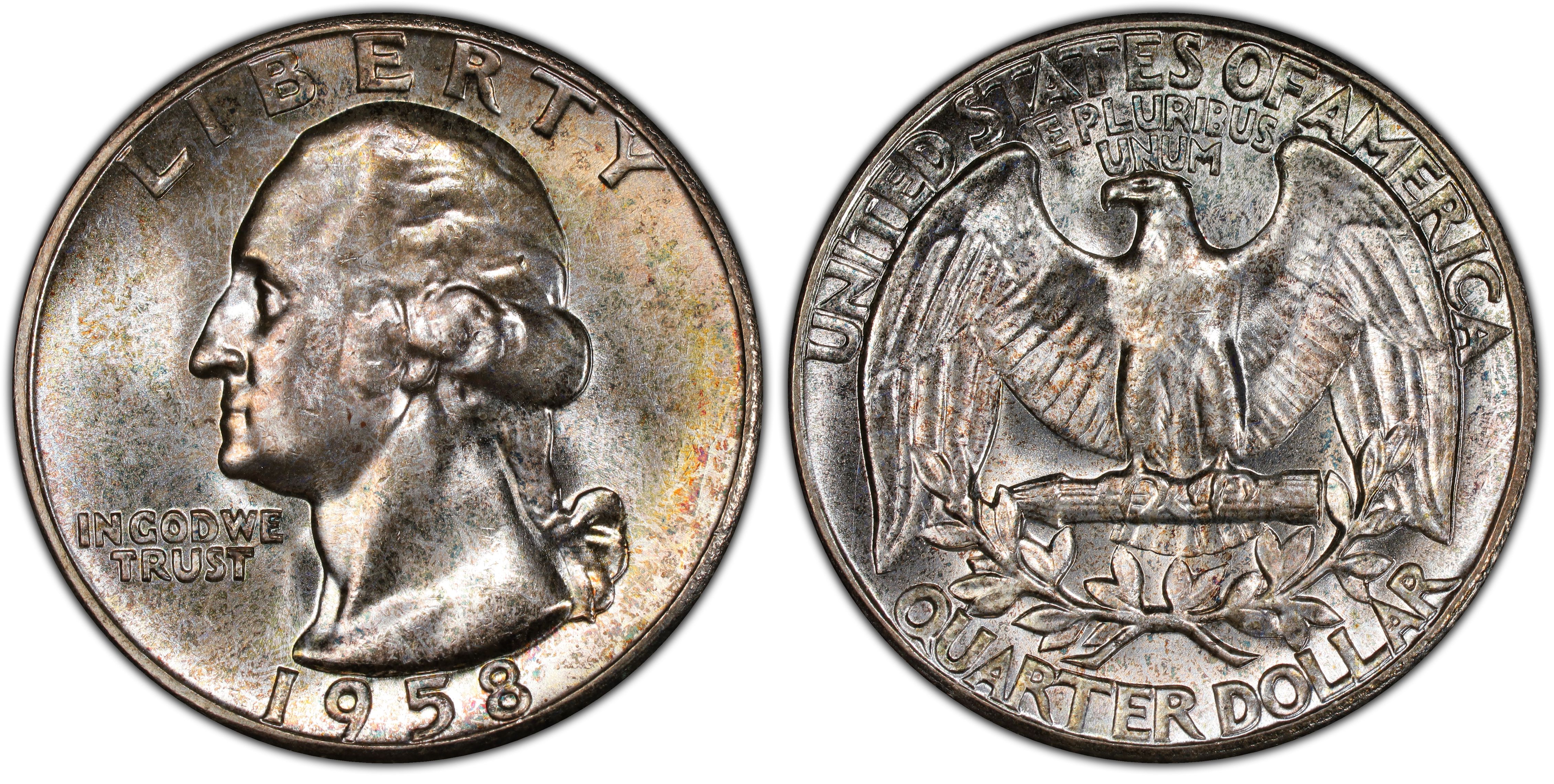 #3 PCGS MS66+
"The e1cnr Collection" (PCGS Set Registry). Mint Set toning in olive-grey, featuring highlights of gold and green visible in the lower-right obverse field. |
 #3 PCGS MS66+
"The Uncle Bill's Type B&C Set" (PCGS Set Registry). Intense iridescent concentric toning that displays gold centers and red, purple, and blue color along the edges. |
| #3 PCGS MS66+ |
The 1958 Washington Quarter
The 1958 economic downturn, known as the “Eisenhower Recession,” was relatively brief but impactful. Lasting only eight months, its effects were largely mitigated by robust growth beginning in May 1958. However, because the slump originated in late 1957, it significantly curtailed the United States Mint’s production forecasts.
Consequently, the Philadelphia Mint struck only 6,360,000 quarters. This represented an 86% decline from the 46,532,000 coins issued in 1957. As a result, the 1958 Philadelphia issue became the second-lowest mintage of the silver Washington Quarter series (1932–1964) and the 16th lowest in the entire series. Similar production declines were reported across all denominations in Philadelphia that year.
Despite the broader economic cooling, Uncirculated Coin Set sales remained resilient. After a slight slump in 1957, 1958 sales climbed to a then-record 50,314 sets- the highest volume since 1947. These sets were sold to collectors for $4.43 (approximately $45.50 adjusted for inflation). Today, these original sets typically trade between $275 and $325. Many of the finest known 1958 quarters originate from these sets, often featuring vibrant, multidimensional toning caused by the high sulfur content of the original paper packaging.
Additionally, the Philadelphia Mint utilized retired Proof dies for a significant portion of the 1958 production, resulting in numerous "Type B" Reverse varieties (#146067). Many of these business strikes exhibit distinct Semi-Prooflike surfaces.
Historic Market Insights
As monthly reports signaled a dramatic production deficit, collectors and dealers moved quickly to hoard rolls and bags directly from the Mint. This led to heavy speculation throughout the 1960s. By 1965, Illinois dealer Ray Kotansky was marketing Brilliant Uncirculated (BU) bags for $6,100. Due to this widespread preservation, thousands of original Uncirculated rolls remain, surfacing periodically on the market.
The PCGS Population Report reflects this hoarding trend. Aside from the 1932-D (#5790) and 1932-S (#5791) keys, only the 1947-S (#5835) shows similar certification patterns. Both the 1947-S and 1958 are submitted almost exclusively in Mint State, whereas approximately 10% of the certified population for the two key dates consists of circulated examples.
Recent Market Insights
Even before joining PCGS, I took a keen interest in monitoring the inflation of the PCGS MS67+ population. This rising supply, predictably, exerted downward pressure on prices. In 2020, a collector might have expected to pay approximately $850 for a MS67+, whereas by 2024–2025, a typical example realized closer to $350-$450. After analyzing our internal data, I discovered that the MS67+ population was overstated by 30 grading events due to the repeated resubmission of a single specimen. For whatever reason, none of the previous certification numbers were deactivated. My research indicates that once the population is adjusted for these plate-matched individual coins, the true number of unique specimens will fall below 50. While I will not disclose the specific coin, I can assure you that the 1958 Washington Quarter "top pop" census is far more stable than it previously appeared. Consequently, due to my audit of the data, the era of bargain pricing for this issue is likely coming to a close.
A Note About Color
A majority of the high-grade, toned 1958 Washington Quarters appearing on the market originated from Mint Sets, whereas most brilliant examples likely surfaced from original rolls. While roll-sourced coins typically top out in the PCGS MS66 range, nearly every PCGS MS67 and MS67+ specimen is a Mint Set toner.
* * *