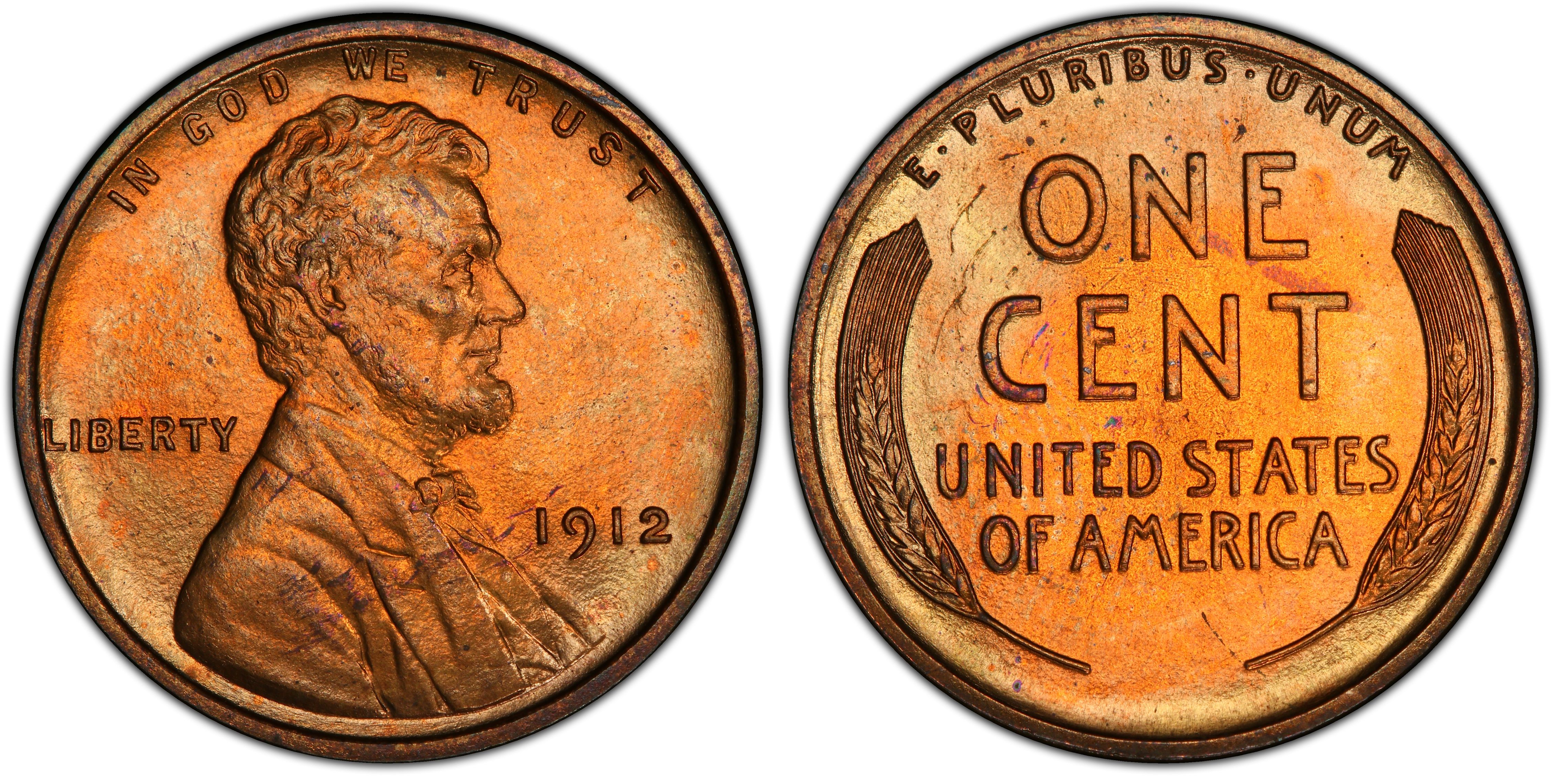
1912 1C, RD (Proof)
Series: Lincoln Cents 1909-1958

PCGS PR66RD

PCGS PR66RD

PCGS PR66RD
- PCGS #:
- 3314
- Designer:
- Victor David Brenner
- Edge:
- Plain
- Diameter:
- 19.00 millimeters
- Weight:
- 3.11 grams
- Mintage:
- 2,172
- Mint:
- Philadelphia
- Metal:
- 95% Copper, 5% Tin and Zinc
- Auction Record:
- $37,600 • PR66RD • 02-18-2016 • Legend Rare Coin Auctions
Rarity and Survival Estimates Learn More
| Survival Estimate | |
|---|---|
| All Grades | 100 |
| 60 or Better | 100 |
| 65 or Better | 35 |
| Numismatic Rarity | |
|---|---|
| All Grades | R-8.0 |
| 60 or Better | R-8.0 |
| 65 or Better | R-8.8 |
| Relative Rarity By Type All Specs in this Type | |
|---|---|
| All Grades | 4 / 26 |
| 60 or Better | 4 / 26 |
| 65 or Better | 2 / 26 TIE |
| Relative Rarity By Series All Specs in this Series | |
|---|---|
| All Grades | 4 / 26 |
| 60 or Better | 4 / 26 |
| 65 or Better | 2 / 26 TIE |
Condition Census What Is This?
|
#1 PCGS PR66RD
|
|
#1 PCGS PR66RD
As PCGS PR66RD #41880439. "The Lincoln Collection of Lincoln Cents," GreatCollections, February 23, 2025, Lot 1575487 - $38,250. As PCGS PR66RD #56207017. "The Jeremy Bolt - Hurricane Milton Collection" (PCGS Set Registry). |
 #1 PCGS PR66RD
|
 #1 PCGS PR66RD
|
| #1 PCGS PR66RD |
| #6 PCGS PR65+RD |
 #6 PCGS PR65+RD
Stack's Bowers, April 3, 2024, Lot 4019 - $6,600. |
The 1912 Lincoln Cent Matte Proof
In 1912, the United States Mint raised the price of minor Proof Sets from 8¢ to 12¢, doubling the premium on the one- and five-cent Proof coins relative to their face value. Even with this increase, the Mint barely recouped its production costs, continuing manufacture largely as a public service to collectors. While demand actually rose slightly despite the price hike, the Mint's total 1912 output of 2,172 sets fell far short of the 4,083 sets delivered just two years prior in 1910.
|
1912 Lincoln Cent Matte Proof Deliveries |
|||
| Date | Struck | Accepted | % Accepted |
| January 2 | 200 | 126 | 63% |
| January 3 | 150 | 88 | 58.7% |
| January 20 | 200 | 100 | 50% |
| February 7 | 300 | 265 | 88.3% |
| February 24 | 350 | 275 | 78.6% |
| April 16 | 250 | 200 | 80% |
| May 13 | 300 | 200 | 66.7% |
| June 8 | 655 | 320 | 48.9% |
| October 12 | 50 | 48 | 96% |
| November 20 | 125 | 100 | 80% |
| November 26 | 400 | 350 | 87.5% |
| December 14 | 150 | 100 | 66.7% |
| Total | 3,130 | 2,172 | 69.4% |
Curiously, quality control for much of 1912 fell well below the standards reported by the Mint’s Medal Room for 1911, with January production hovering around a meager 57% acceptance rate. The June 8 delivery marked a low point, though the Mint’s contradictory record-keeping calls this anomaly into question. Recorded in the Mint’s first Medal and Proof Book (1906–1916) are the totals: 655 struck, 320 accepted. Yet, in a second Medal and Proof Book covering the same period, the ledger reads: "June 10, 320 delivered, 320 good." Given the rest of the data, a 100% approval rate for that batch seems highly unlikely.
Collecting the 1912 Lincoln Cent Matte Proof
While the 1909 V.D.B. (BN #3300) often receives more attention as the unquestioned key to the matte proof series, the 1912 issue is a major conditional rarity in its original red format. For the 1912 Proof, none have graded finer than PCGS PR66RD. A primary culprit in the loss of this original red color was the chemically active yellow tissue paper the Mint used to wrap and protect the coins, the sulfur content of which reacted over time with the bronze surfaces to cause deep toning. Occasionally, the 1912 Lincoln Cent Matte Proof will take on attractive and stable rainbow toning and there is a growing market for these examples, which often fall in the RB and BN categories.
A single set of working dies was used to strike all 1912 Matte Proof Lincoln Cents (BN #3312). On the obverse, the letter E in WE shows slight doubling, which is visible under magnification on early die-state examples. The reverse features the same characteristic die scratch that runs leftward from the M in UNUM into the field above the E in ONE. that is present on all Matte Proof cents struck from 1910-1914.
* * *