1916 1C, BN (Proof)
Series: Lincoln Cents 1909-1958

PCGS PR67BN

PCGS PR66+BN

PCGS PR66BN
- PCGS #:
- 3324
- Designer:
- Victor David Brenner
- Edge:
- Plain
- Diameter:
- 19.00 millimeters
- Weight:
- 3.11 grams
- Mintage:
- 1,050
- Mint:
- Philadelphia
- Metal:
- 95% Copper, 5% Tin and Zinc
- Auction Record:
- $8,000 • PR67BN • 10-17-2021 • eBay
Rarity and Survival Estimates Learn More
| Survival Estimate | |
|---|---|
| All Grades | 225 |
| 60 or Better | 225 |
| 65 or Better | 120 |
| Numismatic Rarity | |
|---|---|
| All Grades | R-6.7 |
| 60 or Better | R-6.7 |
| 65 or Better | R-7.8 |
| Relative Rarity By Type All Specs in this Type | |
|---|---|
| All Grades | 2 / 18 TIE |
| 60 or Better | 3 / 18 |
| 65 or Better | 7 / 18 TIE |
| Relative Rarity By Series All Specs in this Series | |
|---|---|
| All Grades | 2 / 18 TIE |
| 60 or Better | 3 / 18 |
| 65 or Better | 7 / 18 TIE |
Condition Census What Is This?
|
#1 PCGS PR67BN
|
|
#2 PCGS PR66+BN
Stack's Bowers, November 18, 2025, Lot 8050 - $4,560. |
|
#2 PCGS PR66+BN
Heritage Auctions, March 16, 2019, Lot 3035 - $3,840; "The RB Proof Collection" (PCGS Set Registry). |
 #4 PCGS PR66BN
Heritage Auctions, November 22, 2020, Lot 3528 - $5,701.20; Legend Rare Coin Auctions, February 25, 2021, Lot 34 - $6,756.25; "Bodie and Sophie's South Texas Set of Matte Proof Lincoln Cents" (PCGS Set Registry). |
 #4 PCGS PR66BN
Stack's Bowers, May 29, 2019, Lot 154 - $2,760. |
 #4 PCGS PR66BN
Heritage Auctions, August 5, 2014, Lot 3174 - $5,581.25; "The SnLCollection" (PCGS Set Registry). |
 #4 PCGS PR66BN
"The Jeh Collection" (PCGS Set Registry). |
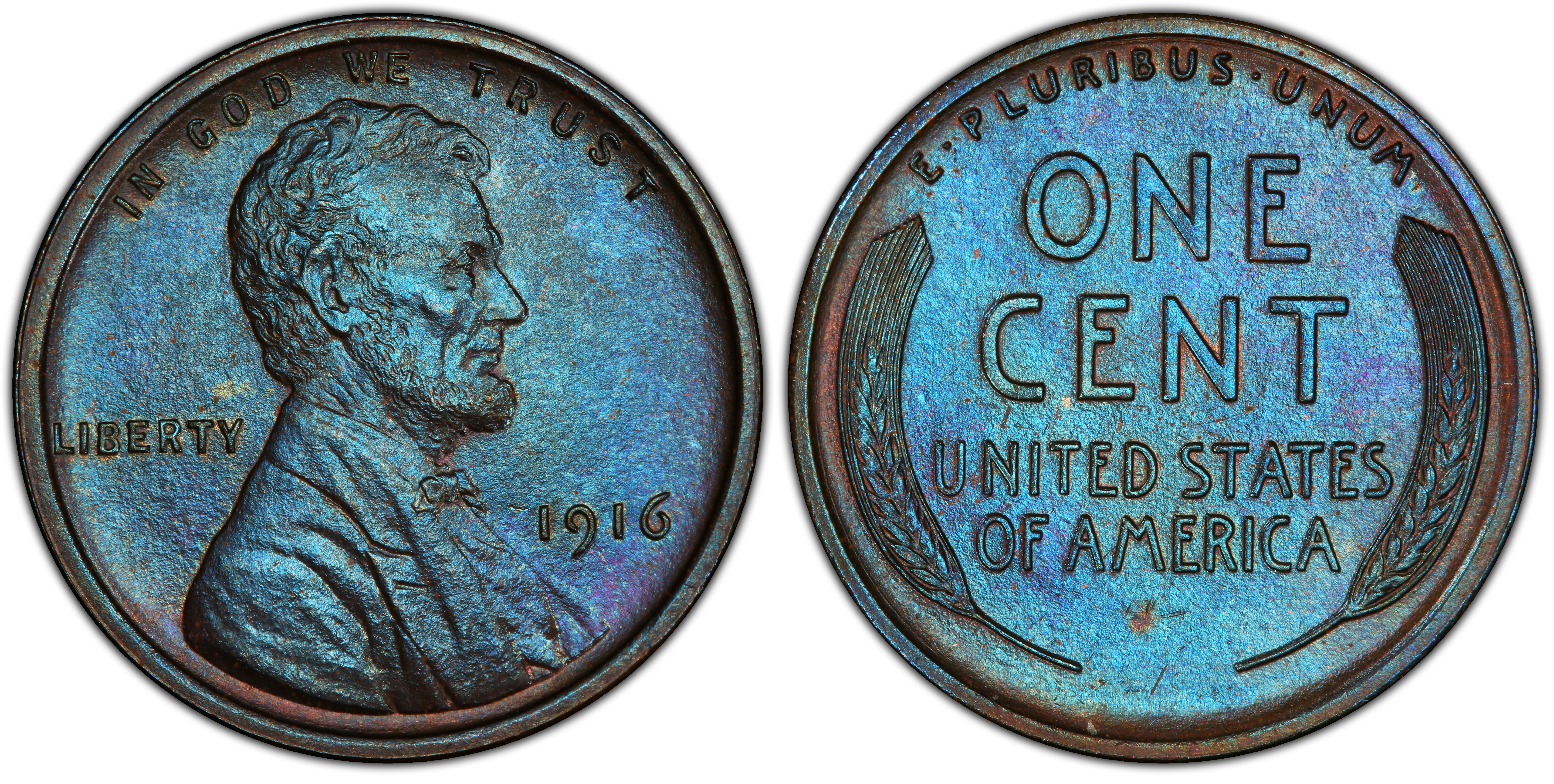 #4 PCGS PR66BN
Intense blue and aubergine patination. |
 #4 PCGS PR66BN
Raspberry and blue patination. |
 #4 PCGS PR66BN
|
 #4 PCGS PR66BN
|
 #4 PCGS PR66BN
|
 #4 PCGS PR66BN
|
 #4 PCGS PR66BN
|
The 1916 Lincoln Cent Matte Proof
One of the unexpected consequences of President Theodore Roosevelt's desire to beautify American coinage was the steady decline of Proof production. The distinct character of the new designs, starting with the Saint-Gaudens issues and continuing through the Bigelow-Pratt gold coins and the Buffalo Nickel, led the Mint to experiment extensively with matte and satin finishes. However, the quality of these Matte Proofs was wildly inconsistent; while some boasted spectacular eye appeal, others were dull and lifeless.
When the Barber silver denominations were replaced in 1916 by the Mercury Dime, Standing Liberty Quarter, and Walking Liberty Half Dollar, the Mint faced an entirely new problem. The fields and relief surfaces of all three new designs were highly uneven. This physical characteristic made it "technically impossible," in the words of Philadelphia Mint Superintendent Adam Joyce, to strike proof coins that were visually distinct from standard business issues. While the Mint would eventually resolve these technical hurdles in 1936, the administration in 1916 ultimately decided it wasn't worth the effort. On October 18, 1916, Mint Director F.J.H. von Engelken ordered the Philadelphia Mint to suspend the proof program effective immediately, bringing a sudden end to the first era of Proof Lincoln Cent production.
A Question of Mintages
The Mint's confusing record-keeping calls into question the actual mintage of the 1916 Matte Proof Lincoln Cent (#3326). In 1947, the Mint reported a total mintage of 1,050 pieces — a figure that subsequently became the accepted total in R.S. Yeoman's Guide Book and Walter Breen's Encyclopedia of United States and Colonial Proof Coins.
However, numismatic researcher Kevin Flynn paints a completely different picture. Referencing two distinct Medal and Proof ledger books kept by the very workers striking the coins, Flynn revealed major discrepancies:
Book 1 documents a single striking on March 24 of 299 pieces, with only 200 accepted and no subsequent entries.
|
1916 Lincoln Cent Matte Proof Deliveries (Book 1) |
|||
| Date | Struck | Accepted | % Accepted |
| March 24 | 299 | 200 | 67% |
| Total | 299 | 200 | 67% |
Book 2 records three separate strikings: one in March, one the day before proof production was officially suspended in October, and a final run on December 26—well after the suspension order.
|
1916 Lincoln Cent Matte Proof Deliveries (Book 2) |
|||
| Date | Struck | Accepted | % Accepted |
| March 25 | 200 | Unknown | |
| October 17 | 200 | Unknown | |
| December 26 | 200 | Unknown | |
| Total | 600 | Unknown | |
While the exact mintage remains a mystery, it is undeniable that the 1916 issue is exceptionally scarce; among Matte Proof Lincoln Cents, only the legendary 1909 V.D.B. (#3300) is tougher to source. However, with a PCGS population currently approaching 300 specimens, it is clear that the Mint struck more coins than were recorded in Book 1, and likely surpassed the figures reported in Book 2, though a survival rate pointing to a true mintage of roughly 600 pieces remains possible.
Collecting the 1916 Lincoln Cent Matte Proof
For those collecting full Red Matte Proof Lincoln Cents, the nine-coin series can be broken down into five distinct categories of difficulty:
- Key Date: The 1909 V.D.B. is the unquestioned key to the series.
- Rare: The 1916 and 1915 issues (ordered from rarest to least rare).
- Scarce: The 1912 (BN #3312) and 1911 (BN #3309) issues. Notably, the 1912 stands out as the absolute rarest coin in the entire series at the PCGS PR66RD grade or above, with none currently certified finer than PR66RD.
- Uncommon: The 1914 (BN #3318) and 1910 (BN #3306) issues (ordered from rarest to least rare).
- Common: The 1913 (#3315) and 1909 Non-V.D.B. (BN #3303) issues.
For the 1916 release specifically, Gems are scarce but available across all three color designations (RD, RB, and BN), though no Superb Gems have been certified to date.
Most collectors are well aware that silver proofs were not struck in 1916, leaving the nickel and the cent as the only two circulating denominations with proof issues. Less known, however, is the existence of 10 matte proof specimens of the 1916 McKinnley Gold Dollar Commemorative Proofs (#7487). Assembling a high-grade, three-coin 1916 proof set would present a wonderful challenge for a true numismatic aficionado.
* * *