1793 1C Chain, S-3, RB (Regular Strike)
Series: Flowing Hair Chain Cents 1793

PCGS MS65RB
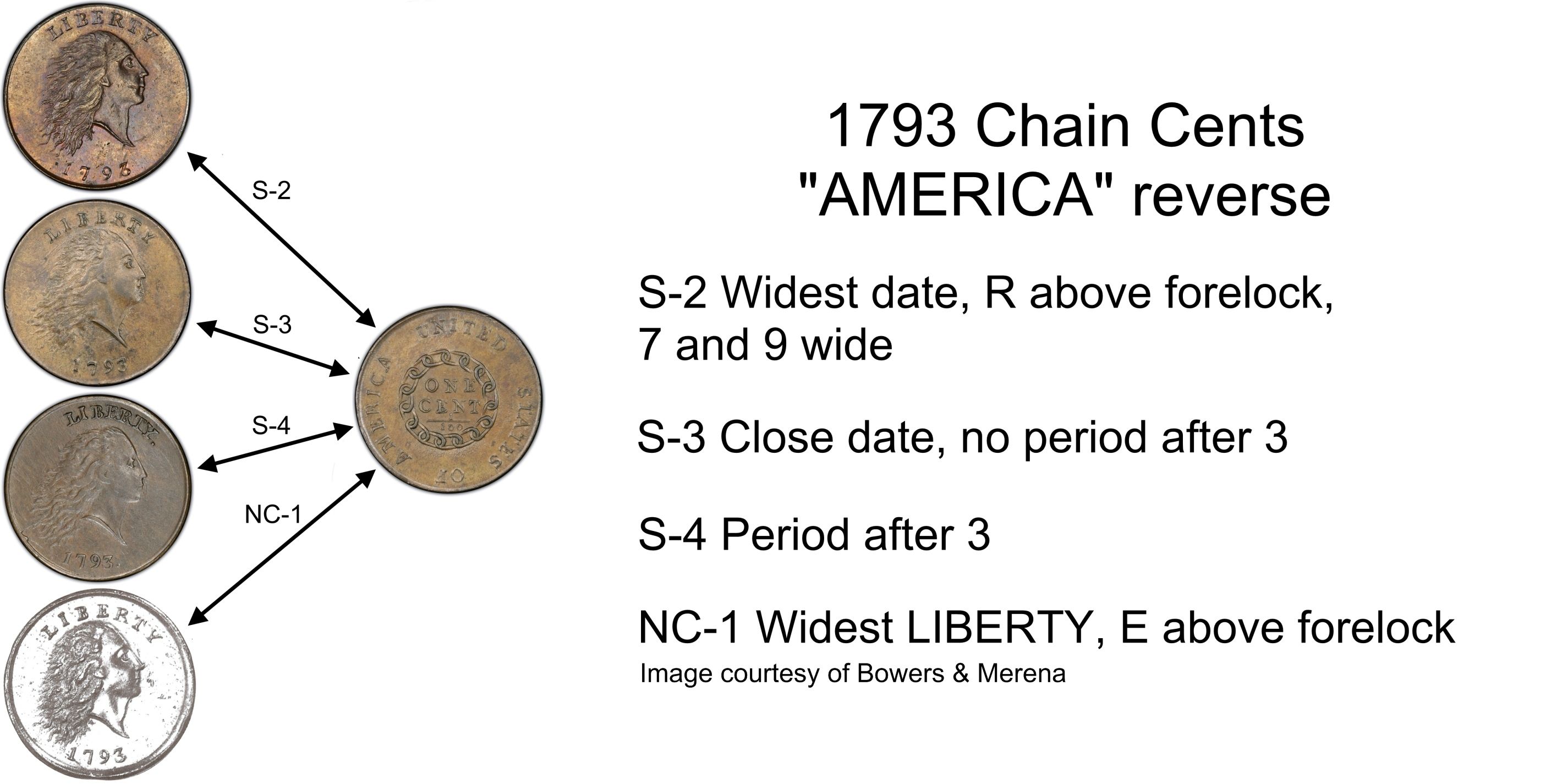
"AMERICA" REVERSE ATTRIBUTION GUIDE
- PCGS #:
- 35439
- Designer:
- Attributed to Henry Voight
- Edge:
- Bars and Vines
- Diameter:
- 27.00 millimeters
- Weight:
- 13.48 grams
- Mintage:
- 36,103
- Mint:
- Philadelphia
- Metal:
- Copper
- Auction Record:
- $998,750 • MS65RB • 02-09-2016 • Stack's Bowers
Die Varieties
- 1793 1C Chain, S-2, BN
- 1793 1C Chain, S-3, BN
- 1793 1C Chain, S-3, RB
- 1793 1C Chain, NC-1, BN
Rarity and Survival Estimates Learn More
| Survival Estimate | |
|---|---|
| All Grades | |
| 60 or Better | |
| 65 or Better | |
| Numismatic Rarity | |
|---|---|
| All Grades | R-10.1 |
| 60 or Better | R-10.1 |
| 65 or Better | R-10.1 |
| Relative Rarity By Type All Specs in this Type | |
|---|---|
| All Grades | 1 / 1 |
| 60 or Better | 1 / 1 |
| 65 or Better | 1 / 1 |
| Relative Rarity By Series All Specs in this Series | |
|---|---|
| All Grades | 1 / 1 |
| 60 or Better | 1 / 1 |
| 65 or Better | 1 / 1 |
Condition Census What Is This?
|
#1 MS65RB PCGS grade
Pierre-Edouard Legras (Paris). Édouard Frossard, sold privately in June or July 1880; George M. Parsons. As "Perfectly struck, sharp, uncirculated." Édouard Frossard, October 23, 1884, Lot 983, $100; T. Harrison Garrett; Robert Garrett; John Work Garrett; Johns Hopkins University. As "MS63." "The Garrett Collection, Part I," Bowers & Ruddy, November 28, 1979, Lot 53, $115,000; Stan Kesselman, sold privately, March 1980; R.E. “Ted” Naftzger, Jr.; Eric Steiner; Jay Parrino. As NGC MS66BN #957212-008. Claude E. Davis; "The Foxfire Collection (Davis)," sold en bloc via Richard Burdick to the Pogue Family. As PCGS MS64RB #31530063. "The D. Brent Pogue Collection, Part III," Stack's Bowers, February 9, 2016, Lot 3013 - $998,750. S-3. |
The 1793 Chain Cent, AMERICA, Close Date, Leaning R, Sheldon-3
The 1793 Chain Cent, occasionally referred to as the “Link” Cent in 19th-century numismatic literature, was the first regular-issue one-cent coin produced by the United States Mint. Struck at the first Philadelphia Mint facility and most likely included in the March 1 delivery, it holds the distinction of being the first federal coin struck for circulation.
While the dies were executed by Henry Voigt (sometimes spelled Voight), the first Chief Coiner, the obverse was inspired by the Libertas Americana medal designed by the famed French engraver Augustin Dupré. The obverse depicts Liberty with "flowing" hair, the inscription LIBERTY above, and the date 1793 below the bust truncation.
The reverse displays a chain of 15 interlocking links, symbolizing the 15 states in the Union in 1793, which encloses the denomination ONE CENT. The legend is spelled UNITED STATES OF AMERI. on the Sheldon-1 and UNITED STATES OF AMERICA on Sheldon-2 through Sheldon-4. This inscription encircles the central motif clockwise from the top of the coin.
The design was poorly received by the public. Critics decried the reverse as "Liberty in chains," perhaps a subtle nod to the ongoing slave trade or a more general fear of federal overreach. A contemporary report from Newark noted:
"The American Cents... do not answer our expectations. The chain on the reverse is but a bad omen for liberty, and Liberty herself appears to be in a fright."
A similar sentiment appeared in the March 18, 1793, edition of Philadelphia’s The Mail, which stated:
"The chain on the reverse is but a bad omen for liberty."
|
1793 Chain Cent Deliveries |
|||
| March 1, 1793 | 11,178 delivered | March 2, 1793 | 2,009 delivered |
| March 4, 1793 | 4,000 delivered | March 5, 1793 | 3,765 delivered |
| March 6, 1793 | 1,573 delivered | March 8, 1793 | 7,000 delivered |
| March 8, 1793 | 7,000 delivered | March 9, 1793 | 1,000 delivered |
| March 12, 1793 | 5,578 delivered | Total: 36,103 coins | |
Over the twelve-day production period, 36,103 pieces were struck using five distinct die combinations. The initial delivery on March 1 consisted of roughly 7,000 cents of the AMERI. variety (S-1), while the remaining 4,178 coins from that first delivery were of the Sheldon-2 variety. The Sheldon-2 and subsequent four Chain Cent varieties utilized the same reverse die where "AMERICA" was spelled out in full. These inaugural coins were struck in relatively low relief; their successor, the Wreath cent, would feature a more robust, higher-relief design.
America, Close Date, Leaning R (S-3) Die Chararacteristics
Rarity-3. The Sheldon-3 variety features a very closely spaced date and a distinctive positioning of LIBERTY. On this variety, the R is slightly larger than the surrounding letters and is canted to the right. This creates a unique visual effect, making it appear as though "LIBE" and "RTY" are two separate, crowded words. The positioning of the date is similarly irregular; the numerals were punched in a staggered formation, placing the tops of the 1 and 9 slightly above the tops of the 7 and 3. It is these artisanal characteristics of the Mint’s early, hand-cut dies that provide early American coinage with such enduring charm.
This reverse die shows AMERICA fully spelled out and was also used to strike the Sheldon-2, Sheldon-4, and NC-1 varieties; only the Sheldon-1 (AMERI.) used a different reverse die. Walter Breen and Mark Borckardt suggest a mintage of up to 18,000 pieces for this variety, accounting for the bulk of the March 2-8 deliveries. Die clash frequently seen at Liberty's mouth and neck.
* * *