1899 5C RPD FS-301 (Regular Strike)
Series: Liberty Head Five Cents 1883-1912
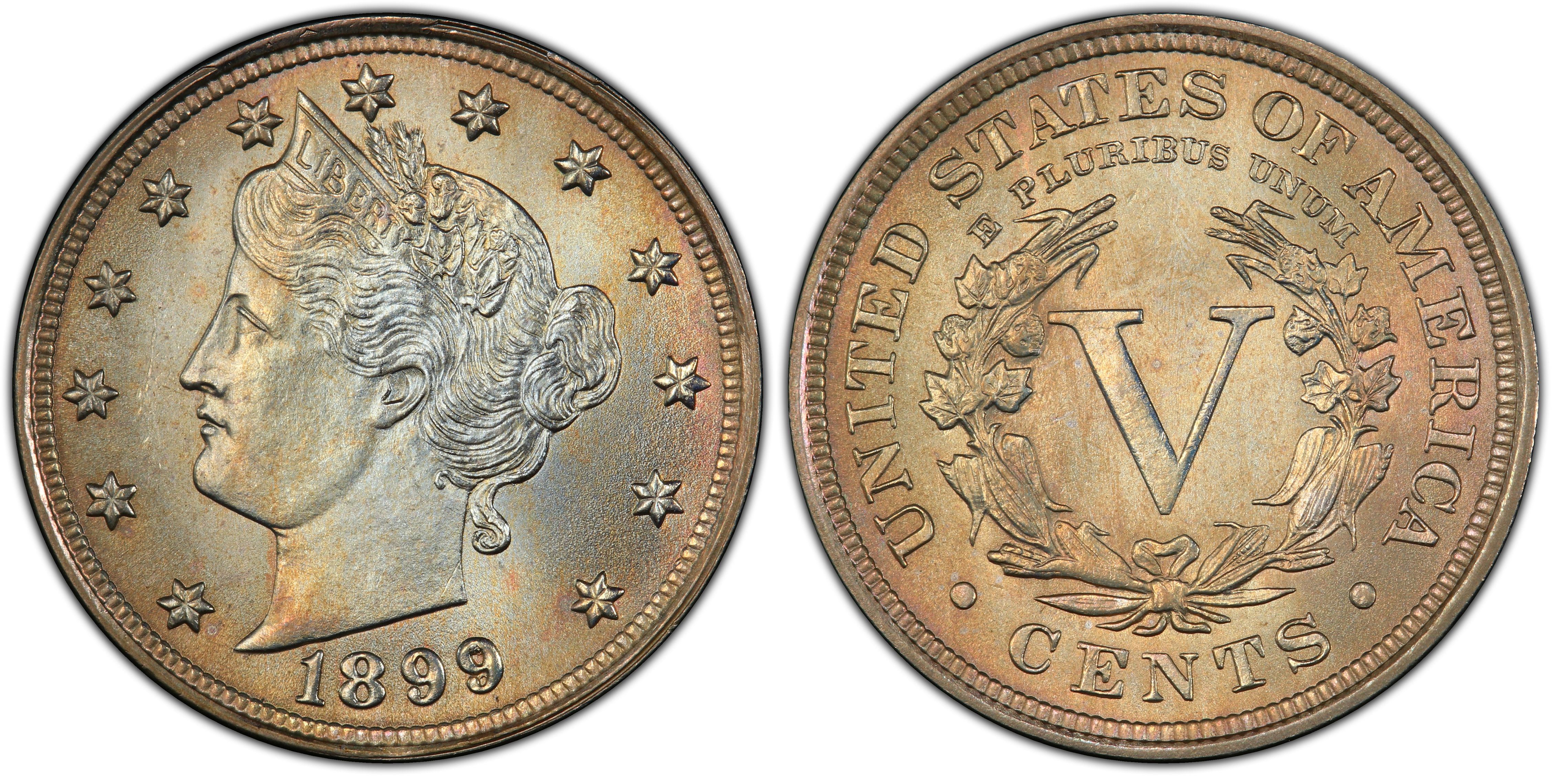
PCGS MS66

PCGS MS65

PCGS MS64
- PCGS #:
- 38425
- Designer:
- Charles E. Barber
- Edge:
- Plain
- Diameter:
- 21.20 millimeters
- Weight:
- 5.00 grams
- Mintage:
- 26,027,000
- Mint:
- Philadelphia
- Metal:
- 75% Copper, 25% Nickel
- Auction Record:
- N/A
Die Varieties
- 1899 5C RPD FS-301
Condition Census What Is This?
|
#1 PCGS MS66
"The KCV Lady Liberty Cir Variety" (PCGS Set Registry). |
|
#2 PCGS MS65
"The LNCS - Extras" (PCGS Set Registry). |
|
#3 PCGS MS64
"The Liberty Nickel Collector Society" (PCGS Set Registry). |
 #3 PCGS MS64
|
The 1899 Liberty Nickel
1899 saw a continued upswing in mintage sizes. This surge followed a temporary suspension of coinage operations in 1894 brought on by the economic fallout of the Panic of 1893. By 1899, the nation's economy was booming, and the demand for small change skyrocketed.
Unlike modern pocket change, a nickel in 1899 carried substantial purchasing power. In fact, a single 1899 Liberty Nickel (#3860) possessed the purchasing power of nearly $1.90 today. This utility was further amplified by a wave of new coin-operated slot and vending machines cropping up across the country, all tooled specifically to accept nickels.
To meet this demand, the United States Mint purchased 75,000 pounds of copper-nickel blanks. Utilizing at least 119 obverse and 63 reverse dies, the Philadelphia Mint struck a massive 26,027,000 nickels, the largest single issuance of the series to that point. This historic output represented a 108% increase over the prior year and a 63% increase over the previous record set in 1897.
Fulfilling this massive requirement pushed the old, neoclassical Philadelphia Mint building to its absolute limits. Crowded with outdated machinery, the facility was abandoned shortly thereafter in favor of the third, much larger Philadelphia Mint building on Spring Garden Street.
While 1899 nickels are generally well-struck, they typically lack vibrant, frosty luster, often exhibiting a more satin or matte-like surface.
The 1899 Repunched Date Variety
The year also produced a notable repunched date variety, cataloged as FS-301 in the Cherrypickers' Guide. For years, it was known only from a solitary, extremely worn example, leaving many numismatists to question its authenticity. However, the discovery of several additional specimens in 1971 confirmed the variety's legitimacy. While some believe this coin may actually be an 1899/8 overdate, most experts agree this is unlikely. Regardless of its true classification, the PCGS population of this variety is exceptionally low, making public auction appearances few and far between.
Collecting the 1899 Liberty Nickel
The 1899 Liberty Nickel is a readily available collector coin in grades up to PCGS MS65. Beyond that, however, it becomes a major conditional rarity; as of July 2026, fewer than 20 examples have earned the Superb Gem grades of PCGS MS67 or PCGS MS67+. The all-time auction record for this date was set in November 2012 at a Stack's Bowers Baltimore sale, where a then-unique, top-population PCGS MS67+ specimen realized $38,187.50. Since then, a second example has been certified at this elite grade level.
* * *