1797 10C JR-1, 16 Stars (Regular Strike)
Series: Draped Bust Dimes 1796-1807

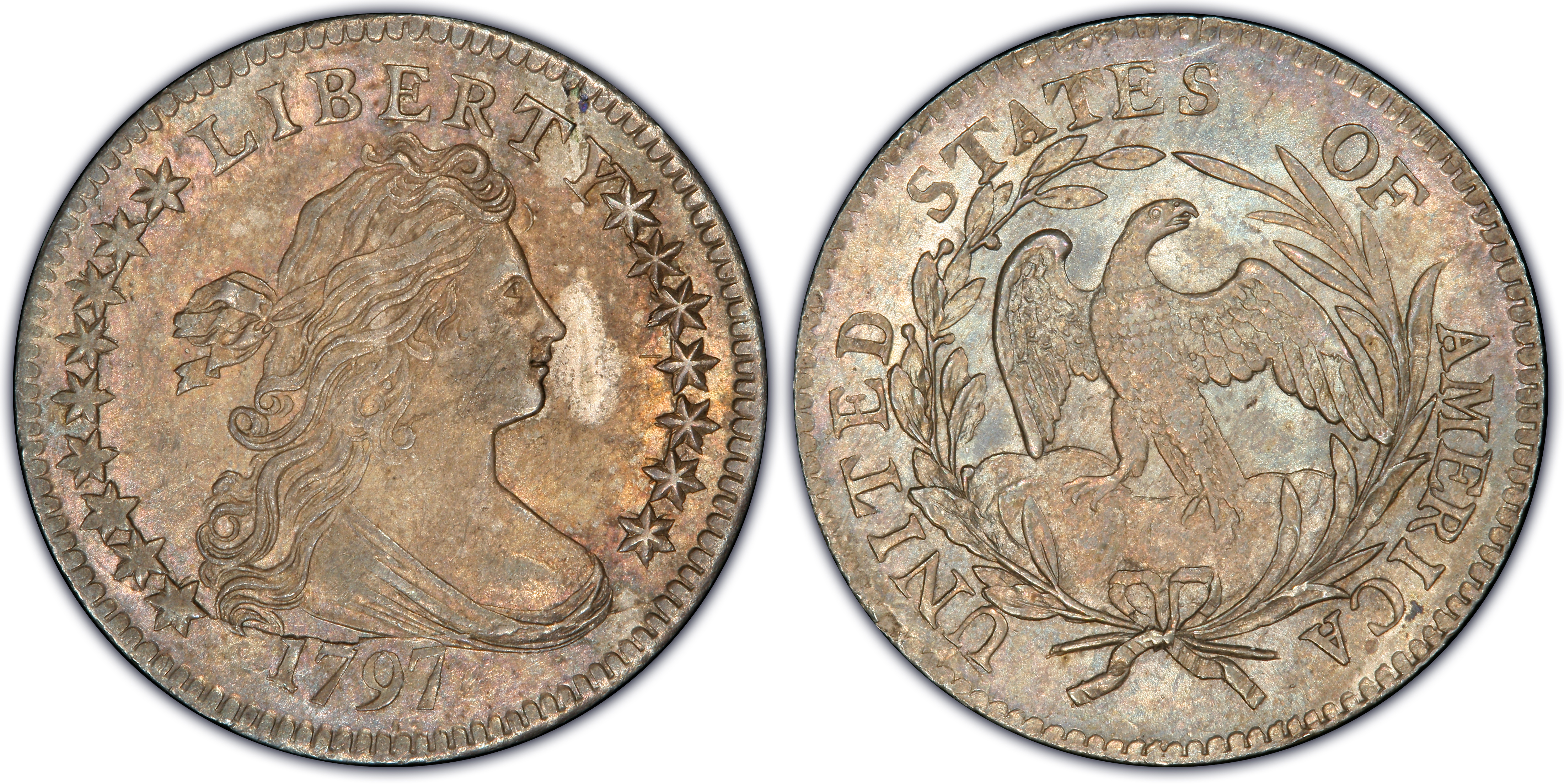
PCGS MS66
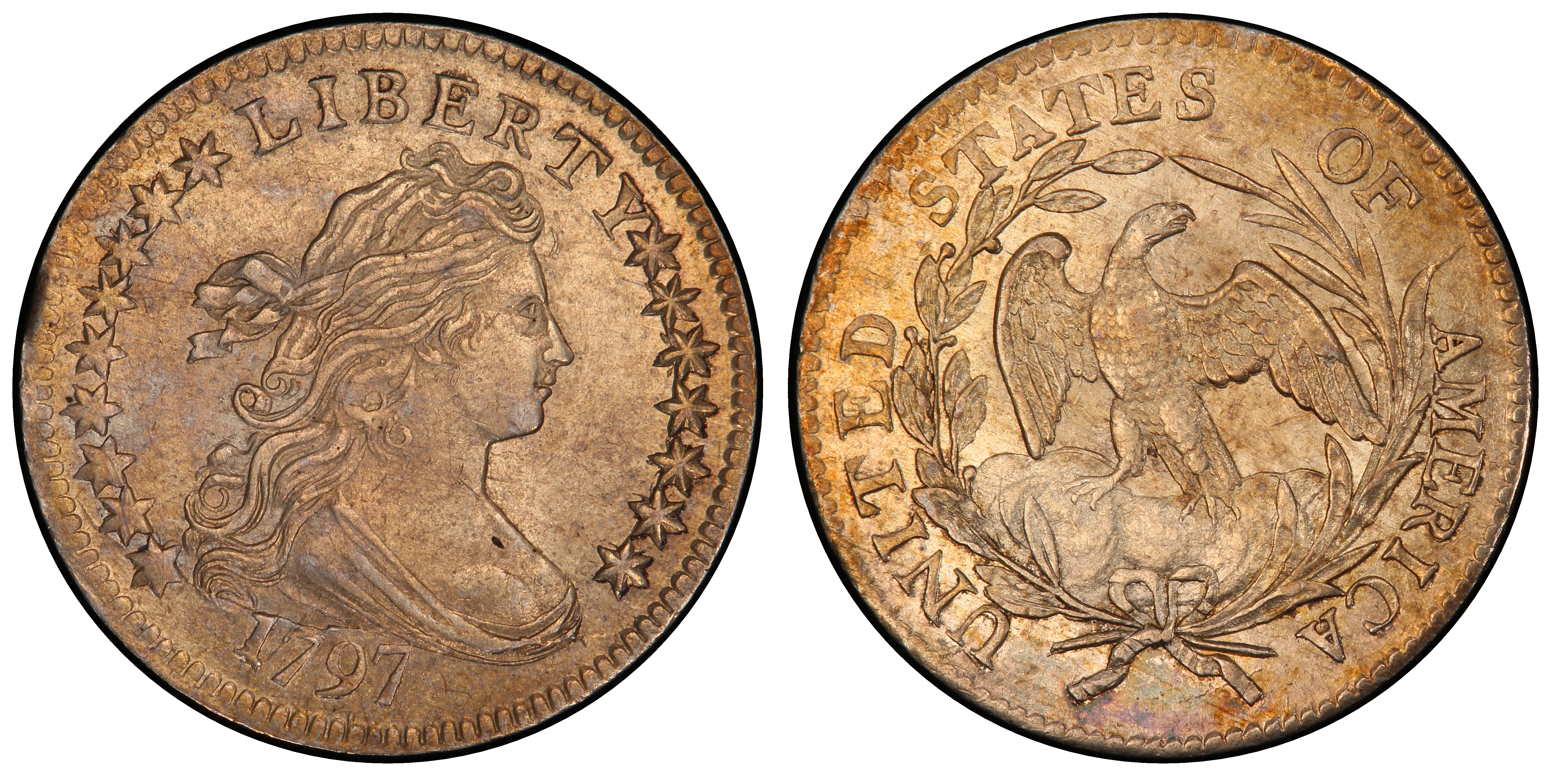
PCGS MS65
PCGS MS61
- PCGS #:
- 38748
- Designer:
- Robert Scot
- Edge:
- Reeded
- Diameter:
- 19.80 millimeters
- Weight:
- 2.70 grams
- Mintage:
- 25,261
- Mint:
- Philadelphia
- Metal:
- 89.2% Silver, 10.8% Copper
- Auction Record:
- $45,600 • MS62 • 11-24-2024 • Heritage Auctions
Die Varieties
- 1797 10C JR-1, 16 Stars
Condition Census What Is This?
|
#1 PCGS MS66
“The Lorin G. Parmelee Collection,” New York Coin and Stamp Company, June 1890, Lot 744; “The Milton A. Holmes Collection,” October 1960, Lot 2675; “The James A. Stack Collection,” Stack’s, January 1990, Lot 3; Jay Parrino; The Knoxville Collection; “The D. Brent Pogue Collection, Part I,” Stack’s Bowers / Sotheby’s, May 2015, Lot 1035 – $199,750; "The JRCSLM32 Collection" (PCGS Set Registry). Attractively toned in grey, periwinkle, orange, and blue. |
| #2 PCGS MS66 |
|
#3 PCGS MS65
The Charles Williams Collection; “The Adolphe Menjou Collection (actually Williams),” Numismatic Gallery, June 1950, Lot 145; John Jay Pittman; As “Very Choice Uncirculated, a virtual Gem”. “The John Jay Pittman Collection,” David Akers, October 1997, Lot 533; Graded NGC MS66. As PCGS MS65 #13437010. Heritage Auctions, January 10, 2013, Lot 5576 – $99,875; Dell Loy Hansen; "The D.L. Hansen Early Dimes Circulation Strike Collection" (PCGS Set Registry). Peach and green toning. "Untoned" area in front of Liberty's face and between T and Y. |
 #4 PCGS MS64
|
 #5 PCGS MS62
“The Robert Michael Prescott Collection,” Stack’s Bowers, January 3, 2006, Lot 242 – $23,000; Stack’s Bowers, July 30, 2009, Lot 295 – Passed; Heritage Auctions, August 3, 2012, Lot 5081 – $38,187.50. CAC added; Stack’s Bowers, March 2, 2010, Lot 628 – Passed; “The Jim O’Neal Collection of U.S. Type, Part One,” Heritage Auctions, April 24, 2014, Lot 5560 – $35,250; Heritage Auctions, December 4, 2014, Lot 3502 – $31,725; Legend Rare Coin Auctions, May 18, 2017, Lot 173 – $27,000. As PCGS MS62 #38759826. "The Ronald Firman Rarities Collection," Heritage Auctions, November 24, 2024, Lot 3696 - $45,600. Faint lavender-grey toning. Toning spot to the left of Liberty’s bow. |
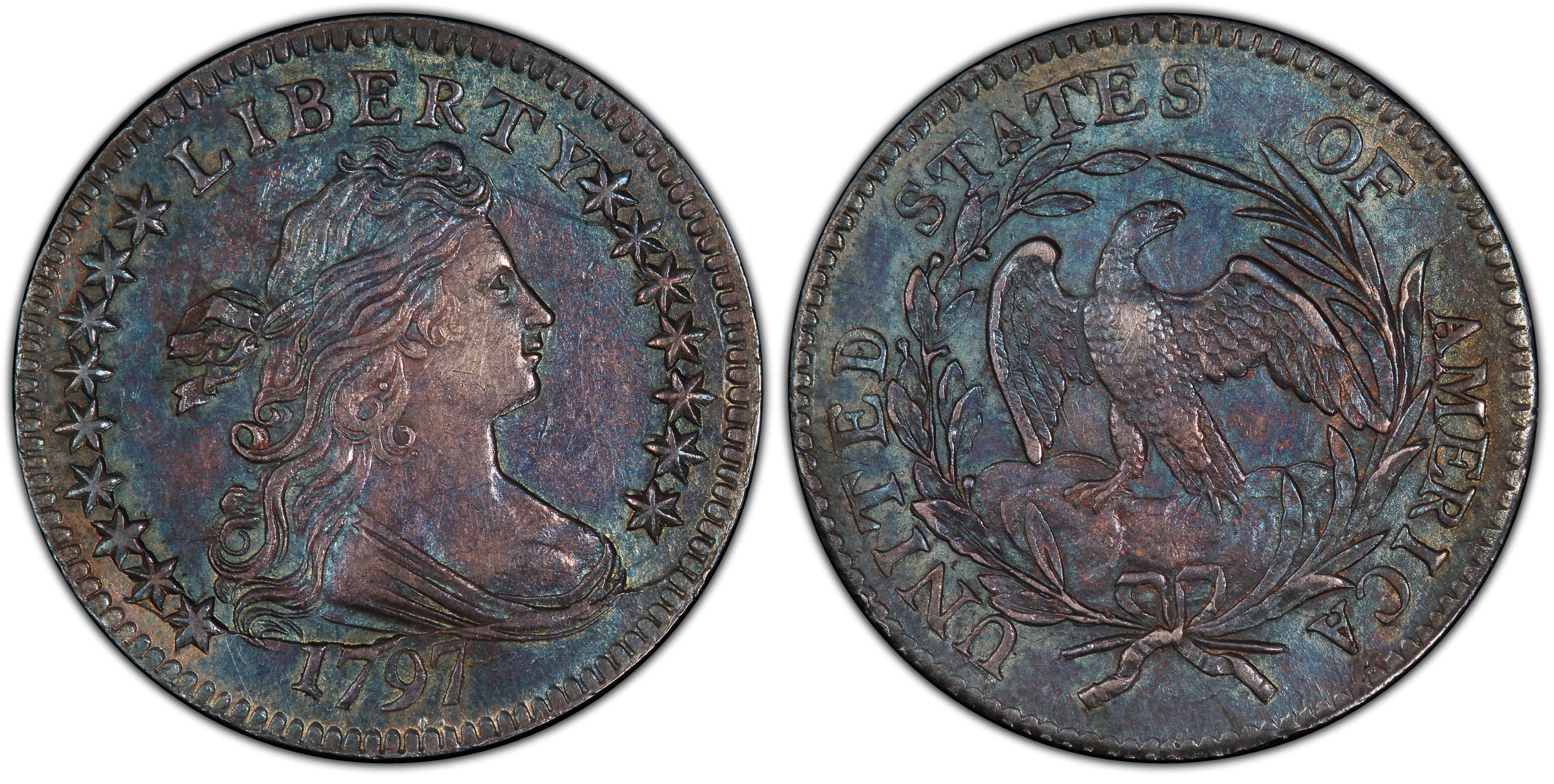 #5 PCGS MS62
As PCGS MS62 #34969490: Stack’s Bowers, August 15, 2018, Lot 1107 – $27,000 Reserve Not Met. As PCGS MS62 #36835724. Rich Rosenfeld; "The Accordian Collection (Rosenfeld)" PCGS Set Registry. Fully toned in cobalt and lilac rose. |
 #5 PCGS MS62
|
| #5 PCGS MS62 |
|
#9 PCGS MS61
|
1797 Draped Bust Dime: The 16-Star (JR-1) Variety
JR-1. Rarity 4. The 1797 Draped Bust Dime (#4462, JR-1 #38748) is the scarcer of the two years featuring the Small Eagle reverse. While U.S. Mint records report a mintage of 25,261 pieces for 1797, numismatic researchers suggest a portion of this total may have been struck using 1796-dated dies.
Two obverse designs were used for the 1797 dime; both are listed in the Red Book and are distinguished by the number of stars on the obverse.
The 16-Star Design (JR-1) represents the culmination of an impractical design concept wherein each star represented a state currently in the Union. Before the admission of Tennessee on June 1, 1796, the number of states stood at 15; accordingly, this union was represented by 15 stars on America's silver and gold coins. Even the 1793 Chain Cent featured 15 interlocking links—a prescient foreshadowing of the conflict to come. With Tennessee's admission, the count moved to 16 stars, creating a crowded canvas and placing unnecessary stress on the dies.
To overcome this, the Mint abandoned the practice of adding a new star for every state, realizing the design would eventually become unsustainable. They subsequently reverted to 13 stars (#4463, JR-2 #38749) to honor the founding colonies.
Diagnostic Die Failure
A defining characteristic of the 16-star 1797 dime is a significant die crack that runs along the lower two stars on the right, extending across the bottom of Liberty’s bust just above the date. Because of this major break, virtually all 16-star specimens exhibit a weak date. In the die's final stages of failure, the date and the final "S" in "STATES" become nearly obliterated. This failure is remarkably similar to the crack found on the 1797 BD-1 Draped Bust Quarter Eagle (#45503), suggesting the Mint may have been working with a batch of defective die steel at the time.
Rarity and Condition Census
While the 16-star variety is more prevalent than the 13-star variety, it remains a major rarity, particularly in high grades. Survival Estimate: Approximately 200 specimens exist across all grades, with 10-15 coins known in Mint State. Examples in the late (terminal) die state are exceptionally rare, with only 7 to 10 specimens known.
* * *