1944-D 5C, FS (Regular Strike)
Series: Jefferson Five Cents 1938-1964

PCGS MS68FS

PCGS MS68FS

PCGS MS68FS
- PCGS #:
- 84023
- Designer:
- Felix Schlag
- Edge:
- Plain
- Diameter:
- 21.20 millimeters
- Weight:
- 5.00 grams
- Mintage:
- 32,309,000
- Mint:
- Denver
- Metal:
- 56% Copper, 35% Silver, 9% Manganese
- Auction Record:
- $22,325 • MS68 • 08-04-2012 • Stack's Bowers
Rarity and Survival Estimates Learn More
| Survival Estimate | |
|---|---|
| All Grades | 450,000 |
| 60 or Better | 450,000 |
| 65 or Better | 220,000 |
| Numismatic Rarity | |
|---|---|
| All Grades | R-1.6 |
| 60 or Better | R-1.6 |
| 65 or Better | R-1.8 |
| Relative Rarity By Type All Specs in this Type | |
|---|---|
| All Grades | 14 / 14 |
| 60 or Better | 14 / 14 |
| 65 or Better | 14 / 14 |
| Relative Rarity By Series All Specs in this Series | |
|---|---|
| All Grades | 78 / 79 |
| 60 or Better | 78 / 79 |
| 65 or Better | 77 / 79 TIE |
Condition Census What Is This?
 #1 PCGS MS68FS |
 #1 PCGS MS68FS "The Neon Lights Collection," GreatCollections, August 30, 2026, Lot 2216916 - $3,600. |
 #1 PCGS MS68FS GreatCollections, June 12, 2022, Lot 1171920 - $7,500.24; "The Terry's Toners Collection of U.S. Coins," GreatCollections, July 26, 2026, Lot 1886026 - $5,906.25; "The Greatest Generation 20th Century Type Set" (PCGS Set Registry). |
 #1 PCGS MS68FS GreatCollections, November 9, 2025, Lot 1889943 - $3,910.49. Wispy rose, blue, and yellow toning. |
 #1 PCGS MS68FS As PCGS MS68FS. Stack's Bowers, August 7, 2012, Lot 11280 - $22,325. Pop 2 when sold. As PCGS MS68FS #51803780. GreatCollections, June 1, 2025, Lot 1538125 - $6,187.50. "The RickJones Collection" (PCGS Set Registry). Pastel Toning. |
 #1 PCGS MS68FS GreatCollections, September 8, 2024, Lot 1260350 - $3,601.13. |
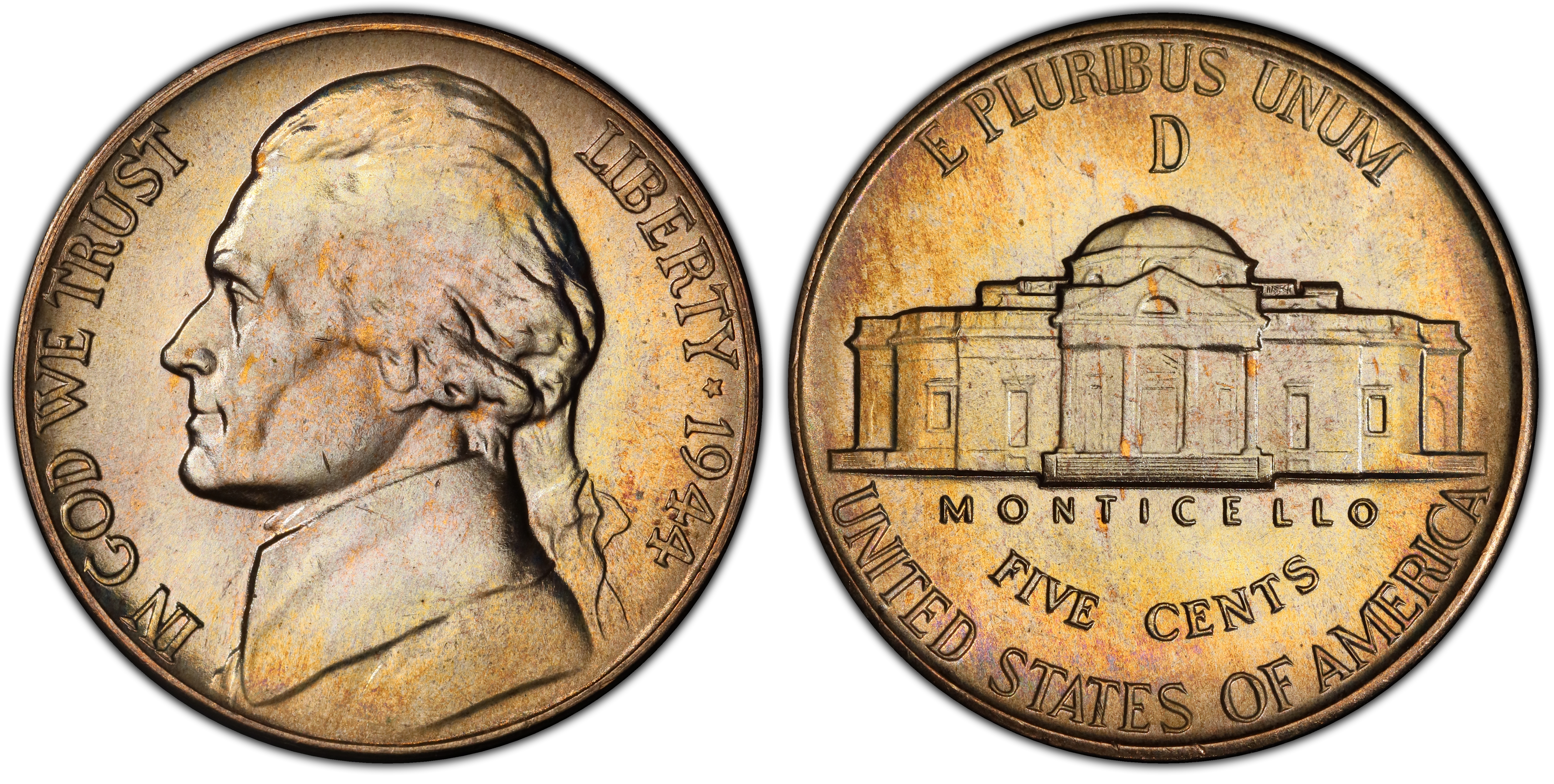 #1 PCGS MS68FS GreatCollections, April 28, 2024, Lot 1378536 - $3,521.25; "The KCV cir Jeffs Collection" (PCGS Set Registry). Wispy gold, peach, blue, and aquamarine toning. |
 #1 PCGS MS68FS "The E. Fisher #1 PCGS Set Registry Set of War Nickels," GreatCollections, February 4, 2024, Lot 1493260 - $6,530.63. |
 #1 PCGS MS68FS As PCGS MS68 #39812857. GreatCollections, April 22, 2021, Lot 1031827 - $5,478.75. As PCGS MS68 #45692565. GreatCollections, August 20, 2023, Lot 1046046 - $3,712.50. "The Grande Mere Collection Nickels" (PCGS Set Registry). |
 #1 PCGS MS68FS GreatCollections, July 30, 2023, Lot 1398062 - $3,487.50. |
|
#1 PCGS MS68FS
GreatCollections, June 25, 2023, Lot 984621 - $5,906.25. "IslandBob's Jeff's Date Set" (PCGS Set Registry). |
 #1 PCGS MS68FS GreatCollections, March 5, 2023, Lot 1089442 - $4,415.63. "The rickypapabear Collection" (PCGS Set Registry). |
 #1 PCGS MS68FS "The Sunset Collection, Part 193," GreatCollections, October 9, 2022, Lot 1232626 - $6,356.25. |
 #1 PCGS MS68FS GreatCollections, September 25, 2022, Lot 952009 - $5,611.50; "CLIFF VERMONT FS WAR CIRCULATION NICKELS (BASIC) 1942-1945" (PCGS Set Registry). Muted gold and plum toning. |
 #1 PCGS MS68FS Heritage Auctions, November 11, 2021, Lot 3073 - $4,800. Rich, iridescent toning exhibiting vibrant hues of blue, orange, and rose. |
 #1 PCGS MS68FS GreatCollections, October 25, 2020, Lot 681126 - $5,737.50; "The Grand Cru Collection" (PCGS Set Registry). |
 #1 PCGS MS68FS GreatCollections, November 17, 2019, Lot 737587 - $4,612.50. |
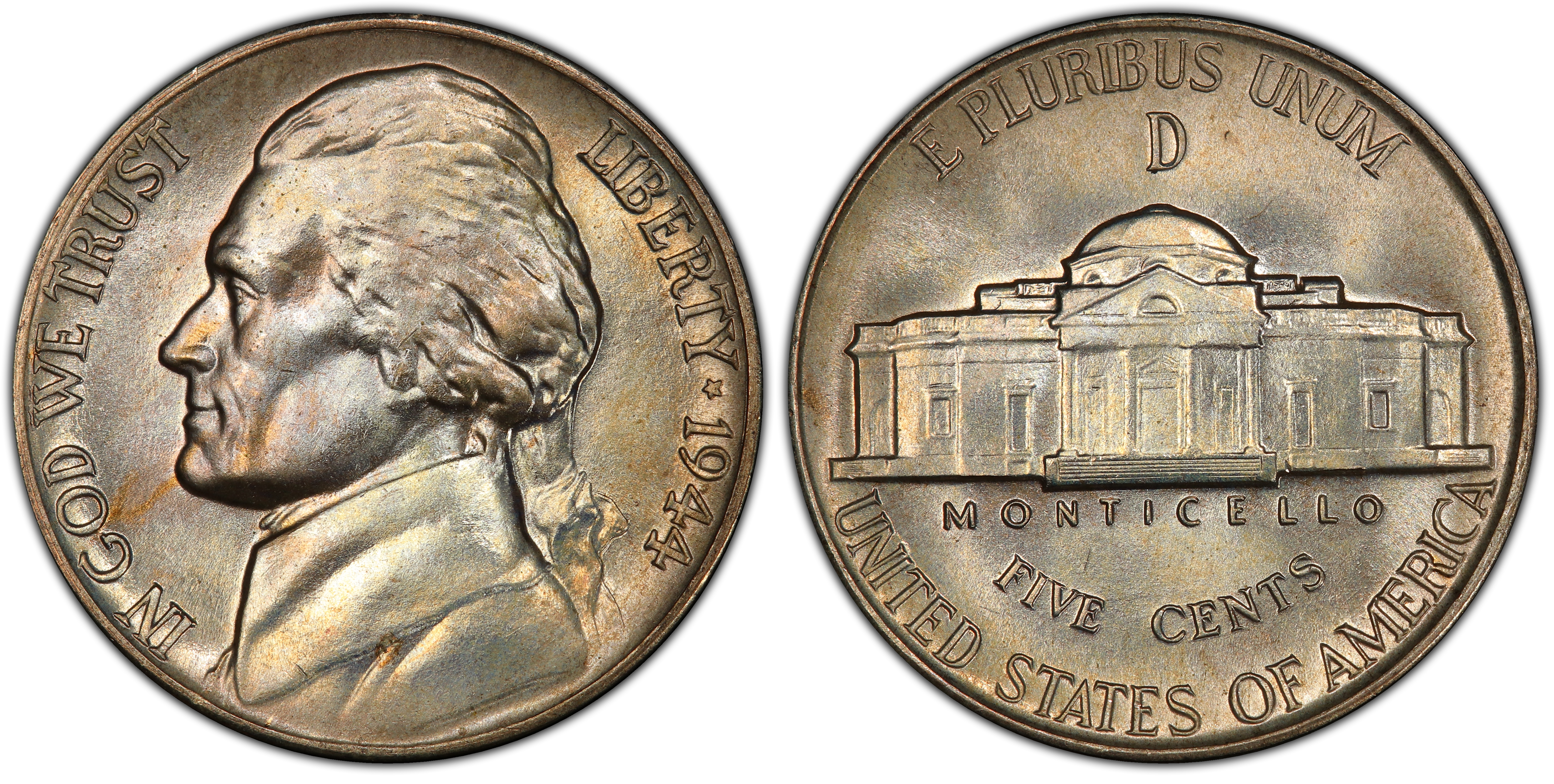 #1 PCGS MS68FS GreatCollections, March 24, 2019, Lot 602056 - $3,663. |
|
#1 PCGS MS68FS
Heritage Auctions, February 27, 2014, Lot 3780 - $10,575. Pop 3 when offered. Diagonal toning mark under R in TRUST. |
 #1 PCGS MS68FS Heritage Auctions, January 7, 2015, Lot 3706 - $6,462.50. |
The 1944-D Jefferson Nickel
Nickel was one of the most critical strategic metals of World War II. Its ability to strengthen steel, resist corrosion, and withstand high temperatures made it indispensable in the production of armor plate, weapons, aircraft, ships, and munitions. While heavily rationed by the Allied powers, the global supply was largely controlled by Canada. At the height of World War II, global nickel production exceeded 170,000 metric tons, with Canada's Sudbury Basin deposits contributing over 120,000 metric tons of that total. The United States, by contrast, produced very little domestic nickel, relying primarily on what was recovered as a byproduct of electrolytic copper refining. Germany and Japan, on the other hand, had no meaningful domestic supply of nickel to draw from; Germany’s entire wartime nickel production is estimated at just 50,000 metric tons, while the Allies consumed approximately 680,000 metric tons throughout the conflict.
As a result, Allied armor grew stronger as the war progressed, whereas Germany was forced to resort to thinner or lower-grade armor formulations, which had a decisive effect on the battlefield by war’s end. The impact was acutely felt on the freezing Eastern Front, where low-nickel German steel components grew brittle and frequently cracked under stress.
In the United States, the War Production Board organized extensive nationwide drives under the "Salvage for Victory" campaign. These efforts were designed to supply the American war effort with iron, steel, aluminum, copper, tin, rubber, silk, and waste cooking fats. While nickel was an essential military material, its primary civilian use was in the production of the five-cent coin.
In 1942, Congress authorized the United States Mint to alter the composition of the Jefferson Nickel to an alloy of 56% copper, 35% silver, and 9% manganese. During this period, the "War Nickel" contained no nickel at all. To denote this temporary change in composition and facilitate their eventual withdrawal, the Mint placed a large mintmark above the dome of Monticello, marking the first time the letter "P" appeared on a U.S. coin for Philadelphia. Distinct in appearance though identical in official weight (5.00 grams) and diameter to standard nickels, the War Nickel remained in production from 1942 through 1945. It circulated for decades afterward, only being systematically removed from circulation after the Coinage Act of 1965 transitioned the composition of America's .900 fine silver dimes and quarters to copper-nickel clad, and the .900 fine half dollar to a .400 fine silver-clad composition. Even then, because the War Nickel contained only 35% silver, it was not hoarded as aggressively as traditional 90% silver coinage.
Collecting the 1944-D Jefferson Nickel
While 1944 nickel production occurred across all three mint branches, the Philadelphia Mint produced nearly four times as many nickels as Denver (119,150,000 vs. 32,309,000) and nearly six times as many as San Francisco (21,640,000). The coin-roll hoarding craze of the 1950s and 1960s placed heavy emphasis on the lower-mintage 1944-S over the 1944-D, creating an unusual dynamic where the issue with the lowest mintage was preserved in uncirculated rolls in larger quantities than the Denver issue.
However, this dynamic applies primarily to generic, raw Mint State examples. As certified population reports demonstrate, condition scarcity, specifically coins exhibiting Full Steps, tells a different story. Strike quality at Denver was generally sharper than at San Francisco, meaning the 1944-S remains significantly scarcer with Full Steps than the 1944-D. For collectors seeking the 1944-D, the coin is readily obtainable in grades up to PCGS MS66FS, only becoming genuinely rare at the PCGS MS67FS level and above.
* * *