1854 G50C BG-308 (Regular Strike)
Series: California Fractional Gold
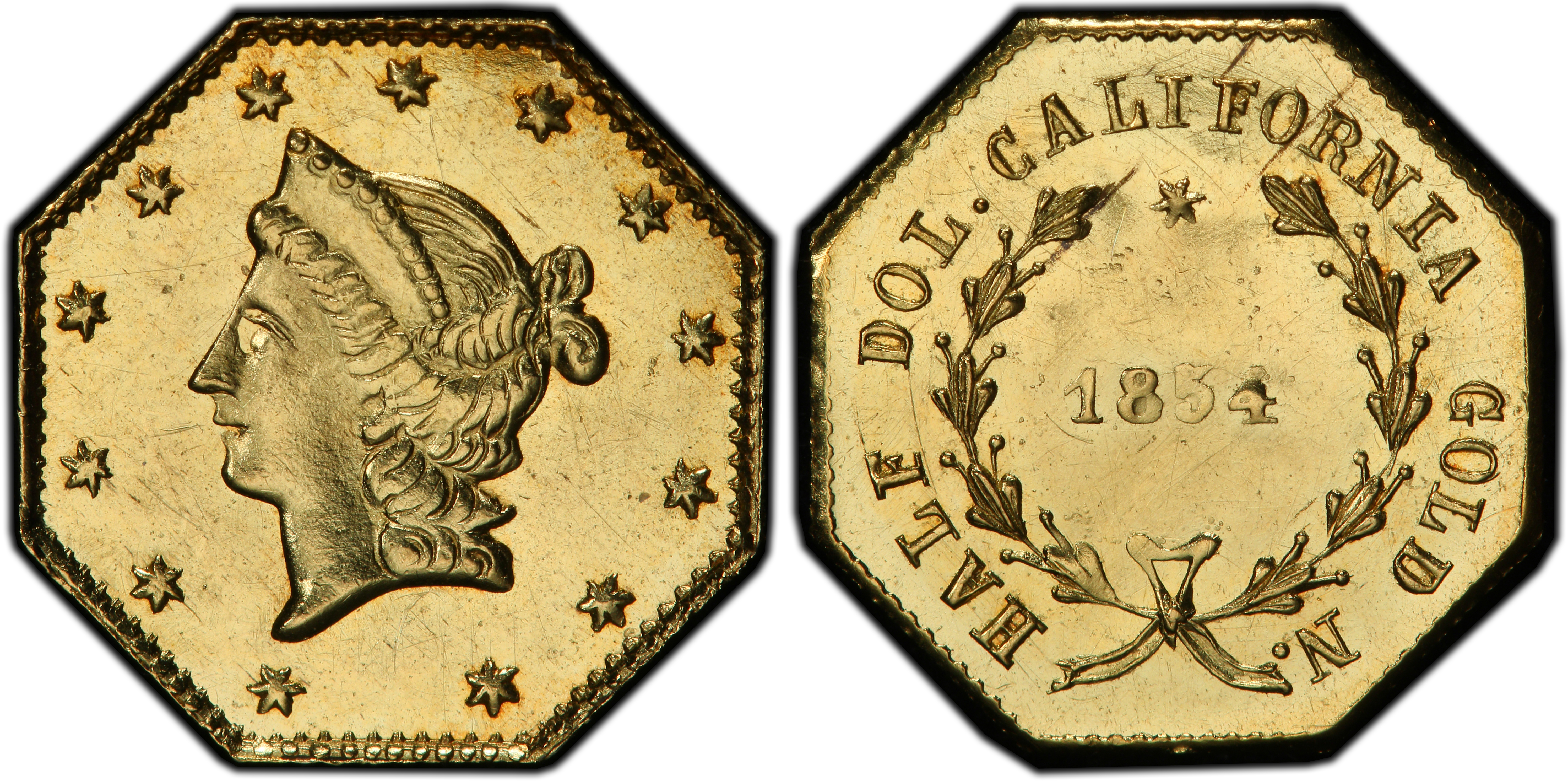
PCGS MS64

PCGS MS63

PCGS MS63
- PCGS #:
- 10428
- Designer:
- N/A
- Edge:
- N/A
- Diameter:
- N/A
- Weight:
- N/A
- Mintage:
- N/A
- Mint:
- Philadelphia
- Metal:
- Other
- Auction Record:
- $4,600 • MS65 • 06-01-2011 • Heritage Auctions
Major Varieties
- 1854 G50C BG-308
Rarity and Survival Estimates Learn More
| Survival Estimate | |
|---|---|
| All Grades | 150 |
| 60 or Better | 95 |
| 65 or Better | 2 |
| Numismatic Rarity | |
|---|---|
| All Grades | R-7.5 |
| 60 or Better | R-8.0 |
| 65 or Better | R-9.9 |
| Relative Rarity By Type All Specs in this Type | |
|---|---|
| All Grades | 492 / 580 TIE |
| 60 or Better | 464 / 580 TIE |
| 65 or Better | 43 / 580 TIE |
| Relative Rarity By Series All Specs in this Series | |
|---|---|
| All Grades | 492 / 580 TIE |
| 60 or Better | 464 / 580 TIE |
| 65 or Better | 43 / 580 TIE |
Condition Census What Is This?
|
#1 PCGS MS64
Heritage Auctions, October 12, 2022, Lot 23960 - $1,020. Thin diagonal mark midway down Liberty's diadem. Top of 1854 is soft. |
|
#1 PCGS MS64
"The Vanek Collection," Heritage Auctions, July 12, 2007, Lot 3334 - $1,380. Old Green Holder. |
|
#1 PCGS MS64
Heritage Auctions, November 7, 2003, Lot 8159 - $748; "The Robert H. Lande Collection" (PCGS Set Registry). Prospector label. |
|
#1 PCGS MS64
"The Kirk Evans Collection" (PCGS Set Registry). Slight weakness in the centers. Orange-gold toning along the upper-right obverse border, with two diagonal streaks on the upper-right reverse. |
| #1 PCGS MS64 |
| #1 PCGS MS64 |
| #1 PCGS MS64 |
1854 Antoine Louis Nouizillet Gold 50 Cents, BG-308
The California Gold Rush led to a massive influx of people into the newly acquired California territory, with the commercial center being the once-sleepy coastal town of San Francisco. By 1854, roughly one-third of its residents were foreign-born, creating a chaotic, multicultural city unlike anywhere else in the mid-19th century.
These new Californians included "Pikers" from the Missouri frontier—so-called because Pike County, Missouri, was a major jumping-off point for the California and Oregon trails. Joining them were Chilean and Peruvian miners, Hawaiians, European professionals and the working poor, Chinese immigrants fleeing economic hardship and the Taiping Rebellion, and fortune seekers from Australia and New Zealand. It was a predominantly male city and, in the earliest days of the Gold Rush, almost "democratic" because everyone lived in tents and waded through the same knee-deep mud, as the city's infrastructure had not yet been built. Economic stratification would come later.
Beyond a lack of adequate housing, sewers, and stable roads, there was an acute lack of circulating coinage, especially in low denominations. Copper coins were struck exclusively in Philadelphia, and silver coinage was struck only in Philadelphia and New Orleans. Furthermore, the U.S. government did not have a reliable, large-scale system for transporting federal coinage from East to West. The coins that did circulate in the city either arrived with the settlers (many of whom had little money to begin with) or through foreign trade.
With the lack of official currency, private coiners sprang into business in 1849. The first issue was produced by Norris, Gregg & Norris, followed by others including Moffat & Co., Miner's Bank, and Dubosq & Company. Private issuers came and went as public sentiment surrounding each individual issue waxed and waned. Still, little attention was paid to smaller transactions until fractional gold coinage began to appear in 1852. These 25-cent, 50-cent, and $1 issues were struck by Antoine Louis Nouizillet and his assorted partners, Frontier, Deviercy & Co., Gaime, Guillemot & Co., and various others.
Collecting the 1854 Nouizillet Gold 50 Cents, BG-308
This 1854 Gold 50-cent coin (BG-308, #10428) was struck by Antoine Louis Nouizillet, a French-born jeweler who operated a shop at 58 Kearny Street and later at 175 Commercial Street. His firm began production of fractional gold pieces in 1852, starting with octagonal and round quarters, half dollars, and octagonal dollars.
One of the earliest known auction appearances of this fractional gold half dollar was in John Haseltine's December 1873 sale of the S.W. Chubbuck Collection. Haseltine described the coin (Lot 313) as: "1854; Half Dollar; octagon; rev., wreath; fine." This example sold for 60¢, which seemed to be the going price for fractional half dollars in that catalog, give or take a nickel.
The coin features a reasonably well-executed facsimile of Christian Gobrecht's Liberty Head portrait surrounded by thirteen stars. The reverse shows a primitively drawn wreath with a single star at the top opening. The date appears at the center, and the inscription "HALF. DOL. CALIFORNIA GOLD N." (for Nouizillet) wraps around the design.
BG-308 is one of the more plentiful 1854 fractional issues, with a significant surviving population of coins in the PCGS MS62 to PCGS MS64 grade range. To date, no Gem examples have been certified.
* * *