1793 1C Chain, America, BN (Regular Strike)
Series: Flowing Hair Chain Cents 1793

PCGS MS64BN

PCGS MS63+BN
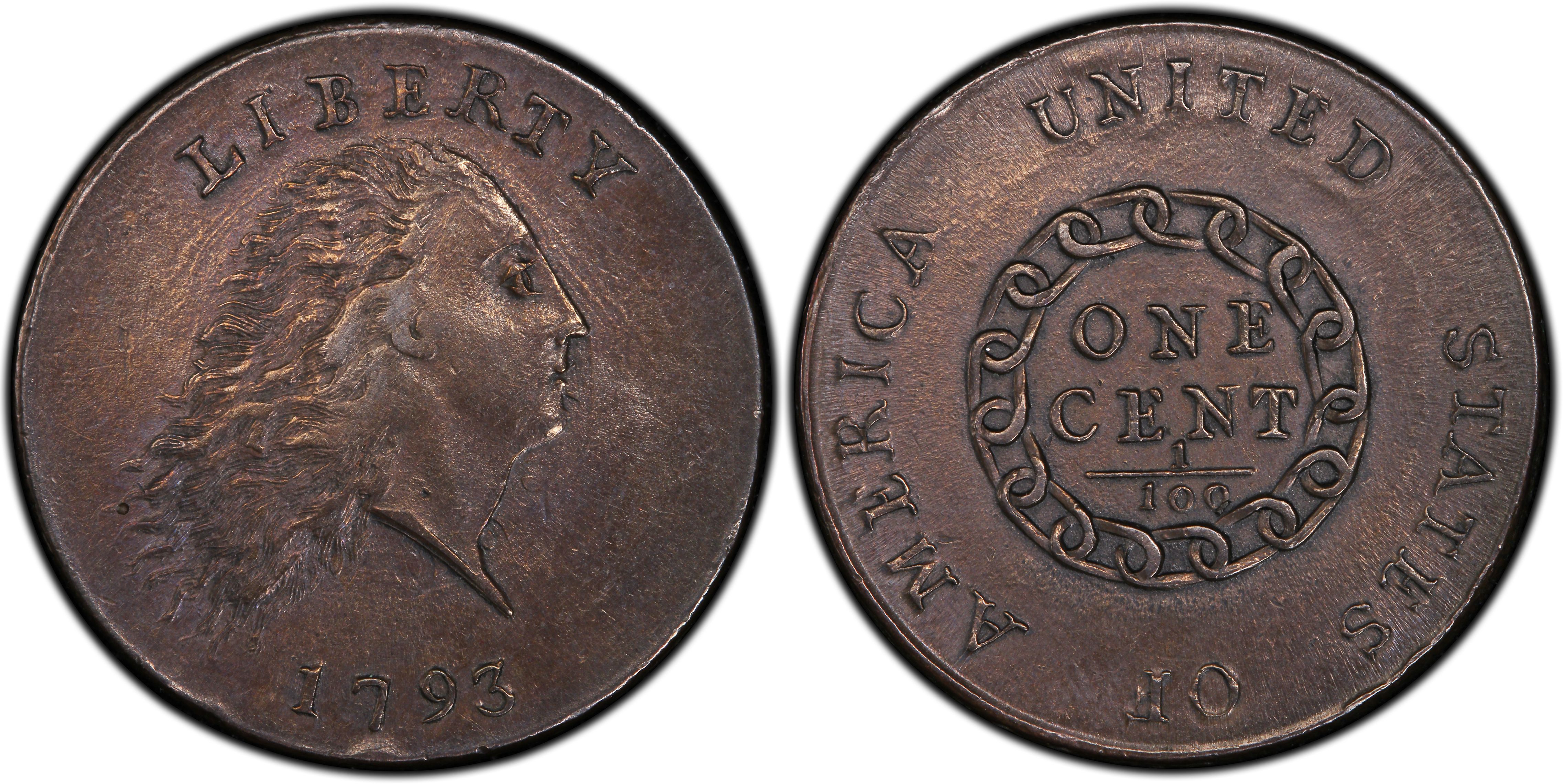
PCGS MS63BN
- PCGS #:
- 1341
- Designer:
- Attributed to Henry Voight
- Edge:
- Bars and Vines
- Diameter:
- 27.00 millimeters
- Weight:
- 13.48 grams
- Mintage:
- 36,103
- Mint:
- Philadelphia
- Metal:
- Copper
- Auction Record:
- $126,500 • MS60 • 02-01-2008 • Heritage Auctions
Major Varieties
- 1793 1C Chain, AMERI., BN
- 1793 1C Chain, America, BN
- 1793 1C Chain, America, RB
- 1793 1C Chain, Periods, BN
Rarity and Survival Estimates Learn More
| Survival Estimate | |
|---|---|
| All Grades | 625 |
| 60 or Better | 6 |
| 65 or Better | 1 |
| Numismatic Rarity | |
|---|---|
| All Grades | R-5.7 |
| 60 or Better | R-9.7 |
| 65 or Better | R-10.0 |
| Relative Rarity By Type All Specs in this Type | |
|---|---|
| All Grades | 3 / 3 |
| 60 or Better | 3 / 3 |
| 65 or Better | 1 / 3 TIE |
| Relative Rarity By Series All Specs in this Series | |
|---|---|
| All Grades | 3 / 3 |
| 60 or Better | 3 / 3 |
| 65 or Better | 1 / 3 TIE |
Condition Census What Is This?
|
#1 PCGS MS65BN
Purchased from the London coin shop of W.S. Lincoln & Son by Benjamin H. Collins, August 1891; Collins to Dr. Henry W. Beckwith, January 30, 1919; “The Dr. Henry W. Beckwith Collection,” S.H. Chapman, April 1923, Lot 1 - $430; purchased by Henry Chapman and sold to Dr. George P. French; “The Dr. George P. French Collection,” B. Max Mehl, 1929, Lot 1 – $850; “The Dr. Henry A. Sternberg Collection,” J.C. Morganthau and Co., April 1933, Lot 2; B. Max Mehl to T. James Clarke; "The T. James Clarke Collection," New Netherlands, April 1956; John H. Payne, 1953; Dr. William H. Sheldon; "The Dr. William H. Sheldon Collection," sold, en bloc, to R.E. “Ted” Naftzger” Jr., April 19, 1972; Part of the “Great Pool Table Swap of Ho-Ho-Kus” to Herman Halpern, December 11, 1986; “Herman Halpern Collection,” Stack’s, March 1988, Lot 2; Anthony Terranova to Andrew Lustig to Don Kagin to Gilbert Steinberg, November 16, 1992; “Gilbert Steinberg Collection,” Superior, September 1996, Lot 1560; Anthony Terranova and Chris Victor-McCawley to Walter J. Husak; private owner and dealer intermediary; Superior, 2001, Lot 2090 – Passed; dealer intermediaries; “The Kennywood Collection,” American Numismatic Rarities, January 10, 2005, Lot 69 – $431,250; "The Cardinal Collection Educational Foundation," Stack's Bowers, January 1, 2013, Lot 13001 - $998.750. S-2. |
|
#1 Est. MS65BN
"The Joseph Zanoni Collection," sold privately by Edward Cogan,1867; Thomas Cleneay; “The Thomas Cleneay Collection,” Samuel Hudson and Henry Chapman, December 1890, Lot 1794; J.F. Anger; Arba Borden; Allison W. Jackman; “The Allison W. Jackman Collection,” Henry Chapman, June 1918, Lot 685; Hillyer Ryder, Ryder estate through 1945; Ryder Collection sold, en bloc, to Wayte Raymond, May 1945; Wayte Raymond to Dr. William H. Sheldon, via private treaty, 1947; "The Dr. Whilliam H. Sheldon Collection" sold, en bloc, to R.E. “Ted” Naftzger, April 19, 1972; R.E. "Ted" Naftzger to Stanley Kesselman in March 1980 as partial payment for the Garrett S-3. As NGC MS66BN. Stack’s Bowers, August 19, 2012, Lot 11180 – $763,750. S-3. |
|
#3 PCGS MS64BN
H.W. Taffs; Glendining & Co., Ltd. (London), November 1956, Lot 506; Spink & Sons, Ltd. (London); New Netherlands Coin Co., December 1957, Lot 880; “The Floyd T. Starr Collection,” Stack’s, June 1984, Lot 2; Herman Halpern, December 11, 1986; R.E. "Ted" Naftzger, Jr., February 23, 1992; Eric Streiner; Jay Parrino (The Mint), April 16, 1996; "The Jack Wadlington Collection, sold privately, June 2005, via Bob Grellman & Chris McCawley; “The Daniel W. Holmes, Jr. Collection,” Goldberg Auctioneers, September 2009, Lot 3 - $402,500; Anthony Terranova; Joseph O'Connor, sold privately, August 2011; “The Oliver Jung Collection,” Heritage Auctions, August 2014, Lot 5518 - $411,250; Joseph O’Conner, March 2016; Rick Snow, April 5, 2016; “The Arizona Collection,” Heritage Auctions, January 123, 2022, Lot 3002 – $528,000. S-2. |
|
#3 PCGS MS64BN
"The George F. Seavey Collection," William H. Strobridge, June 1873, Lot 205; "The Lorin G. Parmelee Collection," New York Coin & Stamp Co., June 1890, Lot 669; Harlan P. Smith; "The M.A. Brown Collection," Chapman Brothers, April 1897, Lot 739; "The George H. Earle, Jr. Collection," Henry Chapman, June 1912, Lot 3353; "The Allison W. Jackman Collection," Henry Chapman, June 1918, Lot 684; Wayte Raymond; "The Howard Rounds Newcomb Collection," J.C. Morgenthau & Co., February 1945, Lot 2; James Kelly, advertised in Kelly's 1945 and 1946 Fixed Price Lists; Dr. James O. Sloss, sold privately in September 1958; "The R.E. “Ted” Naftzger, Jr. Collection," Abe Kosoff, October 1959, Lot 2; Stack's; Stack's, February 1976, Lot 2; Julian Leidman; Joe Flynn, sold privately in April 1977; R. Tettenhorst (Bernard Edison), sold privately in October 1995; Jay Parrino; Superior, September 1997, Lot 29; "The Eugene H. Gardner Collection," Heritage Auctions, June 2014, Lot 30019 - $396,562.50. S-2. |
|
#5 PCGS MS63+BN
S-2. |
|
#7 PCGS MS63BN
“The Colin Lightbody Collection,” Edward Cogan, December 1866, Lot 536; Mortimer Livingston Mackenzie, "The Mackenzie Collection,” Edward Cogan, June 1869, Lot 624; L. Bayard Smith, to an unknown party; Arthur L. Gray; Ted and Carl Brandts of Celina Coin Company, T. James Clarke; "The T. James Clarke Cent Collection" sold, en bloc, to R.E. “Ted” Naftzger in October, 1954; “The T. James Clarke Collection (duplicates and Naftzger castoffs),” Abe Kosoff, April 1956 – Lot 4; Stack’s to Dorothy Nelson; Stack’s, February 1976, Lot 3; Ed Hipps; Steve Ivy, November 1978, Lot 7; to Robert Bender; Heritage Auctions, August 1988, Lot 3; Anthony Terranova to Kevin Lipton; to Stack’s; unknown collector; American Numismatic Rarities, July 25, 2003, Lot 105 – $115,000; Stack’s, July 27, 2008, Lot 1074 – $207,000; Rare Coin Wholesalers (via Chris Victor-McCawley). As PCGS MS63BN #26401316. "The Dan Holmes Collection," Goldberg Auctioneers, September 2009, Lot 5 - $253,000; "The High Desert Collection" (PCGS Set Registry). S-3. Published in April 1869 issue of the American Journal of Numismatics. |
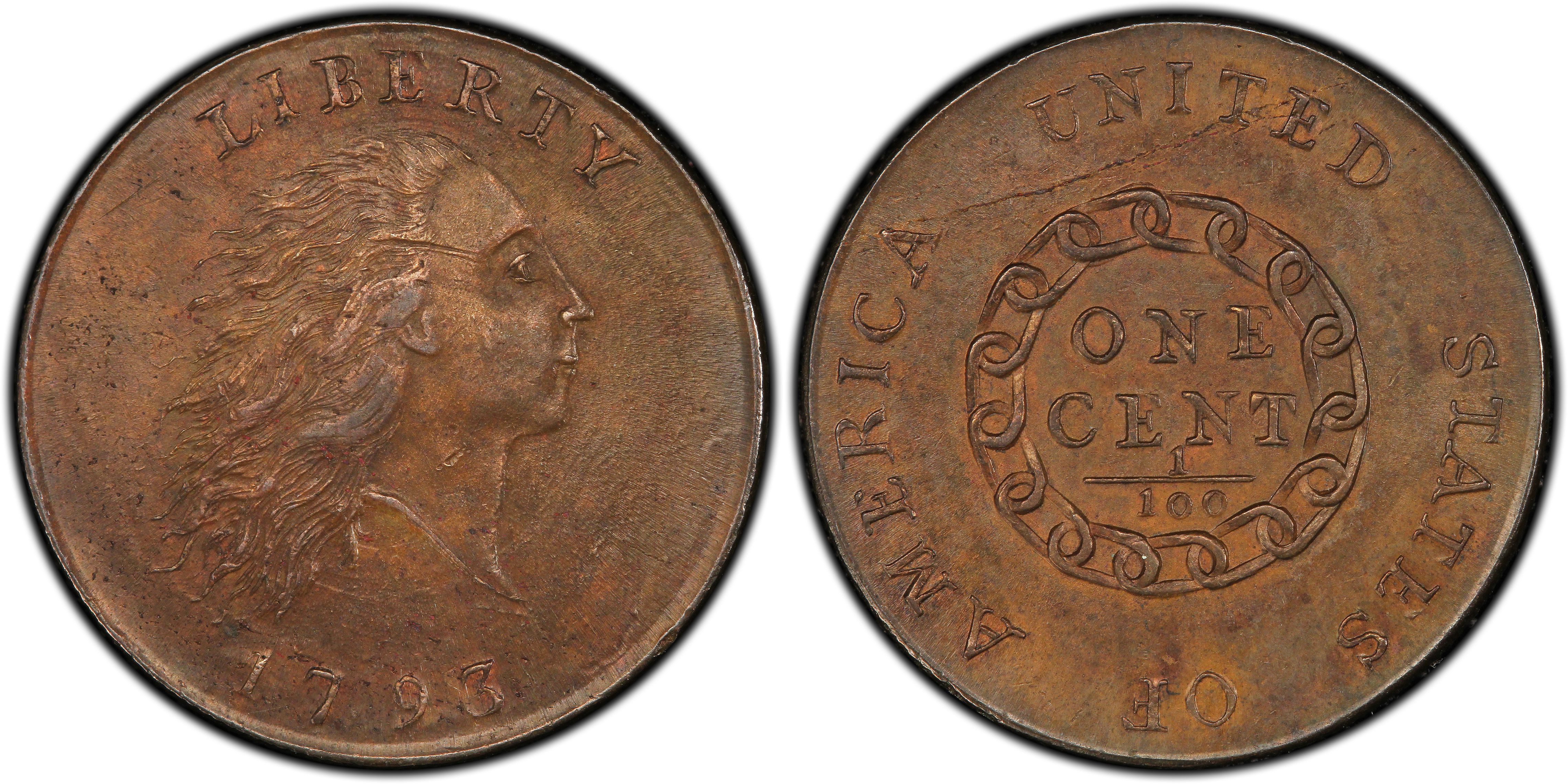 #7 PCGS MS63BN
Hollinbeck Stamp and Coin Co., January 1951, Lot 375; Willard C. Blaisdell; Kenneth M. Goldman; Dennis R. Heller; Norman W. Pullen; Bowers and Merena, June 1985, Lot 461; Kenneth M. Goldman and Anthony Terranova; "The Norman Stack Collection"; Eric Streiner; Mark Yaffe, Ron Karp, and Martin Paul. As PCGS MS63BN #50000449. "The Jenkins Family Collection," Heritage Auctions, January 2018, Lot 4733 - $300,000. S-2. |
The 1793 Chain Cent, AMERICA, No Periods Varieties (Sheldon-2, Sheldon-3, NC-4).
The 1793 Chain Cent, occasionally referred to as the “Link” Cent in 19th-century numismatic literature, was the first regular-issue one-cent coin produced by the United States Mint. Struck at the first Philadelphia Mint facility and most likely included in the March 1 delivery, it holds the distinction of being the first federal coin struck for circulation.
While the dies were executed by Henry Voigt (sometimes spelled Voight), the first Chief Coiner, the obverse was inspired by the Libertas Americana medal designed by the famed French engraver Augustin Dupré. The obverse depicts Liberty with "flowing" hair, the inscription LIBERTY above, and the date 1793 below the bust truncation.
The reverse displays a chain of 15 interlocking links, symbolizing the 15 states in the Union in 1793, which encloses the denomination ONE CENT. The legend is spelled UNITED STATES OF AMERI. on the Sheldon-1 and UNITED STATES OF AMERICA on Sheldon-2 through Sheldon-4. This inscription encircles the central motif clockwise from the top of the coin.
The design was poorly received by the public. Critics decried the reverse as "Liberty in chains," perhaps a subtle nod to the ongoing slave trade or a more general fear of federal overreach. A contemporary report from Newark noted:
"The American Cents... do not answer our expectations. The chain on the reverse is but a bad omen for liberty, and Liberty herself appears to be in a fright."
A similar sentiment appeared in the March 18, 1793, edition of Philadelphia’s The Mail, which stated:
"The chain on the reverse is but a bad omen for liberty."
|
1793 Chain Cent Deliveries |
|||
| March 1, 1793 | 11,178 delivered | March 2, 1793 | 2,009 delivered |
| March 4, 1793 | 4,000 delivered | March 5, 1793 | 3,765 delivered |
| March 6, 1793 | 1,573 delivered | March 8, 1793 | 7,000 delivered |
| March 8, 1793 | 7,000 delivered | March 9, 1793 | 1,000 delivered |
| March 12, 1793 | 5,578 delivered | Total: 36,103 coins | |
Over the twelve-day production period, 36,103 pieces were struck using five distinct die combinations. The initial delivery on March 1 consisted of roughly 7,000 cents of the AMERI. variety (S-1), while the remaining 4,178 coins from that first delivery were of the Sheldon-2 variety. The Sheldon-2 and subsequent four Chain Cent varieties utilized the same reverse die where "AMERICA" was spelled out in full. These inaugural coins were struck in relatively low relief; their successor, the Wreath cent, would feature a more robust, higher-relief design. Three of these four varieties feature obverse dies that do not display periods after LIBERTY or the date. The fourth (S-4) does.
America, Wide Date (S-2) Die Chararacteristics
Rarity-4+. The Sheldon-2 variety features a very wide date, with a noticeable gap between the 17 and the 93. LIBERTY is well-spaced, with the letters more precisely aligned than on other Chain Cent varieties. This is the first use of the AMERICA reverse. This specific reverse die was also used to strike the Sheldon-3, Sheldon-4, and NC-1 varieties; only the Sheldon-1 (AMERI.) used a different reverse die. Excluding the ultra-rare NC-1, the S-2 is considered the scarcest variety of the Chain Cent.
America, Close Date, Leaning R (S-3) Die Chararacteristics
Rarity-3. The Sheldon-3 variety features a very closely spaced date and a distinctive positioning of LIBERTY. On this variety, the R is slightly larger than the surrounding letters and is canted to the right. This creates a unique visual effect, making it appear as though "LIBE" and "RTY" are two separate, crowded words. The positioning of the date is similarly irregular; the numerals were punched in a staggered formation, placing the tops of the 1 and 9 slightly above the tops of the 7 and 3. It is these artisanal characteristics of the Mint’s early, hand-cut dies that provide early American coinage with such enduring charm.
This reverse die shows AMERICA fully spelled out and was also used to strike the Sheldon-2, Sheldon-4, and NC-1 varieties; only the Sheldon-1 (AMERI.) used a different reverse die. Walter Breen and Mark Borckardt suggest a mintage of up to 18,000 pieces for this variety, accounting for the bulk of the March 2-8 deliveries. Die clash frequently seen at Liberty's mouth and neck.
AMERICA, Widest LIBERTY (NC-1) Die Chararacteristics
Only two examples are known to exist. The first, graded an estimated XF45 by PCGS, is permanently impounded in the American Numismatic Society (ANS) Collection. The second specimen was described by Goldberg Auctioneers as being in Basal State 1+. It is a true tale of two extremes.
The NC-1 utilizes the same AMERICA reverse die seen on the Sheldon-2, Sheldon-3, and Sheldon-4 varieties. However, its distinguishing feature is the placement and spacing of LIBERTY. As noted by Walter Breen and Mark Borckardt, this obverse exhibits the widest letter spacing of any 1793 die. Possibly struck in extremely limited numbers and included in the March 2 delivery.
Save for a few minor obverse marks and a planchet flaw at 6 o’clock, the ANS specimen is breathtaking. If a third example exists, it likely remains hidden in a European collection, having escaped notice for more than 230 years.
* * *
The incredible SP67 is from the fabulous large cent collection of the late Ted Naftzger, the greatest large cent collection of all-time by far. This amazing coin has semi-prooflike surfaces and is virtually perfect. Large cent affcianados refer to this amazing specimen as "THE coin."