1723 Farth Hibernia, Silver (Special Strike)
Series: (None)

PCGS SP65
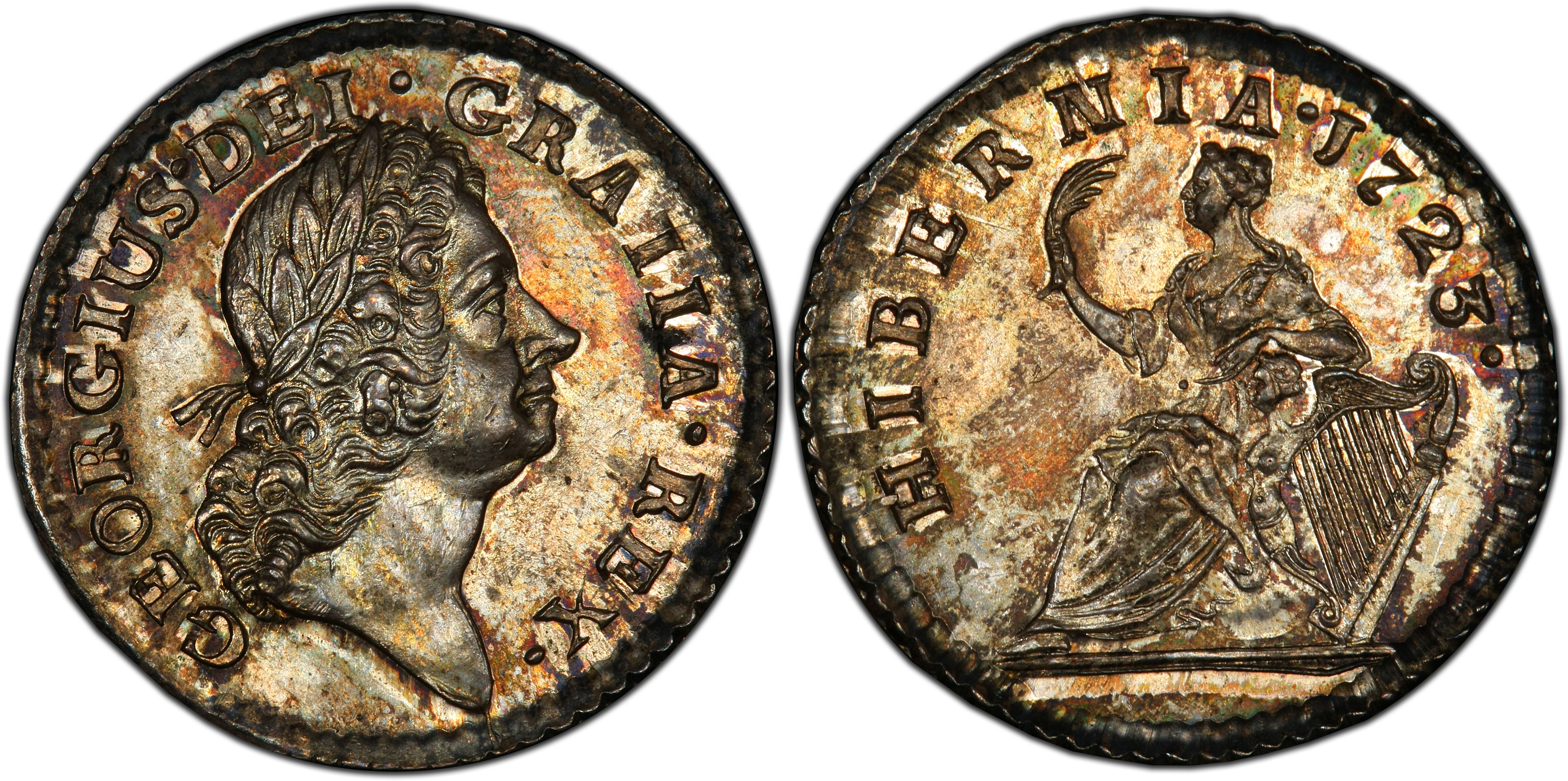
PCGS SP65
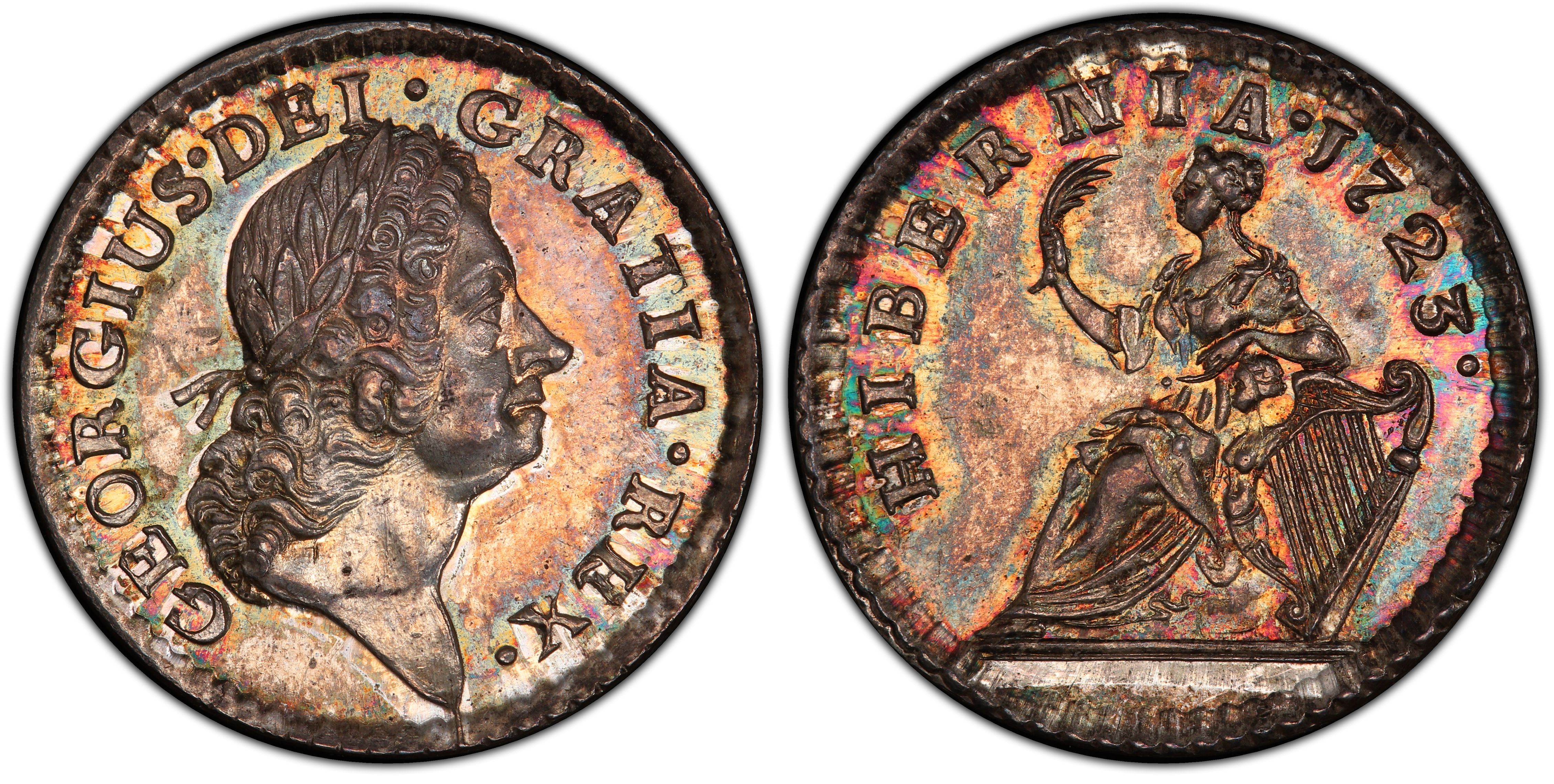
PCGS SP64+
- PCGS #:
- 179
- Designer:
- N/A
- Edge:
- N/A
- Diameter:
- N/A
- Weight:
- N/A
- Mintage:
- N/A
- Mint:
- Philadelphia
- Metal:
- Other
- Auction Record:
- $25,300 • GEM UNC • 01-01-2005 • Stack's
Major Varieties
- 1723 Farth Hibernia, Silver
Condition Census What Is This?
|
#1 PCGS SP65
A.H. Baldwin & Sons, Ltd, March 1970. As "Gem Uncirculated." "The John J. Ford, Jr. Collection," Stack’s, January 2005, Lot 68 - $23,000. As PCGS MS65 #06760371. PCGS MSS65 on holder-PCGS now designates the silver 1723 Wood's Hibernia Farthings as "Specimens." Mirrorlike surfaces with iridescent blue toning. |
|
#1 PCGS SP65
As PCGS SP65 #29861704. Heritage Auctions, August 12, 2015, Lot 3906 - $11,750. As PCGS SP65 #36095145. Deeply toned in red, orange, and electric blue. Some untoned areas above the letters and below the exergue line. |
|
#1 PCGS SP65
Heritage Auctions, August 12, 1999, Lot 6450 - $5,060; Heritage Auctions, September 27, 2007, Lot 5 - $21,850; Heritage Auctions, August 11, 2010, Lto 3009 - $13,800. Scattered aubergine toning throughout with splashes of electric blue along the periphery. Diagonal toning streaks from George's forehead to RA. |
|
#1 PCGS SP65
Olive gold toning throughout the surfaces. Untoned areas are visible above the lettering on the right side of the obverse and along the entirety of the reverse. |
| #1 PCGS SP65 |
|
#6 PCGS SP64+
As PCGS MS64 #6601722. "The Julian Kaufman Collection," Heritage Auctions, January 4, 2018, Lot 4708 - $10,800. As PCGS SP64+ #34590884. Peach-gold toning in the fields, with highlights of iridescent blue, green, and magenta toning. Untoned area below the exergue line. |
|
#6 PCGS SP64+
Stack's Bowers, January 22, 2013, Lot 10644 - $11,750. Bathed in iridescent gold toning, this example features two dark toning spots beneath the second A of GRATIA. Areas of original silver remain in the protected spaces above the left-side reverse lettering, extending toward the denticles. |
The 1723 Wood's Hibernia Farthing Silver Specimens
William Wood’s Hibernian coinage became a circulating staple in the American colonies after a controversial rollout and Jonathan Swift’s successful campaign to discredit it made the coppers moneta non grata in Ireland.
In the 1720s, Ireland suffered from a chronic shortage of small-denomination copper coins, which hampered daily commerce. Concurrently, the little gold and silver coin the nation possessed was largely being exported to England to pay absentee landlords. To facilitate trade, English ironmaster William Wood successfully applied for a royal patent to strike £100,000 worth of copper coins for Ireland.
The coins featured a laureate profile of King George I on the obverse and Hibernia (the allegorical personification of Ireland) on the reverse, seated with a harp.
Swift’s "Drapier" and the Duchess
Wood’s problems began when the Irish public grew incensed that his royal patent was secured through the King’s mistress, the Duchess of Kendal (also known as 'The Maypole'). Wood had been awarded the patent only after agreeing to pay the Duchess a bribe of £10,000 for its release. Crucially, the Irish Parliament and Privy Council were never consulted. While Wood likely entered the contract with honest entrepreneurial intent, he was unaware of the political firestorm this lack of communication would ignite.
Jonathan Swift, then in the midst of writing Gulliver’s Travels, pilloried the coinage under the pseudonym “M.B. Drapier,” posing as a humble Dublin wool merchant. Swift’s seven pamphlets, known as The Drapier’s Letters, spread economic alarmism, falsely claiming the coins were debased, and successfully incited a total boycott.
Migration to the Colonies
By 1725, Wood was forced to surrender his patent; his coinage was scuttled and his reputation was in tatters. He accepted a small pension, and the unwanted Irish copper was eventually diverted to the coin-starved American colonies. As high-quality copper, these "Wood’s Hibernia" pieces circulated in America for decades, remaining a common sight well into the early 19th century. Wood's coinage was good copper and Sir Isaac Newton's 1724 assay proved that the coppers were actually better than the patent required. While this didn't help matters in Ireland, it did ensure their usefulness in America.
The Wood’s Hibernia Silver Farthings
Wood's Hibertnia Silver Farthings are rare silver strikings. Given their silver composition and the refinement of their characteristics, PCGS now classifies these silver farthings as Specimen pieces—likely struck as "presentation" examples for government officials to demonstrate the quality of Wood's manufacture.
Historically, farthings were indeed produced in silver.
Before the reign of Edward I in the 13th century, silver pennies were physically cut into four pieces (each a "fourthing" or farthing) to facilitate change. While the Mint eventually issued dedicated silver farthings to eliminate this practice, the rising value of silver caused the coins to shrink to an impractical size. By 1613, the farthing had transitioned to copper tokens (the "Harrington" issues), and by 1672, official royal copper farthings entered production.
Vintage Market Snippet
Per Ron Guth:
The silver versions of the 1723 Hibernia Farthings are among the most highly prized of the series. Though considered a pattern coinage by some, their numbers suggest a special striking of some sort. According to the cataloger of the sale of the John J. Ford, Jr. Collection, the firm of A.H. Baldwin & Sons uncovered a silver tube containing 43 silver Hibernia Halfpennies, all of which were dispersed during the 1960s and 1970s. Today, they appear at auction very infrequently.
* * *