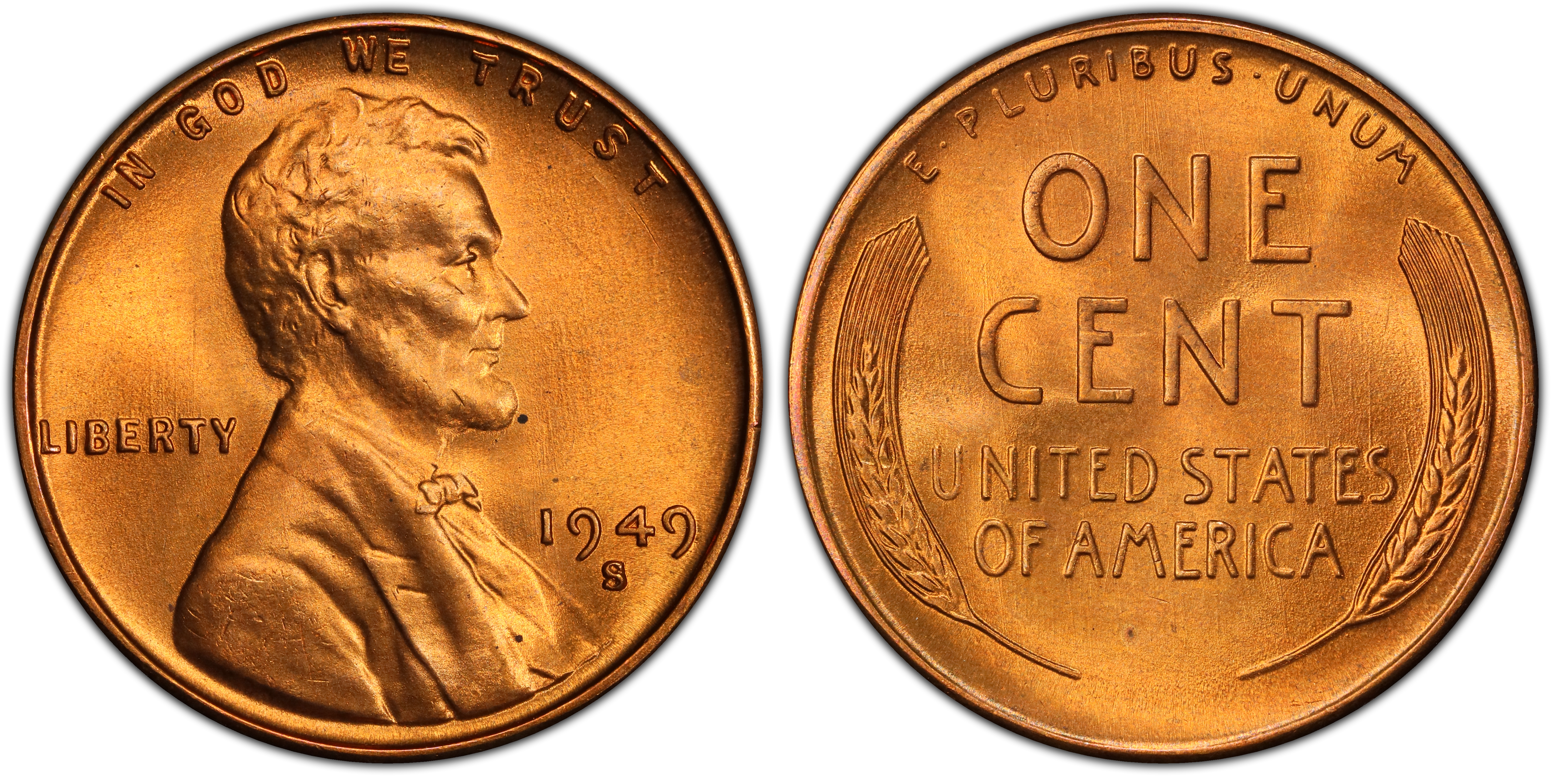
1949-S 1C, RD (Regular Strike)
Series: Lincoln Cents 1909-1958

PCGS MS67+RD

PCGS MS67+RD

PCGS MS67+RD
- PCGS #:
- 2776
- Designer:
- Victor David Brenner
- Edge:
- Plain
- Diameter:
- 19.00 millimeters
- Weight:
- 3.11 grams
- Mintage:
- 64,290,000
- Mint:
- San Francisco
- Metal:
- 95% Copper, 5% Tin and Zinc
- Auction Record:
- $3,525 • MS67+RD • 12-17-2015 • Legend Rare Coin Auctions
Rarity and Survival Estimates Learn More
| Survival Estimate | |
|---|---|
| All Grades | 15,000 |
| 60 or Better | 15,000 |
| 65 or Better | 7,500 |
| Numismatic Rarity | |
|---|---|
| All Grades | R-2.9 |
| 60 or Better | R-2.9 |
| 65 or Better | R-3.5 |
| Relative Rarity By Type All Specs in this Type | |
|---|---|
| All Grades | 111 / 143 TIE |
| 60 or Better | 111 / 143 TIE |
| 65 or Better | 115 / 143 TIE |
| Relative Rarity By Series All Specs in this Series | |
|---|---|
| All Grades | 111 / 146 TIE |
| 60 or Better | 111 / 146 TIE |
| 65 or Better | 115 / 146 TIE |
Condition Census What Is This?
|
#1 PCGS MS67+RD
GreatCollections, June 14, 2026, Lot 2162591 - $1,379.25. |
 #1 PCGS MS67+RD
"The MJW Collection of Lincoln Cents," GreatCollections, April 26, 2026, Lot 2101853 - $1,181.25. |
 #1 PCGS MS67+RD
GreatCollections, July 27, 2025, Lot 1736295 - $1,374.75. |
 #1 PCGS MS67+RD
GreatCollections, July 13, 2025, Lot 1754847 - $1,800; "The Curtis Collection" (PCGS Set Registry). |
 #1 PCGS MS67+RD
GreatCollections, July 6, 2025, Lot 1754843 - $1,518.75. |
| #1 PCGS MS67+RD |
 #1 PCGS MS67+RD
GreatCollections, March 2, 2025, Lot 1557392 - $1,130.63; "The Warren Thorne Legacy Date Set (CS)" (PCGS Set Registry). |
 #1 PCGS MS67+RD
GreatCollections, January 19, 2025, Lot 1732256 - $815.63; "The Mint State Lincoln Collection" (PCGS Set Registry). |
The 1949-S Lincoln Cent
Following World War II, the American economy benefited tremendously from pent-up domestic demand and a brisk export business, as large swaths of Europe, Asia, and North Africa were forced to rebuild. Cent production during the war had already reached staggering levels. In 1942, the first full year of American involvement in the conflict, the Philadelphia Mint struck 657 million cents, following an output of 887 million the year prior. After the failed 1943 steel cent experiment, production surpassed 1.4 billion and 1 billion cents, respectively, in the two years that followed. Cent production would likely have been high even without the war; with the Great Depression firmly in the rearview mirror, a fully recovered American economy was racing toward a new era of automation and industrial growth.
Yet, lost in the gauze of this postwar boom was the short, self-correcting recession of 1948-1949. Often referred to by economists as the "inventory recession," this downturn resulted from the natural unwinding of the immediate post-World War II boom and was driven largely by overproduction. With the turnover of goods lower than expected, investments in plants, equipment, and heavy machinery slowed. In response, the Federal Reserve lowered reserve requirements, relaxed consumer installment credit controls, and reduced stock margin requirements. The government also introduced landmark legislation to provide support for homeowners. In the wake of these policies, Americans became broadly more accustomed to carrying consumer debt to finance major purchases like cars, appliances, and other high-ticket items.
The San Francisco Mint's final 1949 Lincoln Cent (BN #2774) mintage of 64,290,000 masks a quiet year at the facility. Due to a national recession, domestic coinage operations were shut down entirely from May through September. While numismatists often target the 1949-S Roosevelt Dime (#5093) as a classic low-mintage issue, San Francisco produced no Washington Quarters at all that year. As a result of this extended operational pause, the 1949-S Lincoln Cent wound up with the lowest production numbers of any S-mint cent of the 1940s, cementing its reputation as a tough find for collectors.
* * *