1796 25C Browning 1 (Regular Strike)
Series: Draped Bust Quarters 1796-1807

PCGS MS64
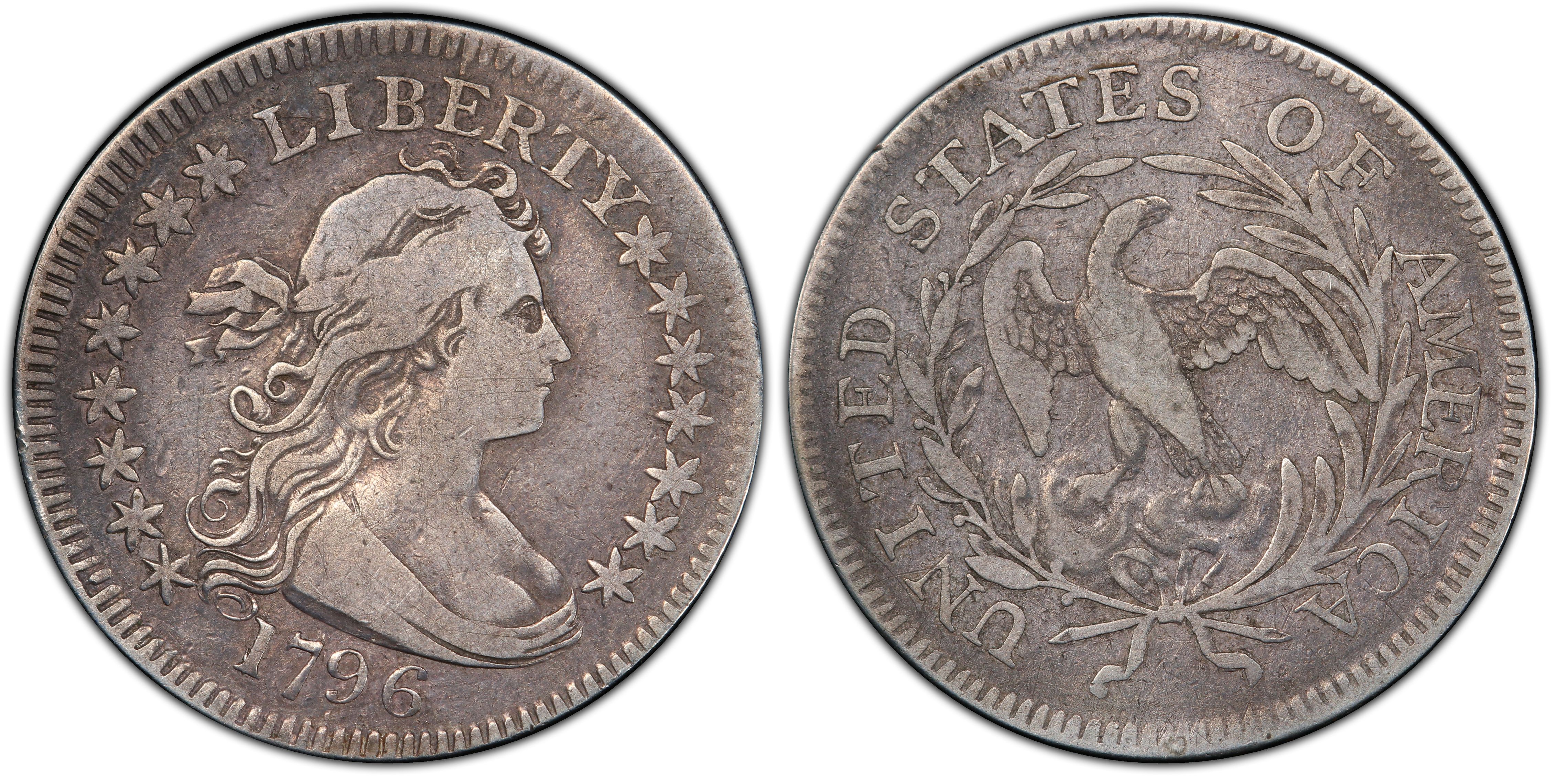
PCGS VF20

PCGS VG10
- PCGS #:
- 38919
- Designer:
- Robert Scot
- Edge:
- Reeded
- Diameter:
- 27.50 millimeters
- Weight:
- 6.74 grams
- Mintage:
- 6,146
- Mint:
- Philadelphia
- Metal:
- 89.2% Silver, 10.8% Copper
- Auction Record:
- $264,000 • MS64+ • 11-01-2017 • Heritage Auctions
Condition Census What Is This?
|
#1 PCGS SP66
“The Matthew Stickney Collection,” Henry Chapman, June 1907, Lot 1116; John H. Clapp; Clapp Estate; Clapp Collection sold en bloc to Louis E. Eliasberg, Sr., February 1942; “The Louis E. Eliasberg, Sr. Collection,” Bowers and Merena, April 1997, Lot 1356 - $176,000. As PCGS SP66 #4714887. Heritage Auctions, August 7, 2014, Lot 5565 – $881,250. B-1. Boasting brilliant surfaces and sharp, even milling, this specimen features golden-orange toning that blends seamlessly into the silver centers, punctuated by vibrant cobalt along the margins. It is one of only two possible presentation strikes produced for the 1796 Draped Bust Quarter. As its counterpart has remained untraced since the late 1940s, this represents a singular opportunity for the sophisticated cabinet. Old Green Holder. |
|
#2 PCGS MS64
“Colonel” E.H.R. Green; Green Estate; Partnership of Eric P. Newman / B.G. Johnson d.b.a. St. Louis Stamp and Coin Co.; Eric P. Newman – $125.00; Eric P. Newman Numismatic Education Society. As MS63+ Plated in Early Quarter Dollars of the United States Mint. As NGC MS64+ CAC #2064031-045. Heritage Auctions, November 1, 2017, Lot 15083 – $264,000. As PCGS MS64 #34461533. "The Black Cat - 100 Greatest Coins Collection" (PCGS Set Registry). B-1. Dark Olive, Gold, and purple toning. Adjustment marks on the reverse over eagle’s head and legs. |
|
#3 Est. MS62
“The George H. Earle Collection,” S.H. and H. Chapman, June 1912, Lot 3035; Stack’s, acquired March 1990; “The Haig A. Koshkarian Type Set,” American Numismatic Rarities, March 2004, Lot 60 – $47,150; Pinnacle Rarities; Heritage Auctions, April 2011, Lot 5079 – $138,000; Stack’s Bowers, August 11, 2016, Lot 3089 – $105,750. B-1. Plate coin for the 1796 B-1 variety in Tompkins' Early United States Quarters: 1796-1838 (2008). Darkly toned with gold, orange, and blue toning. Well-struck eagle.
|
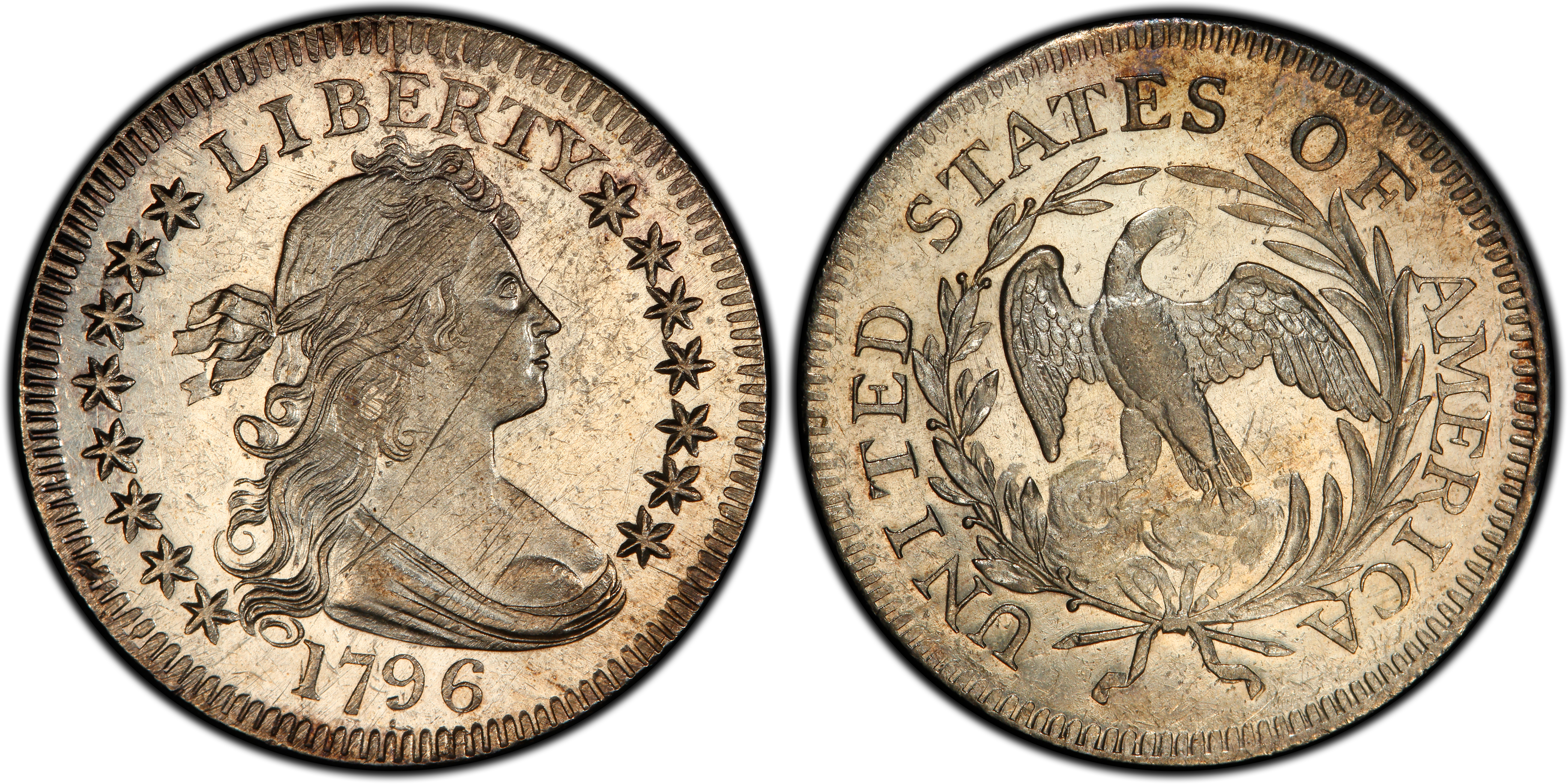 #4 PCGS MS60
Heritage Auctions, January 9, 2013, Lot 5590 - $82,250. B-1. Die State 3. Prooflike. Criss crossing adjustment marks on the obverse. One leaves a long diagonal ridge running the length of the portrait. Denticles fully visible, but softly impressed from 12 o'clock to 4 o'clock. |
 #5 PCGS AU58
American Numismatic Rarities, July 2005, Lot 1048; "The Liberty Collection, Part III," Heritage Auctions, August 16, 2015, Lot 4011 - $49,350. B-1. The obverse is graced by a concentric band of light blue, navy, and violet toning. Fine, curved marks—resembling short line segments—are noted at Liberty's neck and within the center-right field. On the reverse, the palette shifts to a blend of silvery-grey and warm rose. Technical features include visible adjustment marks across the clouds and the top of the design, with the denticles appearing faint from 10 o'clock to 1 o'clock. |
The 1796 Draped Bust Quarter, B-1, Low 6 Variety
Rarity-4+. The 1796 Draped Bust Quarter, B-1 ("Low 6", #38919), is one of two die marriages for the year. It employs an obverse die distinguishable by the placement of the final digit. Calling it "Low" is somewhat of a misnomer, as the 6 is not significantly lower than the other numerals; however, the 9 is canted slightly to the left, and a small raised dimple is present between the denticles and the ball of the 9. By comparison, on the B-2 ("High 6", #38920) variety, the 6 nearly touches the bust truncation. The position of LIBERTY in relation to the figure also differs between the two obverses. On the B-1, the point of the leftmost top curl aligns with the center of the B, while the ridge of the second top leftmost curl is centered on the trunk of the E. On the B-2, the placement of the letters shifts leftward: the leftmost curl points to the right side of the B, and the second curl is positioned beneath the lower arm of E.
Star placement and hair details also serve as key diagnostics. On the B-1, the lower right tip of Star 1 slightly overlaps a low curl but otherwise sits in an open field. On the B-2, additional hair detail is present above the lower curl, and the entire right side of Star 1 is bordered by hair. Furthermore, on the B-1, the bottom left tip of Star 13 sits close to Liberty’s chest, whereas a wider gap exists on the B-2. On the B-1, a blundered denticle between Stars 1 and 2 appears as a rounded mound.
The two varieties share a common reverse. Observations of the reverse die state indicate that the B-1 was struck after the B-2; this is evidenced by die clashes on some examples and the development of a die crack connecting the F and A of OF AMERICA. Perhaps the most noted weakness of this die marriage is the eagle’s head, which is typically softly struck.
* * *