1797 10C 13 Stars (Regular Strike)
Series: Draped Bust Dimes 1796-1807
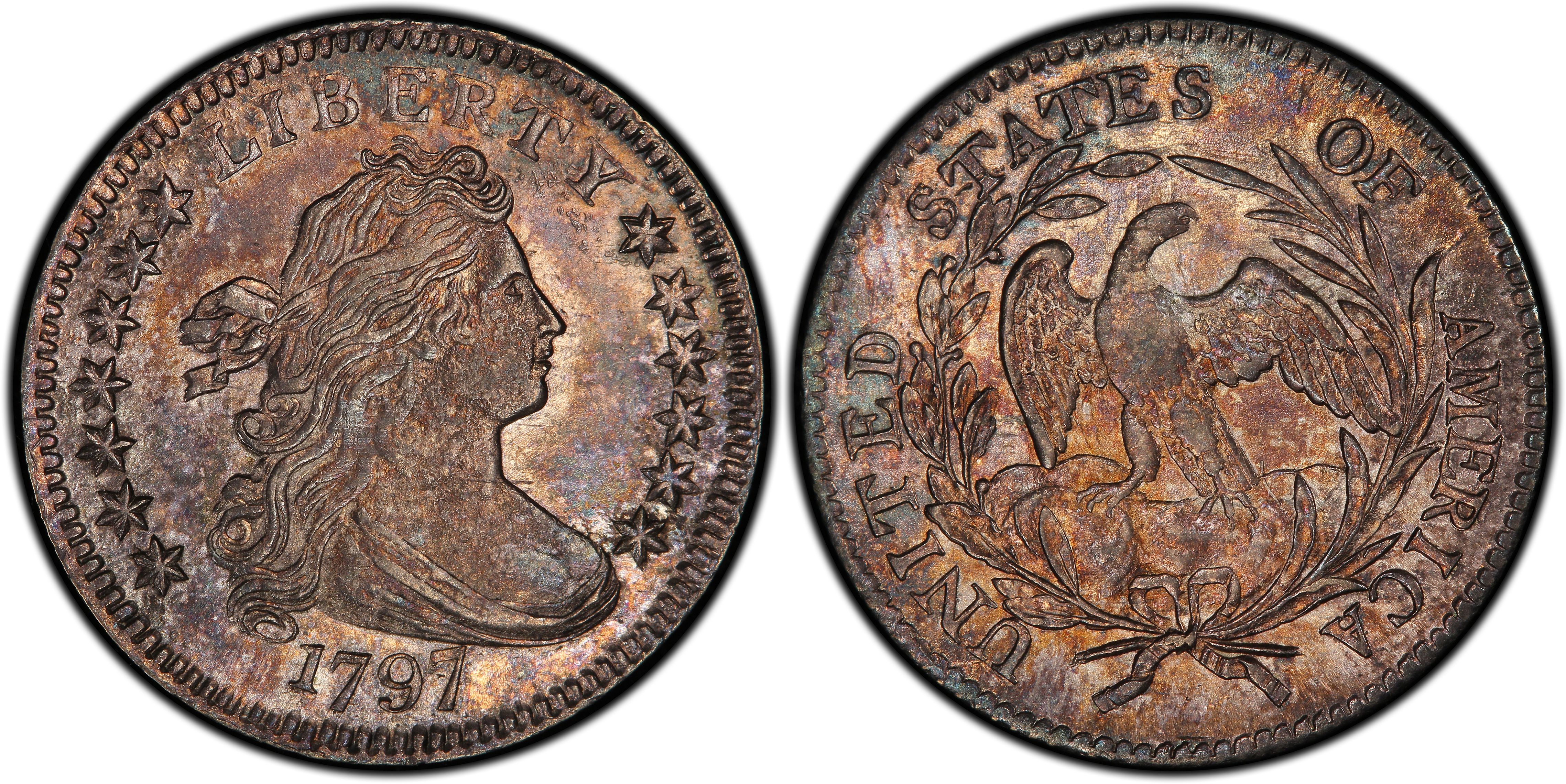
PCGS MS64

PCGS MS62+

PCGS AU58
- PCGS #:
- 4463
- Designer:
- Robert Scot
- Edge:
- Reeded
- Diameter:
- 19.80 millimeters
- Weight:
- 2.70 grams
- Mintage:
- 25,261
- Mint:
- Philadelphia
- Metal:
- 89.2% Silver, 10.8% Copper
- Auction Record:
- $402,500 • MS65 • 07-30-2008 • Heritage Auctions
Rarity and Survival Estimates Learn More
| Survival Estimate | |
|---|---|
| All Grades | 50 |
| 60 or Better | 5 |
| 65 or Better | |
| Numismatic Rarity | |
|---|---|
| All Grades | R-8.5 |
| 60 or Better | R-9.7 |
| 65 or Better | R-10.1 |
| Relative Rarity By Type All Specs in this Type | |
|---|---|
| All Grades | 1 / 3 |
| 60 or Better | 1 / 3 |
| 65 or Better | 1 / 3 |
| Relative Rarity By Series All Specs in this Series | |
|---|---|
| All Grades | 2 / 16 TIE |
| 60 or Better | 1 / 16 TIE |
| 65 or Better | 1 / 16 |
Condition Census What Is This?
|
#1 PCGS MS64
Thomas Cleneay, before 1887; “The Thomas Cleneay Collection," Samuel Hudson and Henry Chapman, December 1890, Lot 1470; (possibly) DeWitt Smith and H.O. Granberg; William Cutler Atwater; “The William Cutler Atwater Collection,” June 1946, Lot 888; Lester Merkin, April 1966, Lot 89 – $7,250; “The Charles Kahn Collection,” Stack’s, October 1980, Lot 564; Allen F. Lovejoy. As NGC MS64.”The Allen F. Lovejoy Collection of United States Dimes,” Stack’s, October 1990, Lot 9 – $26,000; Rarcoa and David W. Akers, Inc., August 1991, Lot 229; "The Waldo Bolen Collection"; Rarcoa and David W. Akers, Inc, November 1995, Lot 2005; Larry Whitlow to Ed Price, by private treaty sale; As NGC MS65 #3122634-011. “The Ed Price Collection,” Heritage Auctions, July 31, 2008, Lot 1416 – $402,500. As PCGS MS64 #06936151. “The D. Brent Pogue Collection, Part I,” Stack’s Bowers / Sotheby’s, May 2015, Lot 1036 – $176,250; "The JRCSLM32 Collection" (PCGS Set Registry). The finest known 1797, JR-2. Attractive gold, orange, and purple toning on both sides. |
| #1 PCGS MS64 |
|
#3 PCGS MS62+
As PCGS MS61. “The William H. LaBelle, Sr. Collection,” American Numismatic Rarities, July 25, 2005, Lot 979 – $27,600; Heritage Auctions, January 2017, Lot 5573 – $54,050. As PCGS MS62 #83600504. Heritage Auctions, June 2017, Lot 3593 – $51,700. As PCGS MS62+ #38759827. Heritage Auctions, March 2, 2025, Lot 3181 – $63,000. Rose, olive, and gold toning. Two pin-sized toning spots to the right of Liberty’s forehead. dull mark in front of Liberty’s nose. Toning spot on rock below eagle’s talon. |
|
#4 PCGS AU58
Stack's Bowers, September 4, 2025, Lot 3029 - $30,000. Champagne-gold patina. Thin scratch across Liberty's portrait. Splashes of olive toning on Stars 5 and 6. |
|
#5 PCGS AU55
Stack’s Bowers, August 16, 2023, Lot 5025 – $36,000; Jay Parrino; "The St. Jude Collection" (PCGS Set Registry). Steel grey and olive hue with gold and pink highlights. Two small ticks under the ribbon. Curved mark above the IC of AMERICA. |
|
#5 PCGS AU55
Stack's, July 1, 2009, Lot 297 - Passed. Steel grey with darker grey coloration along the periphery. |
|
#5 PCGS AU55
"The Joseph C. Thomas Collection, Part One," Heritage Auctions, April 1, 2009, Lot 2209 - $18,400. Mottled toning in blue, green, and gold. Adjustment marks visible on the reverse. |
1797 Draped Bust Dime: The 13-Star (JR-2) Variety
The 1797 Draped Bust Dime is the scarcer of the two years featuring the Small Eagle reverse. While U.S. Mint records report a mintage of 25,261 pieces for 1797, numismatic researchers suggest a portion of this total may have been struck using 1796-dated dies. Two obverse designs were used for the 1797 dime; both are listed in the Red Book and are distinguished by the number of stars on the obverse.
The 13-Star Design (#4463, JR-2 #38749) represents a profound "reboot" of United States coinage. In 1793, when the first Large Cents were struck, the design featured 15 interlocking links representing each of the 15 states then admitted into the Union. The symbolism of the chain did not sit well with the public—some felt it was a poor omen for LIBERTY—and within months, the design was changed, replacing the chain with a classic wreath.
When the nation's silver and gold coins entered production, the Mint found a more appropriate motif to represent the states: stars. Adding these stars by hand was a time-consuming and undoubtedly frustrating chore for engravers. The system held until 1796, when Tennessee’s admission forced the Mint to add a 16th star.
This ultimately proved unsustainable, leading the Mint to abandon the "one star per state" motif in favor of a 13-star arrangement to honor the original colonies. The two 1797 dime varieties reflect this pivotal transition. The 16-Star (#4462, JR-1 #38748) recognizes Tennessee's admission, while the 13-Star (#4463, JR-2 #38749) represents the design philosophy that would define America’s 19th-century coinage. Another key difference between the two varieties is the style of the "9" in the date. On the 13-Star (JR-2) variety, the tail of the 9 terminates with a distinct knob. On the 16-Star (JR-1) variety, the 9 ends with a sharp point.
Unquestionably Rare
An estimated 200 1797 16-star Draped Bust dimes survive across all grades, with 10 to 15 coins known in Mint State. In contrast, only about 100 13-star examples survive, making the issue nearly four times rarer in the About Uncirculated (AU) to Mint State range. Curiously, auction records do not fully acknowledge this disparity, making high-grade AU examples an exceptional value in today's market.
* * *